LEADER 04197nam a22005775i 4500
001 811392
003 TR_AnAIT
005 20260131010442
007 cr nn 008mamaa
008 100301s2006 ne | s |||| 0|eng d
020 |a9781402041921|9978-1-4020-4192-1
024 7 |a10.1007/1-4020-4192-6|2doi
041 |aeng
049 |aTürk Tarih Kurumu Kütüphanesi
050 4|aB1-5802
072 7|aHPC|2bicssc
072 7|aPHI009000|2bisacsh
072 7|aQDH|2thema
082 04|a109|223
090 |aDK/12654
100 1 |aGoldstein, Joshua D.|eauthor.|4aut|4http://id.loc.gov/vocabulary/relators/aut
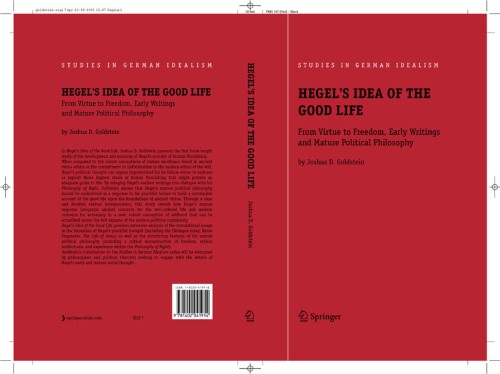
245 10|aHegel's Idea of the Good Life|h[electronic resource] :|bFrom Virtue to Freedom, Early Writings and Mature Political Philosophy /|cby Joshua D. Goldstein.
250 |a1st ed. 2006.
264 1|aDordrecht :|bSpringer Netherlands :|bImprint: Springer,|c2006.
300 |aXXIV, 256 p.|bonline resource.
336 |atext|btxt|2rdacontent
337 |acomputer|bc|2rdamedia
338 |aonline resource|bcr|2rdacarrier
347 |atext file|bPDF|2rda
490 1 |aStudies in German Idealism,|x2542-9868 ;|v7
505 0 |aTHE DEVELOPMENT AND DECLINE OF AN ARISTOTELIAN IDEA OF THE GOOD LIFE, 1793 TO 1800 -- THE HUMAN SPIRIT AND FOLK-RELIGION: THE TÜBINGEN ESSAY OF 1793 -- DISCOVERING THE COMMUNITY: THE BERNE FRAGMENTS OF 1794 -- THE END OF THE HUMAN SPIRIT: THE LIFE OF JESUS OF 1795 -- FREEDOM AND THE COMPLETION OF ARISTOTELIAN VIRTUE, 1821 -- THE MATURE FOUNDATION OF THE GOOD LIFE: SPIRIT AND FREEDOM -- THE LIVING FORM OF THE GOOD LIFE -- THE IDEA OF THE GOOD LIFE.
520 |aIn Hegel’s Idea of the Good Life, Joshua D. Goldstein presents the first book-length study of the development and meaning of Hegel’s account of human flourishing. When compared to the robust conceptions of human excellence found in ancient virtue ethics or the commitment to individualism in the modern ethics of the will, Hegel’s political thought can appear impoverished for its failure either to embrace or exposit those highest ideals of human flourishing that might provide an adequate guide to life. By bringing Hegel’s earliest writings into dialogue with his Philosophy of Right, Goldstein argues that Hegel’s mature political philosophy should be understood as a response to his youthful failure to build a sustainable account of the good life upon the foundations of ancient virtue. Through a clear and detailed textual interpretation, this study reveals how Hegel’s mature response integrates ancient concerns for the well-ordered life and modern concerns for autonomy in a new, robust conception of selfhood that can be actualized across the full expanse of the modern political community. Hegel’s Idea of the Good Life provides extensive analysis of the foundational essays in the formation of Hegel’s youthful thought (including the Tübingen essay, Berne Fragments, The Life of Jesus) as well as the structuring features of his mature political philosophy (including a critical reconstruction of freedom, ethical institutions, and experience within the Philosophy of Right). Goldstein’s contribution to the Studies in German Idealism series will be welcomed by philosophers and political theorists seeking to engage with the details of Hegel’s early and mature social thought.
650 0|aPhilosophy|xHistory.
650 0|aPolitical science|xPhilosophy.
650 0|aEthics.
650 0|aPhilosophy of mind.
650 0|aSelf.
650 0|aPolitical science.
650 14|aHistory of Philosophy.
650 24|aPolitical Philosophy.
650 24|aMoral Philosophy and Applied Ethics.
650 24|aPhilosophy of the Self.
650 24|aPolitical Science.
710 2 |aSpringerLink (Online service)
773 0 |tSpringer Nature eBook
776 08|iPrinted edition:|z9781402041914
776 08|iPrinted edition:|z9789048106318
776 08|iPrinted edition:|z9789048170654
830 0|aStudies in German Idealism,|x2542-9868 ;|v7
856 40|uhttps://doi.org/10.1007/1-4020-4192-6
912 |aZDB-2-SHU
912 |aZDB-2-SXPR
950 |aHumanities, Social Sciences and Law (SpringerNature-11648)
950 |aPhilosophy and Religion (R0) (SpringerNature-43725)