LEADER 03357nam a22004935i 4500
001 811400
003 TR_AnAIT
005 20260131010417
007 cr nn 008mamaa
008 100301s2006 ne | s |||| 0|eng d
020 |a9781402045547|9978-1-4020-4554-7
024 7 |a10.1007/1-4020-4554-9|2doi
041 |aeng
049 |aTürk Tarih Kurumu Kütüphanesi
050 4|aBJ1-1725
072 7|aHPQ|2bicssc
072 7|aPHI005000|2bisacsh
072 7|aQDTQ|2thema
082 04|a170|223
090 |aDK/12662
100 1 |aCoff, Christian.|eauthor.|4aut|4http://id.loc.gov/vocabulary/relators/aut
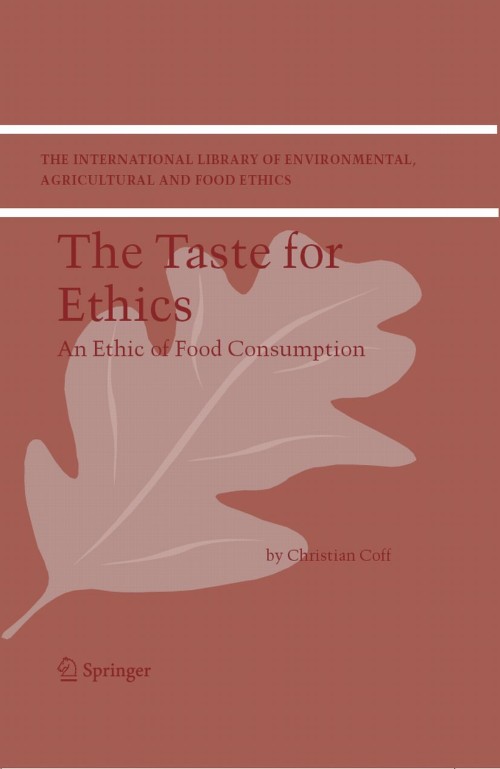
245 14|aThe Taste for Ethics|h[electronic resource] :|bAn Ethic of Food Consumption /|cby Christian Coff.
250 |a1st ed. 2006.
264 1|aDordrecht :|bSpringer Netherlands :|bImprint: Springer,|c2006.
300 |aXIX, 212 p.|bonline resource.
336 |atext|btxt|2rdacontent
337 |acomputer|bc|2rdamedia
338 |aonline resource|bcr|2rdacarrier
347 |atext file|bPDF|2rda
490 1 |aThe International Library of Environmental, Agricultural and Food Ethics,|x2215-1737 ;|v7
505 0 |aI -Food and Ethics -- Eating, Society and Ethics -- II -The Intellectualization of Food -- Food to Science: On the Intellectualization of Food -- The Storylessness of Food -- III - Food Ethics and the Production History -- Tracing the Production History -- Food Ethics as the Ethics of the Trace -- Traceability and Food Ethics.
520 |aThis book marks a new departure in ethics. In our culture ethics has first and foremost been a question of ‘the good life’ in relation to other people. Central to this ethic was friendship, inspired by Greek thought, and the caritas concept from the Judaeo-Christian tradition. But no early moral teaching discussed man’s relation to the origin of foodstuffs and the system that produced them; doubtless the question was of little interest since the production path was so short. Before industrialisation the production of food was easy to follow. As a rule that is no longer the case. The field of ethics must therefore be extended to cover responsibility for the production and choice of foodstuffs, and it is this food ethic that Christian Coff sets out to trace. In doing so he shows how the focus of ethics can be expanded from its concern for the good life with and for others to cover the good life in fair food production practices, and how not least through using our integrity orlife coherence we can reflect ethically, or caringly, about living organisms, ecological systems and our human identity. From the foreword by Dr. Peter Kemp, Professor of Philosophy at the Danish University of Education.
650 0|aEthics.
650 0|aBiology|xPhilosophy.
650 14|aMoral Philosophy and Applied Ethics.
650 24|aPhilosophy of Biology.
710 2 |aSpringerLink (Online service)
773 0 |tSpringer Nature eBook
776 08|iPrinted edition:|z9781402045530
776 08|iPrinted edition:|z9789048107674
776 08|iPrinted edition:|z9789048171477
830 0|aThe International Library of Environmental, Agricultural and Food Ethics,|x2215-1737 ;|v7
856 40|uhttps://doi.org/10.1007/1-4020-4554-9
912 |aZDB-2-SHU
912 |aZDB-2-SXPR
950 |aHumanities, Social Sciences and Law (SpringerNature-11648)
950 |aPhilosophy and Religion (R0) (SpringerNature-43725)