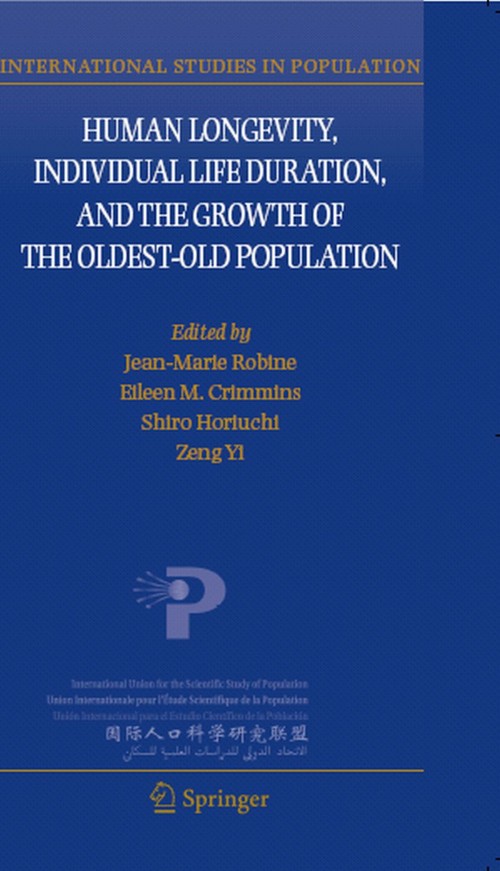
Human Longevity, Individual Life Duration, and the Growth of the Oldest-Old Population [electronic resource] / edited by Jean-Marie Robine, Eileen M. Crimmins, Shiro Horiuchi, Yi Zeng.
Erişim Adresi
ISBN
9781402048487
Dil Kodu
İngilizce
Yer Numarası
DK/12666
Basım Bildirimi
1st ed. 2007.
Yayın Bilgisi
Dordrecht : Springer Netherlands : Imprint: Springer, 2007.
Fiziksel Niteleme
XVI, 442 p. online resource.
Dizi
International Studies in Population, 2543-0459 ; 4
İçindekiler Notu
Theoretical and Comparative Biological Concepts -- Research Issues on Human Longevity -- Patterns in Mammalian Ageing: Demography and Evolution -- Life Span Extension in Humans is Self-Reinforcing: A General Theory of Longevity -- Empirical and Analytical Studies of Ageing and Oldest-Old Populations -- Oldest-Old Mortality in China -- Central and Dispersion Indicators of Individual Life Duration: New Methods -- Recent Trends in Life Expectancy and Rectangularisation of the Survival Curve at Advanced Ages in The Netherlands -- The Validation of Exceptional Male Longevity in Sardinia -- Mortality at Extreme Ages and Data Quality: The Canadian Experience -- Causes of Death and Biological Frailty -- Causes of Death among the Oldest-Old: Validity and Comparability -- Causes of Death among the Oldest-Old: Age-Related Changes in the Cause-of-Death Distribution -- Genetic Factors Associated with Individual Life Duration: Heritability -- Mortality among the Least Frail: Lessons from Research on the APOE GENE -- Sex, Gender, and Social Determinants and Consequences of Mortality -- Social Determinants of Mortality in the Oldest-Old: Social Class and Individual Way-of-Life -- Social Differences in Older Adult Mortality in the United States: Questions, Data, Methods, and Results -- Mortality Differences by Sex among the Oldest-Old -- Causes of the Trend in Mortality and Morbidity -- Explanation of the Decline in Mortality among the Oldest-Old: The Impact of Circulatory Diseases -- Explanation of the Decline in Mortality among the Oldest-Old: A Demographic Point of View -- Marital Status and Family Support for the Oldest-Old in Great Britain -- Causes of the Trend in Mortality and Morbidity -- Marital Status and Family Support for the Oldest-Old in Great Britain.
Özet, vb.
Old-age survival has considerably improved in the second half of the twentieth century. Life expectancy in wealthy countries has increased, on average, from 65 years in 1950 to 76 years in 2005. The rise was more spectacular in some countries: the life expectancy for Japanese women rose from 62 years to 86 years during the same period. Driven by this longevity extension, the population aged 80 and over in those countries has grown fivefold from 8.5 million in 1950 to 44.5 million in 2005. Why has such a substantial extension of human lifespan occurred? How long can we live? In this book, these fundamental questions are explored by experts from such diverse fields as biology, medicine, epidemiology, demography, sociology, and mathematics: they report on recent cutting-edge studies about essential issues of human longevity such as evolution of lifespan of species, genetics of human longevity, reasons for the recent improvement in survival of the elderly, medical and behavioral causes of deaths among very old people, and social factors of long survival in old age.
Konu
Demography.
Population.
Aging.
Geriatrics.
Social sciences.
Population and Demography.
Ageing.
Geriatrics.
Society.
Population.
Aging.
Geriatrics.
Social sciences.
Population and Demography.
Ageing.
Geriatrics.
Society.
Kurum Adı

Eseri Alıntıla
Referansları kullanmadan önce gözden geçirmeniz ve varsa gerekli düzeltmeleri yapmanız önerilir.
Dijital Kaynak
MARC Görünümü
LEADER 05065nam a22005895i 4500
001 811404
003 TR_AnAIT
005 20260131010347
007 cr nn 008mamaa
008 100301s2007 ne | s |||| 0|eng d
020 |a9781402048487|9978-1-4020-4848-7
024 7 |a10.1007/978-1-4020-4848-7|2doi
041 |aeng
049 |aTürk Tarih Kurumu Kütüphanesi
050 4|aHB848-3697
072 7|aJHBD|2bicssc
072 7|aSOC006000|2bisacsh
072 7|aJHBD|2thema
082 04|a304.6|223
090 |aDK/12666
245 10|aHuman Longevity, Individual Life Duration, and the Growth of the Oldest-Old Population|h[electronic resource] /|cedited by Jean-Marie Robine, Eileen M. Crimmins, Shiro Horiuchi, Yi Zeng.
250 |a1st ed. 2007.
264 1|aDordrecht :|bSpringer Netherlands :|bImprint: Springer,|c2007.
300 |aXVI, 442 p.|bonline resource.
336 |atext|btxt|2rdacontent
337 |acomputer|bc|2rdamedia
338 |aonline resource|bcr|2rdacarrier
347 |atext file|bPDF|2rda
490 1 |aInternational Studies in Population,|x2543-0459 ;|v4
505 0 |aTheoretical and Comparative Biological Concepts -- Research Issues on Human Longevity -- Patterns in Mammalian Ageing: Demography and Evolution -- Life Span Extension in Humans is Self-Reinforcing: A General Theory of Longevity -- Empirical and Analytical Studies of Ageing and Oldest-Old Populations -- Oldest-Old Mortality in China -- Central and Dispersion Indicators of Individual Life Duration: New Methods -- Recent Trends in Life Expectancy and Rectangularisation of the Survival Curve at Advanced Ages in The Netherlands -- The Validation of Exceptional Male Longevity in Sardinia -- Mortality at Extreme Ages and Data Quality: The Canadian Experience -- Causes of Death and Biological Frailty -- Causes of Death among the Oldest-Old: Validity and Comparability -- Causes of Death among the Oldest-Old: Age-Related Changes in the Cause-of-Death Distribution -- Genetic Factors Associated with Individual Life Duration: Heritability -- Mortality among the Least Frail: Lessons from Research on the APOE GENE -- Sex, Gender, and Social Determinants and Consequences of Mortality -- Social Determinants of Mortality in the Oldest-Old: Social Class and Individual Way-of-Life -- Social Differences in Older Adult Mortality in the United States: Questions, Data, Methods, and Results -- Mortality Differences by Sex among the Oldest-Old -- Causes of the Trend in Mortality and Morbidity -- Explanation of the Decline in Mortality among the Oldest-Old: The Impact of Circulatory Diseases -- Explanation of the Decline in Mortality among the Oldest-Old: A Demographic Point of View -- Marital Status and Family Support for the Oldest-Old in Great Britain -- Causes of the Trend in Mortality and Morbidity -- Marital Status and Family Support for the Oldest-Old in Great Britain.
520 |aOld-age survival has considerably improved in the second half of the twentieth century. Life expectancy in wealthy countries has increased, on average, from 65 years in 1950 to 76 years in 2005. The rise was more spectacular in some countries: the life expectancy for Japanese women rose from 62 years to 86 years during the same period. Driven by this longevity extension, the population aged 80 and over in those countries has grown fivefold from 8.5 million in 1950 to 44.5 million in 2005. Why has such a substantial extension of human lifespan occurred? How long can we live? In this book, these fundamental questions are explored by experts from such diverse fields as biology, medicine, epidemiology, demography, sociology, and mathematics: they report on recent cutting-edge studies about essential issues of human longevity such as evolution of lifespan of species, genetics of human longevity, reasons for the recent improvement in survival of the elderly, medical and behavioral causes of deaths among very old people, and social factors of long survival in old age.
650 0|aDemography.
650 0|aPopulation.
650 0|aAging.
650 0|aGeriatrics.
650 0|aSocial sciences.
650 14|aPopulation and Demography.
650 24|aAgeing.
650 24|aGeriatrics.
650 24|aSociety.
700 1 |aRobine, Jean-Marie.|eeditor.|4edt|4http://id.loc.gov/vocabulary/relators/edt
700 1 |aCrimmins, Eileen M.|eeditor.|4edt|4http://id.loc.gov/vocabulary/relators/edt
700 1 |aHoriuchi, Shiro.|eeditor.|4edt|4http://id.loc.gov/vocabulary/relators/edt
700 1 |aZeng, Yi.|eeditor.|4edt|4http://id.loc.gov/vocabulary/relators/edt
710 2 |aSpringerLink (Online service)
773 0 |tSpringer Nature eBook
776 08|iPrinted edition:|z9781402048463
776 08|iPrinted edition:|z9781402048470
776 08|iPrinted edition:|z9789048108909
830 0|aInternational Studies in Population,|x2543-0459 ;|v4
856 40|uhttps://doi.org/10.1007/978-1-4020-4848-7
912 |aZDB-2-SHU
912 |aZDB-2-SXS
950 |aHumanities, Social Sciences and Law (SpringerNature-11648)
950 |aSocial Sciences (R0) (SpringerNature-43726)
001 811404
003 TR_AnAIT
005 20260131010347
007 cr nn 008mamaa
008 100301s2007 ne | s |||| 0|eng d
020 |a9781402048487|9978-1-4020-4848-7
024 7 |a10.1007/978-1-4020-4848-7|2doi
041 |aeng
049 |aTürk Tarih Kurumu Kütüphanesi
050 4|aHB848-3697
072 7|aJHBD|2bicssc
072 7|aSOC006000|2bisacsh
072 7|aJHBD|2thema
082 04|a304.6|223
090 |aDK/12666
245 10|aHuman Longevity, Individual Life Duration, and the Growth of the Oldest-Old Population|h[electronic resource] /|cedited by Jean-Marie Robine, Eileen M. Crimmins, Shiro Horiuchi, Yi Zeng.
250 |a1st ed. 2007.
264 1|aDordrecht :|bSpringer Netherlands :|bImprint: Springer,|c2007.
300 |aXVI, 442 p.|bonline resource.
336 |atext|btxt|2rdacontent
337 |acomputer|bc|2rdamedia
338 |aonline resource|bcr|2rdacarrier
347 |atext file|bPDF|2rda
490 1 |aInternational Studies in Population,|x2543-0459 ;|v4
505 0 |aTheoretical and Comparative Biological Concepts -- Research Issues on Human Longevity -- Patterns in Mammalian Ageing: Demography and Evolution -- Life Span Extension in Humans is Self-Reinforcing: A General Theory of Longevity -- Empirical and Analytical Studies of Ageing and Oldest-Old Populations -- Oldest-Old Mortality in China -- Central and Dispersion Indicators of Individual Life Duration: New Methods -- Recent Trends in Life Expectancy and Rectangularisation of the Survival Curve at Advanced Ages in The Netherlands -- The Validation of Exceptional Male Longevity in Sardinia -- Mortality at Extreme Ages and Data Quality: The Canadian Experience -- Causes of Death and Biological Frailty -- Causes of Death among the Oldest-Old: Validity and Comparability -- Causes of Death among the Oldest-Old: Age-Related Changes in the Cause-of-Death Distribution -- Genetic Factors Associated with Individual Life Duration: Heritability -- Mortality among the Least Frail: Lessons from Research on the APOE GENE -- Sex, Gender, and Social Determinants and Consequences of Mortality -- Social Determinants of Mortality in the Oldest-Old: Social Class and Individual Way-of-Life -- Social Differences in Older Adult Mortality in the United States: Questions, Data, Methods, and Results -- Mortality Differences by Sex among the Oldest-Old -- Causes of the Trend in Mortality and Morbidity -- Explanation of the Decline in Mortality among the Oldest-Old: The Impact of Circulatory Diseases -- Explanation of the Decline in Mortality among the Oldest-Old: A Demographic Point of View -- Marital Status and Family Support for the Oldest-Old in Great Britain -- Causes of the Trend in Mortality and Morbidity -- Marital Status and Family Support for the Oldest-Old in Great Britain.
520 |aOld-age survival has considerably improved in the second half of the twentieth century. Life expectancy in wealthy countries has increased, on average, from 65 years in 1950 to 76 years in 2005. The rise was more spectacular in some countries: the life expectancy for Japanese women rose from 62 years to 86 years during the same period. Driven by this longevity extension, the population aged 80 and over in those countries has grown fivefold from 8.5 million in 1950 to 44.5 million in 2005. Why has such a substantial extension of human lifespan occurred? How long can we live? In this book, these fundamental questions are explored by experts from such diverse fields as biology, medicine, epidemiology, demography, sociology, and mathematics: they report on recent cutting-edge studies about essential issues of human longevity such as evolution of lifespan of species, genetics of human longevity, reasons for the recent improvement in survival of the elderly, medical and behavioral causes of deaths among very old people, and social factors of long survival in old age.
650 0|aDemography.
650 0|aPopulation.
650 0|aAging.
650 0|aGeriatrics.
650 0|aSocial sciences.
650 14|aPopulation and Demography.
650 24|aAgeing.
650 24|aGeriatrics.
650 24|aSociety.
700 1 |aRobine, Jean-Marie.|eeditor.|4edt|4http://id.loc.gov/vocabulary/relators/edt
700 1 |aCrimmins, Eileen M.|eeditor.|4edt|4http://id.loc.gov/vocabulary/relators/edt
700 1 |aHoriuchi, Shiro.|eeditor.|4edt|4http://id.loc.gov/vocabulary/relators/edt
700 1 |aZeng, Yi.|eeditor.|4edt|4http://id.loc.gov/vocabulary/relators/edt
710 2 |aSpringerLink (Online service)
773 0 |tSpringer Nature eBook
776 08|iPrinted edition:|z9781402048463
776 08|iPrinted edition:|z9781402048470
776 08|iPrinted edition:|z9789048108909
830 0|aInternational Studies in Population,|x2543-0459 ;|v4
856 40|uhttps://doi.org/10.1007/978-1-4020-4848-7
912 |aZDB-2-SHU
912 |aZDB-2-SXS
950 |aHumanities, Social Sciences and Law (SpringerNature-11648)
950 |aSocial Sciences (R0) (SpringerNature-43726)
Materyaller
Depodan talep edilen materyal sadece kütüphane içerisinde kullanılmaktadır.
Materyal dışarıya ödünç verilmemektedir.
