LEADER 03251nam a22005175i 4500
001 811407
003 TR_AnAIT
005 20260131010323
007 cr nn 008mamaa
008 100301s2006 ne | s |||| 0|eng d
020 |a9781402049439|9978-1-4020-4943-9
024 7 |a10.1007/1-4020-4943-9|2doi
041 |aeng
049 |aTürk Tarih Kurumu Kütüphanesi
050 4|aK201-487
072 7|aLAB|2bicssc
072 7|aPHI000000|2bisacsh
072 7|aLAB|2thema
082 04|a340.1|223
090 |aDK/12669
100 1 |aWalton, Douglas.|eauthor.|4aut|4http://id.loc.gov/vocabulary/relators/aut
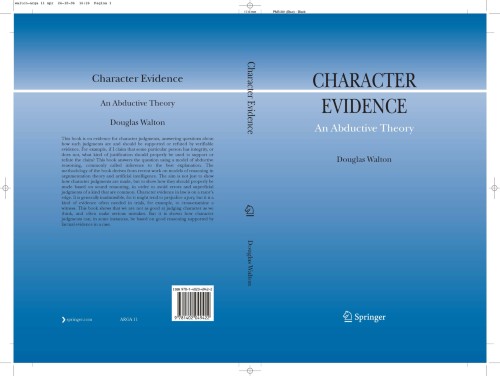
245 10|aCharacter Evidence|h[electronic resource] :|bAn Abductive Theory /|cby Douglas Walton.
250 |a1st ed. 2006.
264 1|aDordrecht :|bSpringer Netherlands :|bImprint: Springer,|c2006.
300 |aXVI, 240 p.|bonline resource.
336 |atext|btxt|2rdacontent
337 |acomputer|bc|2rdamedia
338 |aonline resource|bcr|2rdacarrier
347 |atext file|bPDF|2rda
490 1 |aArgumentation Library,|x2215-1907 ;|v11
505 0 |aThe Problem of Character Evidence -- Defining and Judging Character -- Integrity and Hypocrisy -- Simulative Reasoning and Plan Recognition -- Multi-Agent Dialogue -- A Multi-Agent System for Character Evidence. .
520 |aThis book is on evidence for character judgments, answering questions about how such judgments are and should be supported or refuted by verifiable evidence. For example, if I claim that some particular person has integrity, or does not, what kind of justification should properly be used to support or refute the claim? This book answers the question using a model of abductive reasoning, commonly called inference to the best explanation. The methodology of the book derives from recent work on models of reasoning in argumentation theory and artificial intelligence. The aim is not just to show how character judgments are made, but to show how they should be properly be made based on sound reasoning, in order to avoid errors and superficial judgments of a kind that are common. Character evidence in law is on a razor’s edge. It is generally inadmissible, for it might tend to prejudice a jury, but it is a kind of evidence often needed in trials, for example, to cross-examine a witness. This book shows that we are not as good at judging character as we think, and often make serious mistakes. But it is shown how character judgments can, in some instances, be based on good reasoning supported by factual evidence in a case.
650 0|aLaw|xPhilosophy.
650 0|aLaw|xHistory.
650 0|aCriminal law.
650 14|aPhilosophy of Law.
650 24|aTheories of Law, Philosophy of Law, Legal History.
650 24|aCriminal Law and Criminal Procedure Law.
710 2 |aSpringerLink (Online service)
773 0 |tSpringer Nature eBook
776 08|iPrinted edition:|z9781402049422
776 08|iPrinted edition:|z9789048109265
776 08|iPrinted edition:|z9789048172351
830 0|aArgumentation Library,|x2215-1907 ;|v11
856 40|uhttps://doi.org/10.1007/1-4020-4943-9
912 |aZDB-2-SHU
912 |aZDB-2-SXPR
950 |aHumanities, Social Sciences and Law (SpringerNature-11648)
950 |aPhilosophy and Religion (R0) (SpringerNature-43725)