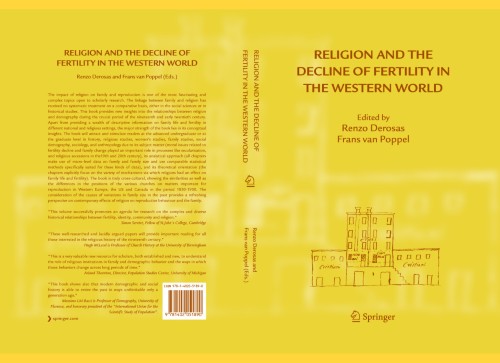
Religion and the Decline of Fertility in the Western World [electronic resource] / edited by Renzo Derosas, Frans van Poppel.
Erişim Adresi
ISBN
9781402051906
Dil Kodu
İngilizce
Yer Numarası
DK/12675
Basım Bildirimi
1st ed. 2006.
Yayın Bilgisi
Dordrecht : Springer Netherlands : Imprint: Springer, 2006.
Fiziksel Niteleme
XI, 319 p. online resource.
İçindekiler Notu
Theoretical and analytical approaches to religious beliefs, values, and identities during the modern fertility transition -- Religion, family, and fertility: What do we know historically and comparatively? -- Religious differentials in marital fertility in The Hague (Netherlands), 1860–1909 -- Stemming the tide. Denomination and religiousness in the Dutch fertility transition, 1845–1945 -- Family limitation among political Catholics in Baden in 1869 -- The evolution of religious differences in fertility: Lutherans and Catholics in Alsace, 1750–1860 -- State institutions as mediators between religion and fertility: A comparison of two Swiss regions, 1860–1930 -- Between identity and assimilation: Jewish fertility in nineteenth-century Venice -- The religious claim on babies in nineteenth-century Montreal -- Religious diversity and the onset of the fertility transition: Canada, 1870–1900 -- Religion and the decline of fertility: Conclusions.
Özet, vb.
The impact of religion on family and reproduction is one of the most fascinating and complex topics open to scholarly research. The linkage between family and religion has received no systematic treatment on a comparative basis, either in the social sciences or in historical studies. This book provides new insights into the relationships between religion and demography during the crucial period of the nineteenth and early twentieth century. Apart from providing a wealth of descriptive information on family life and fertility in different national and religious settings, the major strength of the book lies in its conceptual insights. The book will attract and stimulate readers at the advanced undergraduate or at the graduate level in history, religious studies, women’s studies, family studies, social demography, sociology, and anthropology due to its subject matter (moral issues related to fertility decline and family change played an important role in processes like secularisation, and religious secessions in the19th and 20th century), its analytical approach (all chapters make use of micro-level data on family and family size and use comparable statistical methods specifically suited for these kinds of data), and its theoretical orientation (the chapters explicitly focus on the variety of mechanisms via which religions had an effect on family life and fertility). The book is truly cross-cultural, showing the similarities as well as the differences in the positions of the various churches on matters important for reproduction in Western Europe, the US and Canada in the period 1850-1950. The consideration of the causes of variations in family size in the past provides a refreshing perspective on contemporary effects of religion on reproductive behaviour and the family. "This volume successfully promotes an agenda for research on the complex and diverse historical relationships between fertility, identity, communityand religion." Simon Szreter, Fellow of St John's College, Cambridge "These well-researched and lucidly argued papers will provide important reading for all those interested in the religious history of the nineteenth century." Hugh McLeod is Professor of Church History at the University of Birmingham "This is a very valuable new resource for scholars, both established and new, to understand the role of religious institutions in family and demographic behavior and the ways in which those behaviors change across long periods of time." Arland Thornton, Director, Population Studies Center, University of Michigan "This book shows also that modern demographic and social history is able to revive the past in ways unthinkable only a generation ago." Massimo Livi-Bacci is Professor of Demography, University of Florence, and honorary president of the "International Union for the Scientific Study of Population".
Konu
Demography.
Population.
History.
Religion.
Sociology.
Counseling.
Population and Demography.
History.
Religion.
Sociology.
Counseling Psychology.
Population.
History.
Religion.
Sociology.
Counseling.
Population and Demography.
History.
Religion.
Sociology.
Counseling Psychology.
Diğer Yazarlar
Kurum Adı

Eseri Alıntıla
Referansları kullanmadan önce gözden geçirmeniz ve varsa gerekli düzeltmeleri yapmanız önerilir.
Dijital Kaynak
MARC Görünümü
LEADER 05713nam a22005655i 4500
001 811414
003 TR_AnAIT
005 20260131010259
007 cr nn 008mamaa
008 100301s2006 ne | s |||| 0|eng d
020 |a9781402051906|9978-1-4020-5190-6
024 7 |a10.1007/1-4020-5190-5|2doi
041 |aeng
049 |aTürk Tarih Kurumu Kütüphanesi
050 4|aHB848-3697
072 7|aJHBD|2bicssc
072 7|aSOC006000|2bisacsh
072 7|aJHBD|2thema
082 04|a304.6|223
090 |aDK/12675
245 10|aReligion and the Decline of Fertility in the Western World|h[electronic resource] /|cedited by Renzo Derosas, Frans van Poppel.
250 |a1st ed. 2006.
264 1|aDordrecht :|bSpringer Netherlands :|bImprint: Springer,|c2006.
300 |aXI, 319 p.|bonline resource.
336 |atext|btxt|2rdacontent
337 |acomputer|bc|2rdamedia
338 |aonline resource|bcr|2rdacarrier
347 |atext file|bPDF|2rda
505 0 |aTheoretical and analytical approaches to religious beliefs, values, and identities during the modern fertility transition -- Religion, family, and fertility: What do we know historically and comparatively? -- Religious differentials in marital fertility in The Hague (Netherlands), 1860–1909 -- Stemming the tide. Denomination and religiousness in the Dutch fertility transition, 1845–1945 -- Family limitation among political Catholics in Baden in 1869 -- The evolution of religious differences in fertility: Lutherans and Catholics in Alsace, 1750–1860 -- State institutions as mediators between religion and fertility: A comparison of two Swiss regions, 1860–1930 -- Between identity and assimilation: Jewish fertility in nineteenth-century Venice -- The religious claim on babies in nineteenth-century Montreal -- Religious diversity and the onset of the fertility transition: Canada, 1870–1900 -- Religion and the decline of fertility: Conclusions.
520 |aThe impact of religion on family and reproduction is one of the most fascinating and complex topics open to scholarly research. The linkage between family and religion has received no systematic treatment on a comparative basis, either in the social sciences or in historical studies. This book provides new insights into the relationships between religion and demography during the crucial period of the nineteenth and early twentieth century. Apart from providing a wealth of descriptive information on family life and fertility in different national and religious settings, the major strength of the book lies in its conceptual insights. The book will attract and stimulate readers at the advanced undergraduate or at the graduate level in history, religious studies, women’s studies, family studies, social demography, sociology, and anthropology due to its subject matter (moral issues related to fertility decline and family change played an important role in processes like secularisation, and religious secessions in the19th and 20th century), its analytical approach (all chapters make use of micro-level data on family and family size and use comparable statistical methods specifically suited for these kinds of data), and its theoretical orientation (the chapters explicitly focus on the variety of mechanisms via which religions had an effect on family life and fertility). The book is truly cross-cultural, showing the similarities as well as the differences in the positions of the various churches on matters important for reproduction in Western Europe, the US and Canada in the period 1850-1950. The consideration of the causes of variations in family size in the past provides a refreshing perspective on contemporary effects of religion on reproductive behaviour and the family. "This volume successfully promotes an agenda for research on the complex and diverse historical relationships between fertility, identity, communityand religion." Simon Szreter, Fellow of St John's College, Cambridge "These well-researched and lucidly argued papers will provide important reading for all those interested in the religious history of the nineteenth century." Hugh McLeod is Professor of Church History at the University of Birmingham "This is a very valuable new resource for scholars, both established and new, to understand the role of religious institutions in family and demographic behavior and the ways in which those behaviors change across long periods of time." Arland Thornton, Director, Population Studies Center, University of Michigan "This book shows also that modern demographic and social history is able to revive the past in ways unthinkable only a generation ago." Massimo Livi-Bacci is Professor of Demography, University of Florence, and honorary president of the "International Union for the Scientific Study of Population".
650 0|aDemography.
650 0|aPopulation.
650 0|aHistory.
650 0|aReligion.
650 0|aSociology.
650 0|aCounseling.
650 14|aPopulation and Demography.
650 24|aHistory.
650 24|aReligion.
650 24|aSociology.
650 24|aCounseling Psychology.
700 1 |aDerosas, Renzo.|eeditor.|4edt|4http://id.loc.gov/vocabulary/relators/edt
700 1 |aPoppel, Frans van.|eeditor.|4edt|4http://id.loc.gov/vocabulary/relators/edt
710 2 |aSpringerLink (Online service)
773 0 |tSpringer Nature eBook
776 08|iPrinted edition:|z9781402051890
776 08|iPrinted edition:|z9789048110223
776 08|iPrinted edition:|z9789048173044
856 40|uhttps://doi.org/10.1007/1-4020-5190-5
912 |aZDB-2-SHU
912 |aZDB-2-SXS
950 |aHumanities, Social Sciences and Law (SpringerNature-11648)
950 |aSocial Sciences (R0) (SpringerNature-43726)
001 811414
003 TR_AnAIT
005 20260131010259
007 cr nn 008mamaa
008 100301s2006 ne | s |||| 0|eng d
020 |a9781402051906|9978-1-4020-5190-6
024 7 |a10.1007/1-4020-5190-5|2doi
041 |aeng
049 |aTürk Tarih Kurumu Kütüphanesi
050 4|aHB848-3697
072 7|aJHBD|2bicssc
072 7|aSOC006000|2bisacsh
072 7|aJHBD|2thema
082 04|a304.6|223
090 |aDK/12675
245 10|aReligion and the Decline of Fertility in the Western World|h[electronic resource] /|cedited by Renzo Derosas, Frans van Poppel.
250 |a1st ed. 2006.
264 1|aDordrecht :|bSpringer Netherlands :|bImprint: Springer,|c2006.
300 |aXI, 319 p.|bonline resource.
336 |atext|btxt|2rdacontent
337 |acomputer|bc|2rdamedia
338 |aonline resource|bcr|2rdacarrier
347 |atext file|bPDF|2rda
505 0 |aTheoretical and analytical approaches to religious beliefs, values, and identities during the modern fertility transition -- Religion, family, and fertility: What do we know historically and comparatively? -- Religious differentials in marital fertility in The Hague (Netherlands), 1860–1909 -- Stemming the tide. Denomination and religiousness in the Dutch fertility transition, 1845–1945 -- Family limitation among political Catholics in Baden in 1869 -- The evolution of religious differences in fertility: Lutherans and Catholics in Alsace, 1750–1860 -- State institutions as mediators between religion and fertility: A comparison of two Swiss regions, 1860–1930 -- Between identity and assimilation: Jewish fertility in nineteenth-century Venice -- The religious claim on babies in nineteenth-century Montreal -- Religious diversity and the onset of the fertility transition: Canada, 1870–1900 -- Religion and the decline of fertility: Conclusions.
520 |aThe impact of religion on family and reproduction is one of the most fascinating and complex topics open to scholarly research. The linkage between family and religion has received no systematic treatment on a comparative basis, either in the social sciences or in historical studies. This book provides new insights into the relationships between religion and demography during the crucial period of the nineteenth and early twentieth century. Apart from providing a wealth of descriptive information on family life and fertility in different national and religious settings, the major strength of the book lies in its conceptual insights. The book will attract and stimulate readers at the advanced undergraduate or at the graduate level in history, religious studies, women’s studies, family studies, social demography, sociology, and anthropology due to its subject matter (moral issues related to fertility decline and family change played an important role in processes like secularisation, and religious secessions in the19th and 20th century), its analytical approach (all chapters make use of micro-level data on family and family size and use comparable statistical methods specifically suited for these kinds of data), and its theoretical orientation (the chapters explicitly focus on the variety of mechanisms via which religions had an effect on family life and fertility). The book is truly cross-cultural, showing the similarities as well as the differences in the positions of the various churches on matters important for reproduction in Western Europe, the US and Canada in the period 1850-1950. The consideration of the causes of variations in family size in the past provides a refreshing perspective on contemporary effects of religion on reproductive behaviour and the family. "This volume successfully promotes an agenda for research on the complex and diverse historical relationships between fertility, identity, communityand religion." Simon Szreter, Fellow of St John's College, Cambridge "These well-researched and lucidly argued papers will provide important reading for all those interested in the religious history of the nineteenth century." Hugh McLeod is Professor of Church History at the University of Birmingham "This is a very valuable new resource for scholars, both established and new, to understand the role of religious institutions in family and demographic behavior and the ways in which those behaviors change across long periods of time." Arland Thornton, Director, Population Studies Center, University of Michigan "This book shows also that modern demographic and social history is able to revive the past in ways unthinkable only a generation ago." Massimo Livi-Bacci is Professor of Demography, University of Florence, and honorary president of the "International Union for the Scientific Study of Population".
650 0|aDemography.
650 0|aPopulation.
650 0|aHistory.
650 0|aReligion.
650 0|aSociology.
650 0|aCounseling.
650 14|aPopulation and Demography.
650 24|aHistory.
650 24|aReligion.
650 24|aSociology.
650 24|aCounseling Psychology.
700 1 |aDerosas, Renzo.|eeditor.|4edt|4http://id.loc.gov/vocabulary/relators/edt
700 1 |aPoppel, Frans van.|eeditor.|4edt|4http://id.loc.gov/vocabulary/relators/edt
710 2 |aSpringerLink (Online service)
773 0 |tSpringer Nature eBook
776 08|iPrinted edition:|z9781402051890
776 08|iPrinted edition:|z9789048110223
776 08|iPrinted edition:|z9789048173044
856 40|uhttps://doi.org/10.1007/1-4020-5190-5
912 |aZDB-2-SHU
912 |aZDB-2-SXS
950 |aHumanities, Social Sciences and Law (SpringerNature-11648)
950 |aSocial Sciences (R0) (SpringerNature-43726)
Materyaller
Depodan talep edilen materyal sadece kütüphane içerisinde kullanılmaktadır.
Materyal dışarıya ödünç verilmemektedir.
