LEADER 04152nam a22005895i 4500
001 811426
003 TR_AnAIT
005 20260131010144
007 cr nn 008mamaa
008 100530s2009 ne | s |||| 0|eng d
020 |a9781402057809|9978-1-4020-5780-9
024 7 |a10.1007/978-1-4020-5780-9|2doi
041 |aeng
049 |aTürk Tarih Kurumu Kütüphanesi
050 4|aB1-5802
072 7|aHP|2bicssc
072 7|aPHI000000|2bisacsh
072 7|aQD|2thema
082 04|a100|223
090 |aDK/12687
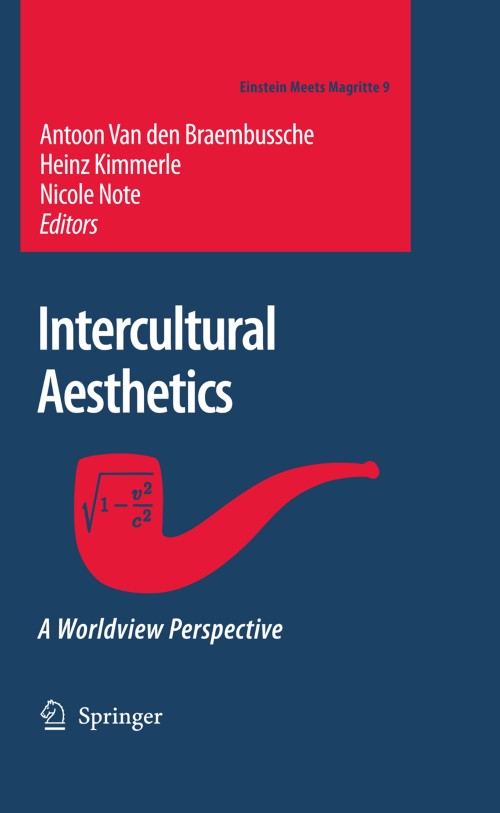
245 10|aIntercultural Aesthetics|h[electronic resource] :|bA Worldview Perspective /|cedited by Antoon van den Braembussche, Heinz Kimmerle, Nicole Note.
250 |a1st ed. 2009.
264 1|aDordrecht :|bSpringer Netherlands :|bImprint: Springer,|c2009.
300 |aVI, 218 p.|bonline resource.
336 |atext|btxt|2rdacontent
337 |acomputer|bc|2rdamedia
338 |aonline resource|bcr|2rdacarrier
347 |atext file|bPDF|2rda
490 1 |aEinstein Meets Magritte: An Interdisciplinary Reflection on Science, Nature, Art, Human Action and Society ;|v9
505 0 |aIntercultural Aesthetics: An Introduction -- An Intercultural Approach to a World Aesthetics -- Living – in between – Cultures -- Living (with) Art: The African Aesthetic Worldview as an Inspiration for the Western Philosophy of Art -- The Origins of Landscape Painting: An Intercultural Perspective -- Nishida, Aesthetics, and the Limits of Cultural Synthesis -- Identity and Hybridity – Chinese Culture and Aesthetics in the Age of Globalization -- The Rasa Theory: A Challenge for Intercultural Aesthetics -- Presenting the Unpresentable. On Trauma and Visual Art -- Visual Archives and the Holocaust: Christian Boltanski, Ydessa Hendeles and Peter Forgacs -- A Distant Laughter: The Poetics of Dislocation -- Where You End and I Begin – The Multiple Ethics of Contemporary Art Practice -- The Ethics of the Wound.
520 |aIn this book the editors brought together outstanding articles concerning intercultural aesthetics. The concept ‘Intercultural aesthetics’ creates a home space for an artistic cross-fertilization between cultures, and for heterogeneity, but it is also firmly linked with the intercultural turn within Western and non-Western philosophy. The book is divided into two parts, yet one can sense a clear unity throughout the whole book. This unity is related to the underlying subject that the different authors, each in their own way and from their own background, try to reveal. They use related, and overlapping terms such as ‘the suchness of things’, ‘dancing and shaping lives’, ‘presenting a meaning beyond words, presenting the unpresentable, experiencing’, in order to bring to our awareness the genuine importance of the non-conceptual, next to the conceptual. Several authors moreover take on a reflective, and at times even a self-reflective stance, pointing to the intrinsic relation between cultural aesthetics and ethics, making this book unique in its kind.
650 0|aPhilosophy.
650 0|aAesthetics.
650 0|aPhilosophy, Modern.
650 0|aArts.
650 0|aAnthropology.
650 14|aPhilosophy.
650 24|aAesthetics.
650 24|aPhilosophical Traditions.
650 24|aFine Art.
650 24|aAnthropology.
700 1 |avan den Braembussche, Antoon.|eeditor.|4edt|4http://id.loc.gov/vocabulary/relators/edt
700 1 |aKimmerle, Heinz.|eeditor.|4edt|4http://id.loc.gov/vocabulary/relators/edt
700 1 |aNote, Nicole.|eeditor.|4edt|4http://id.loc.gov/vocabulary/relators/edt
710 2 |aSpringerLink (Online service)
773 0 |tSpringer Nature eBook
776 08|iPrinted edition:|z9781402045073
776 08|iPrinted edition:|z9789048118014
776 08|iPrinted edition:|z9789048171385
830 0|aEinstein Meets Magritte: An Interdisciplinary Reflection on Science, Nature, Art, Human Action and Society ;|v9
856 40|uhttps://doi.org/10.1007/978-1-4020-5780-9
912 |aZDB-2-SHU
912 |aZDB-2-SXPR
950 |aHumanities, Social Sciences and Law (SpringerNature-11648)
950 |aPhilosophy and Religion (R0) (SpringerNature-43725)