LEADER 03770nam a22005775i 4500
001 811433
003 TR_AnAIT
005 20260131010118
007 cr nn 008mamaa
008 100301s2007 ne | s |||| 0|eng d
020 |a9781402060229|9978-1-4020-6022-9
024 7 |a10.1007/978-1-4020-6022-9|2doi
041 |aeng
049 |aTürk Tarih Kurumu Kütüphanesi
050 4|aLB2801-3095
072 7|aJNK|2bicssc
072 7|aEDU001000|2bisacsh
072 7|aJNK|2thema
082 04|a371.2|223
090 |aDK/12694
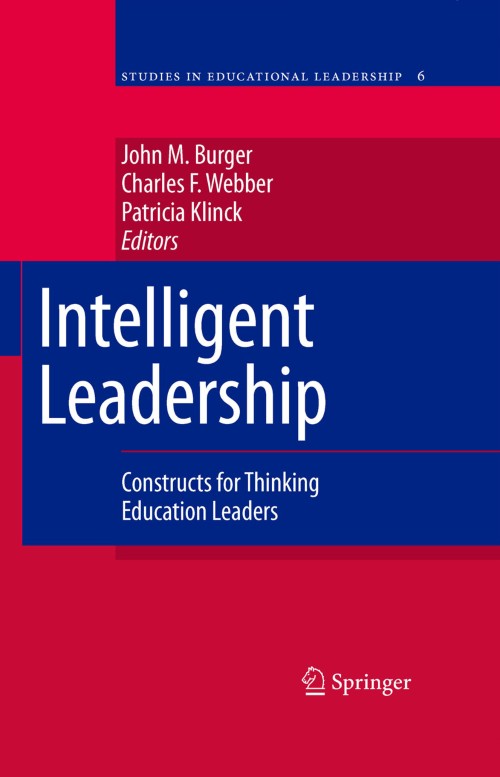
245 10|aIntelligent Leadership|h[electronic resource] :|bConstructs for Thinking Education Leaders /|cedited by John M. Burger, Charles F. Webber, Patricia Klinck.
250 |a1st ed. 2007.
264 1|aDordrecht :|bSpringer Netherlands :|bImprint: Springer,|c2007.
300 |aXIII, 212 p.|bonline resource.
336 |atext|btxt|2rdacontent
337 |acomputer|bc|2rdamedia
338 |aonline resource|bcr|2rdacarrier
347 |atext file|bPDF|2rda
490 1 |aStudies in Educational Leadership,|x2543-0130 ;|v6
505 0 |aIn Search of the Elusive General Theory -- Observations on Leadership: Linking Theory, Practice and Lived Experience -- Change Theory as a Force for School Improvement -- What We Know About Educational Leadership -- Contemporary Learning Theories, Instructional Design and Leadership -- Democratic School Leadership in Canada’s Public School Systems: Professional Value and Social Ethic -- School and Community -- Using Resources Effectively in Education -- Leading Towards Learning and Achievement: The Role of Quality Classroom Assessment -- A Survey of Existing School Leadership Preparation and Development Programs.
520 |aEffective educational leadership, while highly contextualized, is more and more recognized as a crucial input and process variable that determines to a very large extent the outcomes for educational organizations. This book pulls together the thinking of 16 educators with diverse backgrounds and experiences, all of whom hold keen interests in harnessing the forces that can improve educational opportunity for students. Becoming an effective education leader requires more than a passing knowledge of leadership theory; it also requires knowledge of what works in education and an on-going commitment to thinking about how leadership dynamics and pedagogical theory intersect within contextual realities. Intelligent Leadership: Constructs for Thinking Education Leaders is intended to stimulate the thinking of every educator who aspires to influence decision-making and to provide direction to their school, district or institution.
650 0|aSchool management and organization.
650 0|aSchool administration.
650 0|aEducational sociology.
650 0|aEducational tests and measurements.
650 0|aLearning, Psychology of.
650 14|aOrganization and Leadership.
650 24|aSociology of Education.
650 24|aAssessment and Testing.
650 24|aInstructional Psychology.
700 1 |aBurger, John M.|eeditor.|4edt|4http://id.loc.gov/vocabulary/relators/edt
700 1 |aWebber, Charles F.|eeditor.|4edt|4http://id.loc.gov/vocabulary/relators/edt
700 1 |aKlinck, Patricia.|eeditor.|4edt|4http://id.loc.gov/vocabulary/relators/edt
710 2 |aSpringerLink (Online service)
773 0 |tSpringer Nature eBook
776 08|iPrinted edition:|z9781402060212
776 08|iPrinted edition:|z9789048113255
776 08|iPrinted edition:|z9789048175079
830 0|aStudies in Educational Leadership,|x2543-0130 ;|v6
856 40|uhttps://doi.org/10.1007/978-1-4020-6022-9
912 |aZDB-2-SHU
912 |aZDB-2-SXED
950 |aHumanities, Social Sciences and Law (SpringerNature-11648)
950 |aEducation (R0) (SpringerNature-43721)