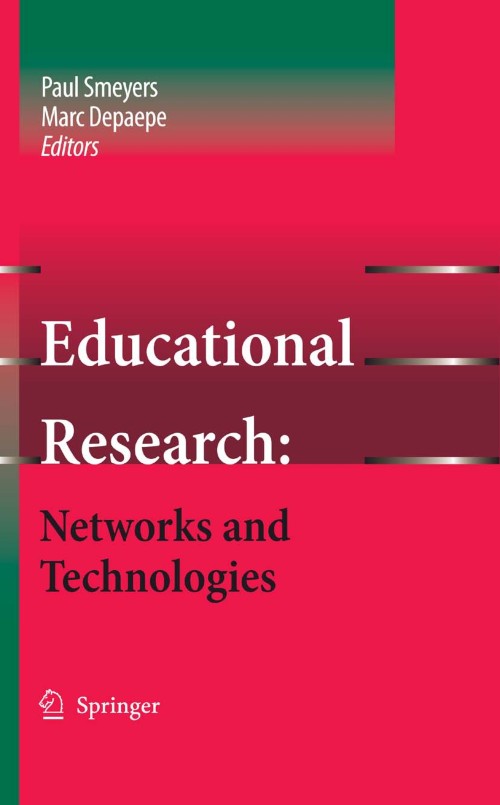
Educational Research: Networks and Technologies [electronic resource] / edited by Paul Smeyers, Marc Depaepe.
Erişim Adresi
ISBN
9781402066139
Dil Kodu
İngilizce
Yer Numarası
DK/12704
Basım Bildirimi
1st ed. 2007.
Yayın Bilgisi
Dordrecht : Springer Netherlands : Imprint: Springer, 2007.
Fiziksel Niteleme
VI, 228 p. online resource.
Dizi
Educational Research, 2543-0653 ; 2
İçindekiler Notu
Networks and Technologies: On the Continuity and Change of Educational Research and Practice -- www.thedevelopmentofknowledge.net -- Networks, Information Politics and the New Paradigm of Social Production -- Networks as Spaces and Places: Their Importance for Educational Research Collaboration1 -- The Role of Electronic Reading and Writing in Networking and in Educational Research: What Difference Does It Make? -- On the Position of the Educationalist Intellectual in the Information Age: Shouldn't We Become Meta-modern Artists? -- The Hidden Homogenization of Educational Research: On Opening up the Sphere of Responsiveness -- Network, Critique, Conversation: Towards a Rethinking of Educational Research Methods Training -- Research in Motion: Doctoral Programmes at the Network University -- Public Space in a Network Society? A Note on the Call for Public Space (Philosophy) in Education Today -- ‘Erasmus the Albatross’: The Transmission of Ideas as Information -- Penelope's Work: Only Disconnect -- Normalizing Parenthood Once Again: What it Means to be a Parent Today -- True Love Waits: Abstinence Education in the USA -- Punishment as an Educational Technology: A Form of Pedagogical Inertia in Schools?.
Özet, vb.
There have always been networks in the context of educational research as well as particular technologies. Yet recent developments in ICT have put their mark on contemporary education and on educational research and more in general on knowledge and understanding. Does the ‘network society’ and its supporting technologies constitute a thoroughly radical innovation in social practice? Does information technology poison the minds of the younger generation? Do educational institutions have to be transformed in order to effectively serve the needs of the twenty-first century? And what are the implications of these changes for educational research and for researchers themselves? In this book distinguished philosophers and historians of education focus on the way ‘networks’ and ‘technologies’ characterize education and educational research nowadays. Attention is paid for instance to online networks as ‘spaces’ and ‘places’ that are changing research practices and relations, to the involvement of the researcher in the moral debate, but also to particular educational technologies such as the use of experts’ advice concerning Internet use, the American True Love Waits movement and the practice of punishment in schools. "This groundbreaking book records the intellectual struggles of a diverse and distinguished group of scholars as they come to grips with the changes in knowledge production, and modes of research communication, engendered by contemporary information and communications technology. The book performs a major service in placing the phenomenon of networks - their potentialities and also their dangers - squarely on our intellectual agenda." D.C. Phillips, Professor Emeritus of Education and Philosophy, Stanford University "In this book, a rich array of international scholars in the philosophy and history of education address a pressing concern in contemporary educational research and educationalpractice: the impact of information technology and networks. The authors are strikingly successful, both in explicating the effects of these changes on both domains and in subverting these effects by pointing out the ironies and continuities lodged beneath technology's veneer of utility and novelty." David F. Labaree, Professor of Education, Stanford University This publication is realized by the Research Community (FWO-Vlaanderen / Research Foundation Flanders, Belgium) Philosophy and History of the Discipline of Education: Evaluation and Evolution of the Criteria for Educational Research. Also realized by the Research Community is Educational Research: Why "What Works" Doesn’t Work, which appeared in 2006.
Konu
Education __ Philosophy.
Educational technology.
Educational sociology.
Education and state.
Educational Philosophy.
Digital Education and Educational Technology.
Sociology of Education.
Educational Policy and Politics.
Educational technology.
Educational sociology.
Education and state.
Educational Philosophy.
Digital Education and Educational Technology.
Sociology of Education.
Educational Policy and Politics.
Diğer Yazarlar
Kurum Adı

Eseri Alıntıla
Referansları kullanmadan önce gözden geçirmeniz ve varsa gerekli düzeltmeleri yapmanız önerilir.
Dijital Kaynak
MARC Görünümü
LEADER 05890nam a22005535i 4500
001 811443
003 TR_AnAIT
005 20260131010048
007 cr nn 008mamaa
008 100408s2007 ne | s |||| 0|eng d
020 |a9781402066139|9978-1-4020-6613-9
024 7 |a10.1007/978-1-4020-6613-9|2doi
041 |aeng
049 |aTürk Tarih Kurumu Kütüphanesi
050 4|aLB1-3640
072 7|aJNA|2bicssc
072 7|aEDU040000|2bisacsh
072 7|aJNA|2thema
082 04|a370.1|223
090 |aDK/12704
245 10|aEducational Research: Networks and Technologies|h[electronic resource] /|cedited by Paul Smeyers, Marc Depaepe.
250 |a1st ed. 2007.
264 1|aDordrecht :|bSpringer Netherlands :|bImprint: Springer,|c2007.
300 |aVI, 228 p.|bonline resource.
336 |atext|btxt|2rdacontent
337 |acomputer|bc|2rdamedia
338 |aonline resource|bcr|2rdacarrier
347 |atext file|bPDF|2rda
490 1 |aEducational Research,|x2543-0653 ;|v2
505 0 |aNetworks and Technologies: On the Continuity and Change of Educational Research and Practice -- www.thedevelopmentofknowledge.net -- Networks, Information Politics and the New Paradigm of Social Production -- Networks as Spaces and Places: Their Importance for Educational Research Collaboration1 -- The Role of Electronic Reading and Writing in Networking and in Educational Research: What Difference Does It Make? -- On the Position of the Educationalist Intellectual in the Information Age: Shouldn't We Become Meta-modern Artists? -- The Hidden Homogenization of Educational Research: On Opening up the Sphere of Responsiveness -- Network, Critique, Conversation: Towards a Rethinking of Educational Research Methods Training -- Research in Motion: Doctoral Programmes at the Network University -- Public Space in a Network Society? A Note on the Call for Public Space (Philosophy) in Education Today -- ‘Erasmus the Albatross’: The Transmission of Ideas as Information -- Penelope's Work: Only Disconnect -- Normalizing Parenthood Once Again: What it Means to be a Parent Today -- True Love Waits: Abstinence Education in the USA -- Punishment as an Educational Technology: A Form of Pedagogical Inertia in Schools?.
520 |aThere have always been networks in the context of educational research as well as particular technologies. Yet recent developments in ICT have put their mark on contemporary education and on educational research and more in general on knowledge and understanding. Does the ‘network society’ and its supporting technologies constitute a thoroughly radical innovation in social practice? Does information technology poison the minds of the younger generation? Do educational institutions have to be transformed in order to effectively serve the needs of the twenty-first century? And what are the implications of these changes for educational research and for researchers themselves? In this book distinguished philosophers and historians of education focus on the way ‘networks’ and ‘technologies’ characterize education and educational research nowadays. Attention is paid for instance to online networks as ‘spaces’ and ‘places’ that are changing research practices and relations, to the involvement of the researcher in the moral debate, but also to particular educational technologies such as the use of experts’ advice concerning Internet use, the American True Love Waits movement and the practice of punishment in schools. "This groundbreaking book records the intellectual struggles of a diverse and distinguished group of scholars as they come to grips with the changes in knowledge production, and modes of research communication, engendered by contemporary information and communications technology. The book performs a major service in placing the phenomenon of networks - their potentialities and also their dangers - squarely on our intellectual agenda." D.C. Phillips, Professor Emeritus of Education and Philosophy, Stanford University "In this book, a rich array of international scholars in the philosophy and history of education address a pressing concern in contemporary educational research and educationalpractice: the impact of information technology and networks. The authors are strikingly successful, both in explicating the effects of these changes on both domains and in subverting these effects by pointing out the ironies and continuities lodged beneath technology's veneer of utility and novelty." David F. Labaree, Professor of Education, Stanford University This publication is realized by the Research Community (FWO-Vlaanderen / Research Foundation Flanders, Belgium) Philosophy and History of the Discipline of Education: Evaluation and Evolution of the Criteria for Educational Research. Also realized by the Research Community is Educational Research: Why "What Works" Doesn’t Work, which appeared in 2006.
650 0|aEducation|xPhilosophy.
650 0|aEducational technology.
650 0|aEducational sociology.
650 0|aEducation and state.
650 14|aEducational Philosophy.
650 24|aDigital Education and Educational Technology.
650 24|aSociology of Education.
650 24|aEducational Policy and Politics.
700 1 |aSmeyers, Paul.|eeditor.|4edt|4http://id.loc.gov/vocabulary/relators/edt
700 1 |aDepaepe, Marc.|eeditor.|4edt|4http://id.loc.gov/vocabulary/relators/edt
710 2 |aSpringerLink (Online service)
773 0 |tSpringer Nature eBook
776 08|iPrinted edition:|z9781402066122
776 08|iPrinted edition:|z9789048115570
776 08|iPrinted edition:|z9789048176816
830 0|aEducational Research,|x2543-0653 ;|v2
856 40|uhttps://doi.org/10.1007/978-1-4020-6613-9
912 |aZDB-2-SHU
912 |aZDB-2-SXED
950 |aHumanities, Social Sciences and Law (SpringerNature-11648)
950 |aEducation (R0) (SpringerNature-43721)
001 811443
003 TR_AnAIT
005 20260131010048
007 cr nn 008mamaa
008 100408s2007 ne | s |||| 0|eng d
020 |a9781402066139|9978-1-4020-6613-9
024 7 |a10.1007/978-1-4020-6613-9|2doi
041 |aeng
049 |aTürk Tarih Kurumu Kütüphanesi
050 4|aLB1-3640
072 7|aJNA|2bicssc
072 7|aEDU040000|2bisacsh
072 7|aJNA|2thema
082 04|a370.1|223
090 |aDK/12704
245 10|aEducational Research: Networks and Technologies|h[electronic resource] /|cedited by Paul Smeyers, Marc Depaepe.
250 |a1st ed. 2007.
264 1|aDordrecht :|bSpringer Netherlands :|bImprint: Springer,|c2007.
300 |aVI, 228 p.|bonline resource.
336 |atext|btxt|2rdacontent
337 |acomputer|bc|2rdamedia
338 |aonline resource|bcr|2rdacarrier
347 |atext file|bPDF|2rda
490 1 |aEducational Research,|x2543-0653 ;|v2
505 0 |aNetworks and Technologies: On the Continuity and Change of Educational Research and Practice -- www.thedevelopmentofknowledge.net -- Networks, Information Politics and the New Paradigm of Social Production -- Networks as Spaces and Places: Their Importance for Educational Research Collaboration1 -- The Role of Electronic Reading and Writing in Networking and in Educational Research: What Difference Does It Make? -- On the Position of the Educationalist Intellectual in the Information Age: Shouldn't We Become Meta-modern Artists? -- The Hidden Homogenization of Educational Research: On Opening up the Sphere of Responsiveness -- Network, Critique, Conversation: Towards a Rethinking of Educational Research Methods Training -- Research in Motion: Doctoral Programmes at the Network University -- Public Space in a Network Society? A Note on the Call for Public Space (Philosophy) in Education Today -- ‘Erasmus the Albatross’: The Transmission of Ideas as Information -- Penelope's Work: Only Disconnect -- Normalizing Parenthood Once Again: What it Means to be a Parent Today -- True Love Waits: Abstinence Education in the USA -- Punishment as an Educational Technology: A Form of Pedagogical Inertia in Schools?.
520 |aThere have always been networks in the context of educational research as well as particular technologies. Yet recent developments in ICT have put their mark on contemporary education and on educational research and more in general on knowledge and understanding. Does the ‘network society’ and its supporting technologies constitute a thoroughly radical innovation in social practice? Does information technology poison the minds of the younger generation? Do educational institutions have to be transformed in order to effectively serve the needs of the twenty-first century? And what are the implications of these changes for educational research and for researchers themselves? In this book distinguished philosophers and historians of education focus on the way ‘networks’ and ‘technologies’ characterize education and educational research nowadays. Attention is paid for instance to online networks as ‘spaces’ and ‘places’ that are changing research practices and relations, to the involvement of the researcher in the moral debate, but also to particular educational technologies such as the use of experts’ advice concerning Internet use, the American True Love Waits movement and the practice of punishment in schools. "This groundbreaking book records the intellectual struggles of a diverse and distinguished group of scholars as they come to grips with the changes in knowledge production, and modes of research communication, engendered by contemporary information and communications technology. The book performs a major service in placing the phenomenon of networks - their potentialities and also their dangers - squarely on our intellectual agenda." D.C. Phillips, Professor Emeritus of Education and Philosophy, Stanford University "In this book, a rich array of international scholars in the philosophy and history of education address a pressing concern in contemporary educational research and educationalpractice: the impact of information technology and networks. The authors are strikingly successful, both in explicating the effects of these changes on both domains and in subverting these effects by pointing out the ironies and continuities lodged beneath technology's veneer of utility and novelty." David F. Labaree, Professor of Education, Stanford University This publication is realized by the Research Community (FWO-Vlaanderen / Research Foundation Flanders, Belgium) Philosophy and History of the Discipline of Education: Evaluation and Evolution of the Criteria for Educational Research. Also realized by the Research Community is Educational Research: Why "What Works" Doesn’t Work, which appeared in 2006.
650 0|aEducation|xPhilosophy.
650 0|aEducational technology.
650 0|aEducational sociology.
650 0|aEducation and state.
650 14|aEducational Philosophy.
650 24|aDigital Education and Educational Technology.
650 24|aSociology of Education.
650 24|aEducational Policy and Politics.
700 1 |aSmeyers, Paul.|eeditor.|4edt|4http://id.loc.gov/vocabulary/relators/edt
700 1 |aDepaepe, Marc.|eeditor.|4edt|4http://id.loc.gov/vocabulary/relators/edt
710 2 |aSpringerLink (Online service)
773 0 |tSpringer Nature eBook
776 08|iPrinted edition:|z9781402066122
776 08|iPrinted edition:|z9789048115570
776 08|iPrinted edition:|z9789048176816
830 0|aEducational Research,|x2543-0653 ;|v2
856 40|uhttps://doi.org/10.1007/978-1-4020-6613-9
912 |aZDB-2-SHU
912 |aZDB-2-SXED
950 |aHumanities, Social Sciences and Law (SpringerNature-11648)
950 |aEducation (R0) (SpringerNature-43721)
Materyaller
Depodan talep edilen materyal sadece kütüphane içerisinde kullanılmaktadır.
Materyal dışarıya ödünç verilmemektedir.
