LEADER 03820nam a22005175i 4500
001 811446
003 TR_AnAIT
005 20260131010043
007 cr nn 008mamaa
008 100301s2008 ne | s |||| 0|eng d
020 |a9781402069109|9978-1-4020-6910-9
024 7 |a10.1007/978-1-4020-6910-9|2doi
041 |aeng
049 |aTürk Tarih Kurumu Kütüphanesi
050 4|aLB1060-1077
072 7|aJNC|2bicssc
072 7|aEDU009000|2bisacsh
072 7|aJNC|2thema
082 04|a370.15|223
090 |aDK/12707
100 1 |aKalman, Calvin S.|eauthor.|4aut|4http://id.loc.gov/vocabulary/relators/aut
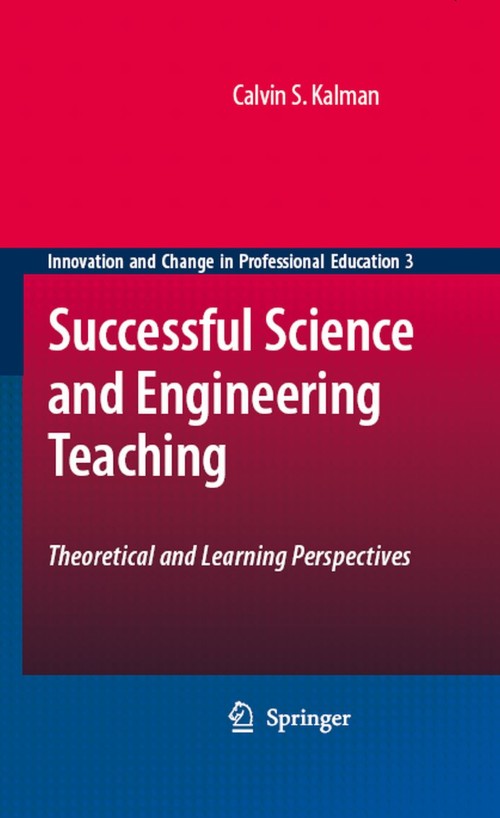
245 10|aSuccessful Science and Engineering Teaching|h[electronic resource] :|bTheoretical and Learning Perspectives /|cby Calvin S. Kalman.
250 |a1st ed. 2008.
264 1|aDordrecht :|bSpringer Netherlands :|bImprint: Springer,|c2008.
300 |aXVI, 192 p.|bonline resource.
336 |atext|btxt|2rdacontent
337 |acomputer|bc|2rdamedia
338 |aonline resource|bcr|2rdacarrier
347 |atext file|bPDF|2rda
490 1 |aInnovation and Change in Professional Education,|x2542-9957 ;|v3
505 0 |aHow Students Learn Science -- Intellectual Development and Psychological Types -- Students Alternative Scientific Conceptions -- Writing to Learn: Reflective Writing -- Changing Student's Epistemologies -- Getting Students to Examine Their Epistemology -- Critical Thinking -- Educational Models Based upon Philosophy of Science -- Changing Student's Epistemologies -- Final Thoughts -- Courses for Non-science Students -- Computer Assisted Instruction -- Summing Up.
520 |aThe intent of this book is to describe how a professor can provide a learning environment that assists students to come to grips with the nature of science and engineering, to understand science and engineering concepts, and to solve problems in science and engineering courses. As such, this book is intended to be useful for any science or engineering professor, who wants to change their course to include more effective teaching methods, to instructors at post-secondary institutions, who are beginning their careers, and as a handbook for TA’s. Since the book is based upon articles that I have had published in Science Educational Research and which are grounded in educational research that I have performed (both quantitative and qualitative) over many years, it will also be of interest to anyone engaged in research into teaching science and engineering at the post-secondary level. I have also tried to include enough background so that the book could be used as a textbook for a course in educational practice in science and engineering. The book has two main axes of development. Firstly, how do we get students to change their epistemology so that their outlook on the course material is not that it consists of a tool kit of assorted practices, classified according to problem type, but rather that the subject comprises a connected structure of concepts. Secondly, helping students to have a deeper understanding of science and engineering.
650 0|aLearning, Psychology of.
650 0|aScience|xStudy and teaching.
650 0|aTeachers|xTraining of.
650 14|aInstructional Psychology.
650 24|aScience Education.
650 24|aTeaching and Teacher Education.
710 2 |aSpringerLink (Online service)
773 0 |tSpringer Nature eBook
776 08|iPrinted edition:|z9781402069093
776 08|iPrinted edition:|z9789048116423
776 08|iPrinted edition:|z9789048177608
830 0|aInnovation and Change in Professional Education,|x2542-9957 ;|v3
856 40|uhttps://doi.org/10.1007/978-1-4020-6910-9
912 |aZDB-2-SHU
912 |aZDB-2-SXED
950 |aHumanities, Social Sciences and Law (SpringerNature-11648)
950 |aEducation (R0) (SpringerNature-43721)