

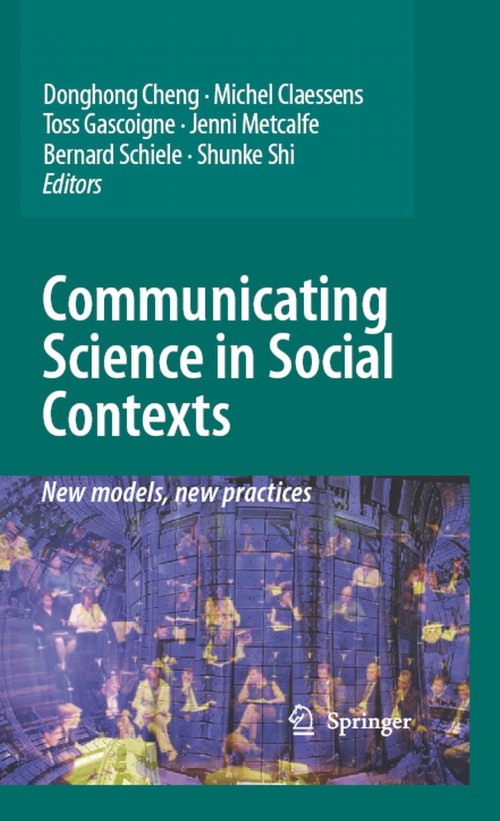
Communicating Science in Social Contexts [electronic resource] : New models, new practices / edited by Donghong Cheng, Michel Claessens, Nicholas R. J. Gascoigne, Jenni Metcalfe, Bernard Schiele, Shunke Shi.
Erişim Adresi
ISBN
9781402085987
Dil Kodu
İngilizce
Yer Numarası
DK/12713
Basım Bildirimi
1st ed. 2008.
Yayın Bilgisi
Dordrecht : Springer Netherlands : Imprint: Springer, 2008.
Fiziksel Niteleme
XVIII, 320 p. online resource.
İçindekiler Notu
Revisiting Models -- Paradigm Change for Science Communication: Commercial Science Needs a Critical Public -- European Trends in Science Communication -- Words and Figures of the Public: the Misunderstanding in Scientific Communication -- Representation and Deliberation: New Perspectives on Communication Among Actors in Science and Technology Innovation -- Medialization of Science as a Prerequisite of Its Legitimization and Political Relevance -- On and about the Deficit Model in an Age of Free Flow -- Towards an Analytical Framework of Science Communication Models -- Crossing Boundaries -- Before and After Science: Science and Technology in Pop Music, 1970–1990 -- The More, the Earlier, the Better: Science Communication Supports Science Education -- Hollywood Knowledge: Communication Between Scientific and Entertainment Cultures -- Situating Science in the Social Context by Cross-Sectoral Collaboration -- Developing Strategies -- From Science Communication to Knowledge Brokering: the Shift from ‘Science Push’ to ‘Policy Pull’ -- Science Advocacy: Challenging Task, Difficult Pathways -- The Epistemic Jumble of Sustainable Development -- In Search of Dialogue: Staging Science Communication in Consensus Conferences -- So Where’s the Theory? on the Relationship between Science Communication Practice and Research -- From Democratization of Knowledge to Bridge Building between Science, Technology and Society -- Bringing Science to the Public.
Özet, vb.
Science communication, as a multidisciplinary field, has developed remarkably in recent years. It is now a distinct and exceedingly dynamic science that melds theoretical approaches with practical experience. Formerly well-established theoretical models now seem out of step with the social reality of the sciences, and the previously clear-cut delineations and interacting domains between cultural fields have blurred. Communicating Science in Social Contexts examines that shift, which itself depicts a profound recomposition of knowledge fields, activities and dissemination practices, and the value accorded to science and technology. Communicating Science in Social Contexts is the product of a long-term effort that would not have been possible without the research and expertise of the Public Communication of Science and Technology (PCST) Network and the editors. For nearly 20 years, this informal, international network has been organizing events and forums for discussion of the public communication of science. This valuable tool is recommended for those interested in teaching people how to cope in a society dominated by science and technology, particularly researchers, science journalists, science museum and science centers staff, academic researchers who study aspects of PCST, scientists who interact closely with the public, press and public information officers of scientic institutions, science theater directors, and anyone interested in issues related to science communication.
Konu
Communication.
Science __ Study and teaching.
Business.
Management science.
Engineering.
Life sciences.
Social sciences.
Humanities.
Media and Communication.
Science Education.
Business and Management.
Technology and Engineering.
Life Sciences.
Humanities and Social Sciences.
Science __ Study and teaching.
Business.
Management science.
Engineering.
Life sciences.
Social sciences.
Humanities.
Media and Communication.
Science Education.
Business and Management.
Technology and Engineering.
Life Sciences.
Humanities and Social Sciences.
Diğer Yazarlar
Kurum Adı
Eseri Alıntıla
Referansları kullanmadan önce gözden geçirmeniz ve varsa gerekli düzeltmeleri yapmanız önerilir.
Dijital Kaynak
MARC Görünümü
LEADER 05494nam a22006495i 4500
001 811452
003 TR_AnAIT
005 20260131005947
007 cr nn 008mamaa
008 100301s2008 ne | s |||| 0|eng d
020 |a9781402085987|9978-1-4020-8598-7
024 7 |a10.1007/978-1-4020-8598-7|2doi
041 |aeng
049 |aTürk Tarih Kurumu Kütüphanesi
050 4|aP87-96
072 7|aJFD|2bicssc
072 7|aSOC052000|2bisacsh
072 7|aJBCT|2thema
082 04|a302.2|223
090 |aDK/12713
245 10|aCommunicating Science in Social Contexts|h[electronic resource] :|bNew models, new practices /|cedited by Donghong Cheng, Michel Claessens, Nicholas R. J. Gascoigne, Jenni Metcalfe, Bernard Schiele, Shunke Shi.
250 |a1st ed. 2008.
264 1|aDordrecht :|bSpringer Netherlands :|bImprint: Springer,|c2008.
300 |aXVIII, 320 p.|bonline resource.
336 |atext|btxt|2rdacontent
337 |acomputer|bc|2rdamedia
338 |aonline resource|bcr|2rdacarrier
347 |atext file|bPDF|2rda
505 0 |aRevisiting Models -- Paradigm Change for Science Communication: Commercial Science Needs a Critical Public -- European Trends in Science Communication -- Words and Figures of the Public: the Misunderstanding in Scientific Communication -- Representation and Deliberation: New Perspectives on Communication Among Actors in Science and Technology Innovation -- Medialization of Science as a Prerequisite of Its Legitimization and Political Relevance -- On and about the Deficit Model in an Age of Free Flow -- Towards an Analytical Framework of Science Communication Models -- Crossing Boundaries -- Before and After Science: Science and Technology in Pop Music, 1970–1990 -- The More, the Earlier, the Better: Science Communication Supports Science Education -- Hollywood Knowledge: Communication Between Scientific and Entertainment Cultures -- Situating Science in the Social Context by Cross-Sectoral Collaboration -- Developing Strategies -- From Science Communication to Knowledge Brokering: the Shift from ‘Science Push’ to ‘Policy Pull’ -- Science Advocacy: Challenging Task, Difficult Pathways -- The Epistemic Jumble of Sustainable Development -- In Search of Dialogue: Staging Science Communication in Consensus Conferences -- So Where’s the Theory? on the Relationship between Science Communication Practice and Research -- From Democratization of Knowledge to Bridge Building between Science, Technology and Society -- Bringing Science to the Public.
520 |aScience communication, as a multidisciplinary field, has developed remarkably in recent years. It is now a distinct and exceedingly dynamic science that melds theoretical approaches with practical experience. Formerly well-established theoretical models now seem out of step with the social reality of the sciences, and the previously clear-cut delineations and interacting domains between cultural fields have blurred. Communicating Science in Social Contexts examines that shift, which itself depicts a profound recomposition of knowledge fields, activities and dissemination practices, and the value accorded to science and technology. Communicating Science in Social Contexts is the product of a long-term effort that would not have been possible without the research and expertise of the Public Communication of Science and Technology (PCST) Network and the editors. For nearly 20 years, this informal, international network has been organizing events and forums for discussion of the public communication of science. This valuable tool is recommended for those interested in teaching people how to cope in a society dominated by science and technology, particularly researchers, science journalists, science museum and science centers staff, academic researchers who study aspects of PCST, scientists who interact closely with the public, press and public information officers of scientic institutions, science theater directors, and anyone interested in issues related to science communication.
650 0|aCommunication.
650 0|aScience|xStudy and teaching.
650 0|aBusiness.
650 0|aManagement science.
650 0|aEngineering.
650 0|aLife sciences.
650 0|aSocial sciences.
650 0|aHumanities.
650 14|aMedia and Communication.
650 24|aScience Education.
650 24|aBusiness and Management.
650 24|aTechnology and Engineering.
650 24|aLife Sciences.
650 24|aHumanities and Social Sciences.
700 1 |aCheng, Donghong.|eeditor.|4edt|4http://id.loc.gov/vocabulary/relators/edt
700 1 |aClaessens, Michel.|eeditor.|4edt|4http://id.loc.gov/vocabulary/relators/edt
700 1 |aGascoigne, Nicholas R. J.|eeditor.|4edt|4http://id.loc.gov/vocabulary/relators/edt
700 1 |aMetcalfe, Jenni.|eeditor.|4edt|4http://id.loc.gov/vocabulary/relators/edt
700 1 |aSchiele, Bernard.|eeditor.|4edt|4http://id.loc.gov/vocabulary/relators/edt
700 1 |aShi, Shunke.|eeditor.|4edt|4http://id.loc.gov/vocabulary/relators/edt
710 2 |aSpringerLink (Online service)
773 0 |tSpringer Nature eBook
776 08|iPrinted edition:|z9781402085970
776 08|iPrinted edition:|z9789048120642
776 08|iPrinted edition:|z9789048179282
856 40|uhttps://doi.org/10.1007/978-1-4020-8598-7
912 |aZDB-2-SHU
912 |aZDB-2-SXS
950 |aHumanities, Social Sciences and Law (SpringerNature-11648)
950 |aSocial Sciences (R0) (SpringerNature-43726)
001 811452
003 TR_AnAIT
005 20260131005947
007 cr nn 008mamaa
008 100301s2008 ne | s |||| 0|eng d
020 |a9781402085987|9978-1-4020-8598-7
024 7 |a10.1007/978-1-4020-8598-7|2doi
041 |aeng
049 |aTürk Tarih Kurumu Kütüphanesi
050 4|aP87-96
072 7|aJFD|2bicssc
072 7|aSOC052000|2bisacsh
072 7|aJBCT|2thema
082 04|a302.2|223
090 |aDK/12713
245 10|aCommunicating Science in Social Contexts|h[electronic resource] :|bNew models, new practices /|cedited by Donghong Cheng, Michel Claessens, Nicholas R. J. Gascoigne, Jenni Metcalfe, Bernard Schiele, Shunke Shi.
250 |a1st ed. 2008.
264 1|aDordrecht :|bSpringer Netherlands :|bImprint: Springer,|c2008.
300 |aXVIII, 320 p.|bonline resource.
336 |atext|btxt|2rdacontent
337 |acomputer|bc|2rdamedia
338 |aonline resource|bcr|2rdacarrier
347 |atext file|bPDF|2rda
505 0 |aRevisiting Models -- Paradigm Change for Science Communication: Commercial Science Needs a Critical Public -- European Trends in Science Communication -- Words and Figures of the Public: the Misunderstanding in Scientific Communication -- Representation and Deliberation: New Perspectives on Communication Among Actors in Science and Technology Innovation -- Medialization of Science as a Prerequisite of Its Legitimization and Political Relevance -- On and about the Deficit Model in an Age of Free Flow -- Towards an Analytical Framework of Science Communication Models -- Crossing Boundaries -- Before and After Science: Science and Technology in Pop Music, 1970–1990 -- The More, the Earlier, the Better: Science Communication Supports Science Education -- Hollywood Knowledge: Communication Between Scientific and Entertainment Cultures -- Situating Science in the Social Context by Cross-Sectoral Collaboration -- Developing Strategies -- From Science Communication to Knowledge Brokering: the Shift from ‘Science Push’ to ‘Policy Pull’ -- Science Advocacy: Challenging Task, Difficult Pathways -- The Epistemic Jumble of Sustainable Development -- In Search of Dialogue: Staging Science Communication in Consensus Conferences -- So Where’s the Theory? on the Relationship between Science Communication Practice and Research -- From Democratization of Knowledge to Bridge Building between Science, Technology and Society -- Bringing Science to the Public.
520 |aScience communication, as a multidisciplinary field, has developed remarkably in recent years. It is now a distinct and exceedingly dynamic science that melds theoretical approaches with practical experience. Formerly well-established theoretical models now seem out of step with the social reality of the sciences, and the previously clear-cut delineations and interacting domains between cultural fields have blurred. Communicating Science in Social Contexts examines that shift, which itself depicts a profound recomposition of knowledge fields, activities and dissemination practices, and the value accorded to science and technology. Communicating Science in Social Contexts is the product of a long-term effort that would not have been possible without the research and expertise of the Public Communication of Science and Technology (PCST) Network and the editors. For nearly 20 years, this informal, international network has been organizing events and forums for discussion of the public communication of science. This valuable tool is recommended for those interested in teaching people how to cope in a society dominated by science and technology, particularly researchers, science journalists, science museum and science centers staff, academic researchers who study aspects of PCST, scientists who interact closely with the public, press and public information officers of scientic institutions, science theater directors, and anyone interested in issues related to science communication.
650 0|aCommunication.
650 0|aScience|xStudy and teaching.
650 0|aBusiness.
650 0|aManagement science.
650 0|aEngineering.
650 0|aLife sciences.
650 0|aSocial sciences.
650 0|aHumanities.
650 14|aMedia and Communication.
650 24|aScience Education.
650 24|aBusiness and Management.
650 24|aTechnology and Engineering.
650 24|aLife Sciences.
650 24|aHumanities and Social Sciences.
700 1 |aCheng, Donghong.|eeditor.|4edt|4http://id.loc.gov/vocabulary/relators/edt
700 1 |aClaessens, Michel.|eeditor.|4edt|4http://id.loc.gov/vocabulary/relators/edt
700 1 |aGascoigne, Nicholas R. J.|eeditor.|4edt|4http://id.loc.gov/vocabulary/relators/edt
700 1 |aMetcalfe, Jenni.|eeditor.|4edt|4http://id.loc.gov/vocabulary/relators/edt
700 1 |aSchiele, Bernard.|eeditor.|4edt|4http://id.loc.gov/vocabulary/relators/edt
700 1 |aShi, Shunke.|eeditor.|4edt|4http://id.loc.gov/vocabulary/relators/edt
710 2 |aSpringerLink (Online service)
773 0 |tSpringer Nature eBook
776 08|iPrinted edition:|z9781402085970
776 08|iPrinted edition:|z9789048120642
776 08|iPrinted edition:|z9789048179282
856 40|uhttps://doi.org/10.1007/978-1-4020-8598-7
912 |aZDB-2-SHU
912 |aZDB-2-SXS
950 |aHumanities, Social Sciences and Law (SpringerNature-11648)
950 |aSocial Sciences (R0) (SpringerNature-43726)
Materyaller
Depodan talep edilen materyal sadece kütüphane içerisinde kullanılmaktadır.
Materyal dışarıya ödünç verilmemektedir.
Materyal dışarıya ödünç verilmemektedir.
