

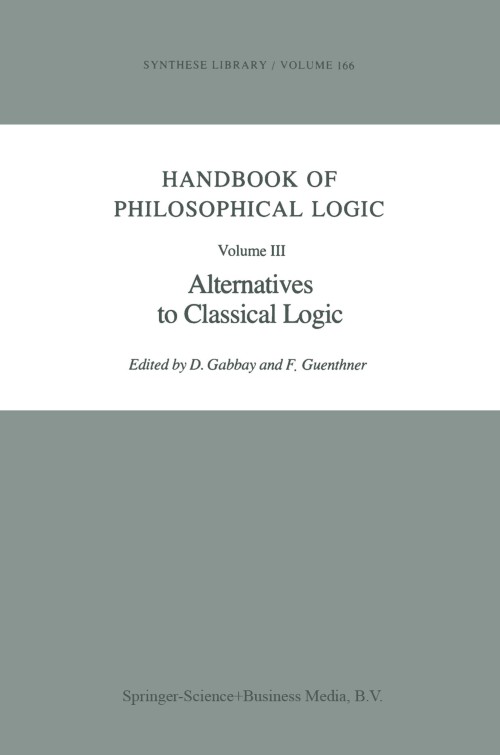
Handbook of Philosophical Logic [electronic resource] : Volume III: Alternatives to Classical Logic / edited by Dov M. Gabbay, Franz Guenthner.
Erişim Adresi
ISBN
9789400952034
Dil Kodu
İngilizce
Yer Numarası
DK/12752
Basım Bildirimi
1st ed. 1986.
Yayın Bilgisi
Dordrecht : Springer Netherlands : Imprint: Springer, 1986.
Fiziksel Niteleme
531 p. 1 illus. online resource.
Dizi
Synthese Library, Studies in Epistemology, Logic, Methodology, and Philosophy of Science, 2542-8292 ; 166
İçindekiler Notu
to Volume III -- III.1. Partial Logic -- III.2. Many-valued Logic -- III.3. Relevance Logic and Entailment -- III.4. Intuitionistic Logic -- III.5. Dialogues as a Foundation for Intuitionistic Logic -- III.6. Free Logics -- III.7. Quantum Logic -- III.8. Proof Theory and Meaning -- Name Index -- Table of Contents to Volumes I, II, and IV.
Özet, vb.
This volume presents a number of systems of logic which can be considered as alternatives to classical logic. The notion of what counts as an alternative is a somewhat problematic one. There are extreme views on the matter of what is the 'correct' logical system and whether one logical system (e. g. classical logic) can represent (or contain) all the others. The choice of the systems presented in this volume was guided by the following criteria for including a logic as an alternative: (i) the departure from classical logic in accepting or rejecting certain theorems of classical logic following intuitions arising from significant application areas and/or from human reasoning; (ii) the alternative logic is well-established and well-understood mathematically and is widely applied in other disciplines such as mathematics, physics, computer science, philosophy, psychology, or linguistics. A number of other alternatives had to be omitted for the present volume (e. g. recent attempts to formulate so-called 'non-monotonic' reason ing systems). Perhaps these can be included in future extensions of the Handbook of Philosophical Logic. Chapter 1 deals with partial logics, that is, systems where sentences do not always have to be either true or false, and where terms do not always have to denote. These systems are thus, in general, geared towards reasoning in partially specified models. Logics of this type have arisen mainly from philo sophical and linguistic considerations; various applications in theoretical computer science have also been envisaged.
Konu
Logic.
Mathematical logic.
Computational linguistics.
Logic.
Mathematical Logic and Foundations.
Computational Linguistics.
Mathematical logic.
Computational linguistics.
Logic.
Mathematical Logic and Foundations.
Computational Linguistics.
Diğer Yazarlar
Kurum Adı
Eseri Alıntıla
Referansları kullanmadan önce gözden geçirmeniz ve varsa gerekli düzeltmeleri yapmanız önerilir.
Dijital Kaynak
MARC Görünümü
LEADER 04762nam a22005895i 4500
001 811492
003 TR_AnAIT
005 20260131005652
007 cr nn 008mamaa
008 130602s1986 ne | s |||| 0|eng d
020 |a9789400952034|9978-94-009-5203-4
024 7 |a10.1007/978-94-009-5203-4|2doi
041 |aeng
049 |aTürk Tarih Kurumu Kütüphanesi
050 4|aBC1-199
072 7|aHPL|2bicssc
072 7|aPHI011000|2bisacsh
072 7|aQDTL|2thema
082 04|a160|223
090 |aDK/12752
245 10|aHandbook of Philosophical Logic|h[electronic resource] :|bVolume III: Alternatives to Classical Logic /|cedited by Dov M. Gabbay, Franz Guenthner.
250 |a1st ed. 1986.
264 1|aDordrecht :|bSpringer Netherlands :|bImprint: Springer,|c1986.
300 |a531 p. 1 illus.|bonline resource.
336 |atext|btxt|2rdacontent
337 |acomputer|bc|2rdamedia
338 |aonline resource|bcr|2rdacarrier
347 |atext file|bPDF|2rda
490 1 |aSynthese Library, Studies in Epistemology, Logic, Methodology, and Philosophy of Science,|x2542-8292 ;|v166
505 0 |ato Volume III -- III.1. Partial Logic -- III.2. Many-valued Logic -- III.3. Relevance Logic and Entailment -- III.4. Intuitionistic Logic -- III.5. Dialogues as a Foundation for Intuitionistic Logic -- III.6. Free Logics -- III.7. Quantum Logic -- III.8. Proof Theory and Meaning -- Name Index -- Table of Contents to Volumes I, II, and IV.
520 |aThis volume presents a number of systems of logic which can be considered as alternatives to classical logic. The notion of what counts as an alternative is a somewhat problematic one. There are extreme views on the matter of what is the 'correct' logical system and whether one logical system (e. g. classical logic) can represent (or contain) all the others. The choice of the systems presented in this volume was guided by the following criteria for including a logic as an alternative: (i) the departure from classical logic in accepting or rejecting certain theorems of classical logic following intuitions arising from significant application areas and/or from human reasoning; (ii) the alternative logic is well-established and well-understood mathematically and is widely applied in other disciplines such as mathematics, physics, computer science, philosophy, psychology, or linguistics. A number of other alternatives had to be omitted for the present volume (e. g. recent attempts to formulate so-called 'non-monotonic' reason ing systems). Perhaps these can be included in future extensions of the Handbook of Philosophical Logic. Chapter 1 deals with partial logics, that is, systems where sentences do not always have to be either true or false, and where terms do not always have to denote. These systems are thus, in general, geared towards reasoning in partially specified models. Logics of this type have arisen mainly from philo sophical and linguistic considerations; various applications in theoretical computer science have also been envisaged.
532 8 |aAccessibility summary: This PDF is not accessible. It is based on scanned pages and does not support features such as screen reader compatibility or described non-text content (images, graphs etc). However, it likely supports searchable and selectable text based on OCR (Optical Character Recognition). Users with accessibility needs may not be able to use this content effectively. Please contact us at accessibilitysupport@springernature.com if you require assistance or an alternative format.
532 8 |aInaccessible, or known limited accessibility
532 8 |aNo reading system accessibility options actively disabled
532 8 |aPublisher contact for further accessibility information: accessibilitysupport@springernature.com
650 0|aLogic.
650 0|aMathematical logic.
650 0|aComputational linguistics.
650 14|aLogic.
650 24|aMathematical Logic and Foundations.
650 24|aComputational Linguistics.
700 1 |aGabbay, Dov M.|eeditor.|4edt|4http://id.loc.gov/vocabulary/relators/edt
700 1 |aGuenthner, Franz.|eeditor.|4edt|4http://id.loc.gov/vocabulary/relators/edt
710 2 |aSpringerLink (Online service)
773 0 |tSpringer Nature eBook
776 08|iPrinted edition:|z9789027716057
776 08|iPrinted edition:|z9789400952041
776 08|iPrinted edition:|z9789401088015
830 0|aSynthese Library, Studies in Epistemology, Logic, Methodology, and Philosophy of Science,|x2542-8292 ;|v166
856 40|uhttps://doi.org/10.1007/978-94-009-5203-4
912 |aZDB-2-SHU
912 |aZDB-2-SXPR
912 |aZDB-2-BAE
950 |aHumanities, Social Sciences and Law (SpringerNature-11648)
950 |aPhilosophy and Religion (R0) (SpringerNature-43725)
001 811492
003 TR_AnAIT
005 20260131005652
007 cr nn 008mamaa
008 130602s1986 ne | s |||| 0|eng d
020 |a9789400952034|9978-94-009-5203-4
024 7 |a10.1007/978-94-009-5203-4|2doi
041 |aeng
049 |aTürk Tarih Kurumu Kütüphanesi
050 4|aBC1-199
072 7|aHPL|2bicssc
072 7|aPHI011000|2bisacsh
072 7|aQDTL|2thema
082 04|a160|223
090 |aDK/12752
245 10|aHandbook of Philosophical Logic|h[electronic resource] :|bVolume III: Alternatives to Classical Logic /|cedited by Dov M. Gabbay, Franz Guenthner.
250 |a1st ed. 1986.
264 1|aDordrecht :|bSpringer Netherlands :|bImprint: Springer,|c1986.
300 |a531 p. 1 illus.|bonline resource.
336 |atext|btxt|2rdacontent
337 |acomputer|bc|2rdamedia
338 |aonline resource|bcr|2rdacarrier
347 |atext file|bPDF|2rda
490 1 |aSynthese Library, Studies in Epistemology, Logic, Methodology, and Philosophy of Science,|x2542-8292 ;|v166
505 0 |ato Volume III -- III.1. Partial Logic -- III.2. Many-valued Logic -- III.3. Relevance Logic and Entailment -- III.4. Intuitionistic Logic -- III.5. Dialogues as a Foundation for Intuitionistic Logic -- III.6. Free Logics -- III.7. Quantum Logic -- III.8. Proof Theory and Meaning -- Name Index -- Table of Contents to Volumes I, II, and IV.
520 |aThis volume presents a number of systems of logic which can be considered as alternatives to classical logic. The notion of what counts as an alternative is a somewhat problematic one. There are extreme views on the matter of what is the 'correct' logical system and whether one logical system (e. g. classical logic) can represent (or contain) all the others. The choice of the systems presented in this volume was guided by the following criteria for including a logic as an alternative: (i) the departure from classical logic in accepting or rejecting certain theorems of classical logic following intuitions arising from significant application areas and/or from human reasoning; (ii) the alternative logic is well-established and well-understood mathematically and is widely applied in other disciplines such as mathematics, physics, computer science, philosophy, psychology, or linguistics. A number of other alternatives had to be omitted for the present volume (e. g. recent attempts to formulate so-called 'non-monotonic' reason ing systems). Perhaps these can be included in future extensions of the Handbook of Philosophical Logic. Chapter 1 deals with partial logics, that is, systems where sentences do not always have to be either true or false, and where terms do not always have to denote. These systems are thus, in general, geared towards reasoning in partially specified models. Logics of this type have arisen mainly from philo sophical and linguistic considerations; various applications in theoretical computer science have also been envisaged.
532 8 |aAccessibility summary: This PDF is not accessible. It is based on scanned pages and does not support features such as screen reader compatibility or described non-text content (images, graphs etc). However, it likely supports searchable and selectable text based on OCR (Optical Character Recognition). Users with accessibility needs may not be able to use this content effectively. Please contact us at accessibilitysupport@springernature.com if you require assistance or an alternative format.
532 8 |aInaccessible, or known limited accessibility
532 8 |aNo reading system accessibility options actively disabled
532 8 |aPublisher contact for further accessibility information: accessibilitysupport@springernature.com
650 0|aLogic.
650 0|aMathematical logic.
650 0|aComputational linguistics.
650 14|aLogic.
650 24|aMathematical Logic and Foundations.
650 24|aComputational Linguistics.
700 1 |aGabbay, Dov M.|eeditor.|4edt|4http://id.loc.gov/vocabulary/relators/edt
700 1 |aGuenthner, Franz.|eeditor.|4edt|4http://id.loc.gov/vocabulary/relators/edt
710 2 |aSpringerLink (Online service)
773 0 |tSpringer Nature eBook
776 08|iPrinted edition:|z9789027716057
776 08|iPrinted edition:|z9789400952041
776 08|iPrinted edition:|z9789401088015
830 0|aSynthese Library, Studies in Epistemology, Logic, Methodology, and Philosophy of Science,|x2542-8292 ;|v166
856 40|uhttps://doi.org/10.1007/978-94-009-5203-4
912 |aZDB-2-SHU
912 |aZDB-2-SXPR
912 |aZDB-2-BAE
950 |aHumanities, Social Sciences and Law (SpringerNature-11648)
950 |aPhilosophy and Religion (R0) (SpringerNature-43725)
Materyaller
Depodan talep edilen materyal sadece kütüphane içerisinde kullanılmaktadır.
Materyal dışarıya ödünç verilmemektedir.
Materyal dışarıya ödünç verilmemektedir.
