LEADER 04036nam a22005175i 4500
001 811520
003 TR_AnAIT
005 20260131005541
007 cr nn 008mamaa
008 121227s1975 ne | s |||| 0|eng d
020 |a9789401015929|9978-94-010-1592-9
024 7 |a10.1007/978-94-010-1592-9|2doi
041 |aeng
049 |aTürk Tarih Kurumu Kütüphanesi
050 4|aB108-708
072 7|aHPCA|2bicssc
072 7|aPHI002000|2bisacsh
072 7|aQDHA|2thema
082 04|a180.0901|223
090 |aDK/12779
100 1 |aMerlan, Fr.|eauthor.|4aut|4http://id.loc.gov/vocabulary/relators/aut
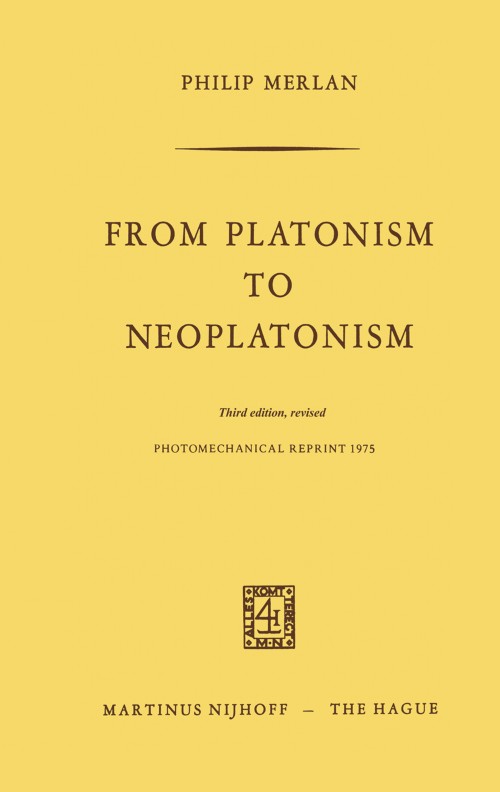
245 10|aFrom Platonism to Neoplatonism|h[electronic resource] :|bThird Edition Revised /|cby Fr. Merlan.
250 |a1st ed. 1975.
264 1|aDordrecht :|bSpringer Netherlands :|bImprint: Springer,|c1975.
300 |aXIX, 250 p.|bonline resource.
336 |atext|btxt|2rdacontent
337 |acomputer|bc|2rdamedia
338 |aonline resource|bcr|2rdacarrier
347 |atext file|bPDF|2rda
505 0 |aI. Soul and Mathematicals -- II. Posidonius and Neoplatonism -- III. The Subdivisions of Theoretical Philosophy -- IV. The Origin of the Quadrivium -- V. Speusippus in Iamblichus -- VI. A New Fragment of Aristotle -- VII. Metaphysica Generalis in Aristotle? -- Conclusion -- Index of Names -- Index of Passages in Greek and Latin Authors.
520 |aThe first edition of this book appeared in 1953; the second, revised and enlarged, in 1960. The present, third edition is essentially a reprint of the second, except for the correction of a few misprints and the following remarks, which refer to some recent publications* and replace the brief preface to the second edition. Neither Eudemus nor Theophrastus, so I said (p. 208£. ) knew a branch of theoretical philosophy the object of which would be something called 0'. 1 ~ 0'. 1 andwhich branch wouldbedistinct from theology. And there is no sign that they found such a branch (corresponding to what was later called metaphysica generalis) in Aristotle. To the names of Eudemus and Theophrastus we now can add that of Nicholas of Damascus. In 1965 H. J. Drossaart Lulofs published: Nicolaus Damascenus On the Philosophy of Aristotle (Leiden: Brill), Le. fragments of his m:pr. njc; 'ApLO''t'o't'&AOUC; qJLAOO'OqJLiXC; preserved in Syriac together with an English trans lation. In these fragments we find a competent presentation of Aristotle's theoretical philosophy, in systematic form. Nicholas subdivides Aristotle's theoretical philosophy into theology, physics, and mathematics and seems to be completely unaware of any additional branch of philosophy the object of which would be 0'. 1 ~ 0'. 1 distinct from theology with its object (the divine).
532 8 |aAccessibility summary: This PDF is not accessible. It is based on scanned pages and does not support features such as screen reader compatibility or described non-text content (images, graphs etc). However, it likely supports searchable and selectable text based on OCR (Optical Character Recognition). Users with accessibility needs may not be able to use this content effectively. Please contact us at accessibilitysupport@springernature.com if you require assistance or an alternative format.
532 8 |aInaccessible, or known limited accessibility
532 8 |aNo reading system accessibility options actively disabled
532 8 |aPublisher contact for further accessibility information: accessibilitysupport@springernature.com
650 0|aPhilosophy, Ancient.
650 0|aHistory.
650 14|aAncient Philosophy / Classical Philosophy.
650 24|aHistory.
710 2 |aSpringerLink (Online service)
773 0 |tSpringer Nature eBook
776 08|iPrinted edition:|z9789024701070
776 08|iPrinted edition:|z9789401015936
856 40|uhttps://doi.org/10.1007/978-94-010-1592-9
912 |aZDB-2-SHU
912 |aZDB-2-SXPR
912 |aZDB-2-BAE
950 |aHumanities, Social Sciences and Law (SpringerNature-11648)
950 |aPhilosophy and Religion (R0) (SpringerNature-43725)