LEADER 04423nam a22005535i 4500
001 811528
003 TR_AnAIT
005 20260131005514
007 cr nn 008mamaa
008 121227s1989 ne | s |||| 0|eng d
020 |a9789400925564|9978-94-009-2556-4
024 7 |a10.1007/978-94-009-2556-4|2doi
041 |aeng
049 |aTürk Tarih Kurumu Kütüphanesi
050 4|aQ174-175.3
050 4|aB67
072 7|aPDA|2bicssc
072 7|aSCI075000|2bisacsh
072 7|aPDA|2thema
082 04|a501|223
090 |aDK/12787
100 1 |aGavroglu, K.|eauthor.|4aut|4http://id.loc.gov/vocabulary/relators/aut
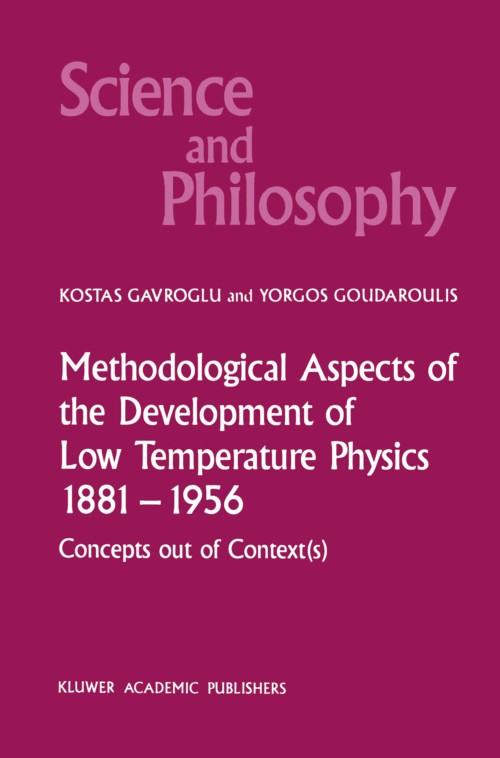
245 10|aMethodological Aspects of the Development of Low Temperature Physics 1881–1956|h[electronic resource] :|bConcepts Out of Context(s) /|cby K. Gavroglu, Yorgos Goudaroulis.
250 |a1st ed. 1989.
264 1|aDordrecht :|bSpringer Netherlands :|bImprint: Springer,|c1989.
300 |aXIV, 178 p.|bonline resource.
336 |atext|btxt|2rdacontent
337 |acomputer|bc|2rdamedia
338 |aonline resource|bcr|2rdacarrier
347 |atext file|bPDF|2rda
490 1 |aScience and Philosophy ;|v4
505 0 |aI: The how -- 1: “Translating” unexpected phenomena into the right physical problems -- II: The what -- 2: Early research at Leiden and some of its methodological implications -- 3: Superconductivity: the paradox that was not -- 4: Superfluidity: old concepts in search of new contexts -- III: The therefore -- 5: (Re-)reading the developments -- Notes.
520 |aThis book is primarily about the methodological questions involved in attempts to understand two of the most peculiar phenomena in physics, both occurring at the lowest of temperatures. Superconductivity (the disappearance of electrical resistance) and superfluidity (the total absence of viscosity in liquid helium) are not merely peculiar in their own right. Being the only macroscopic quantum phenomena they also manifest a sudden and dramatic change even in those properties which have been amply used within the classical framework and which were thought to be fully understood after the advent of quantum theory. A few years ago we set ourselves the task of carrying out a methodological study of the "most peculiar" phenomena in physics and trying to understand the process by which an observed (rather than predicted) new phenomenon gets "translated" into a physical problem. We thought the best way of deciding which phenomena to choose was to rely on our intuitive notion about the "degrees of peculiarity" developed, no doubt, during the past ten years of active research in theoretical atomic and elementary particle physics. While the merits of the different candidates were compared, we were amazed to realize that neither the phenomena of the very small nor those of the very large could compete with the phenomena of the very cold. These were truly remarkable phenomena if for no other reason than for the difficulties encountered in merely describing them.
532 8 |aAccessibility summary: This PDF is not accessible. It is based on scanned pages and does not support features such as screen reader compatibility or described non-text content (images, graphs etc). However, it likely supports searchable and selectable text based on OCR (Optical Character Recognition). Users with accessibility needs may not be able to use this content effectively. Please contact us at accessibilitysupport@springernature.com if you require assistance or an alternative format.
532 8 |aInaccessible, or known limited accessibility
532 8 |aNo reading system accessibility options actively disabled
532 8 |aPublisher contact for further accessibility information: accessibilitysupport@springernature.com
650 0|aScience|xPhilosophy.
650 14|aPhilosophy of Science.
700 1 |aGoudaroulis, Yorgos.|eauthor.|4aut|4http://id.loc.gov/vocabulary/relators/aut
710 2 |aSpringerLink (Online service)
773 0 |tSpringer Nature eBook
776 08|iPrinted edition:|z9789024736997
776 08|iPrinted edition:|z9789400925571
776 08|iPrinted edition:|z9789401076555
830 0|aScience and Philosophy ;|v4
856 40|uhttps://doi.org/10.1007/978-94-009-2556-4
912 |aZDB-2-SHU
912 |aZDB-2-SXPR
912 |aZDB-2-BAE
950 |aHumanities, Social Sciences and Law (SpringerNature-11648)
950 |aPhilosophy and Religion (R0) (SpringerNature-43725)