

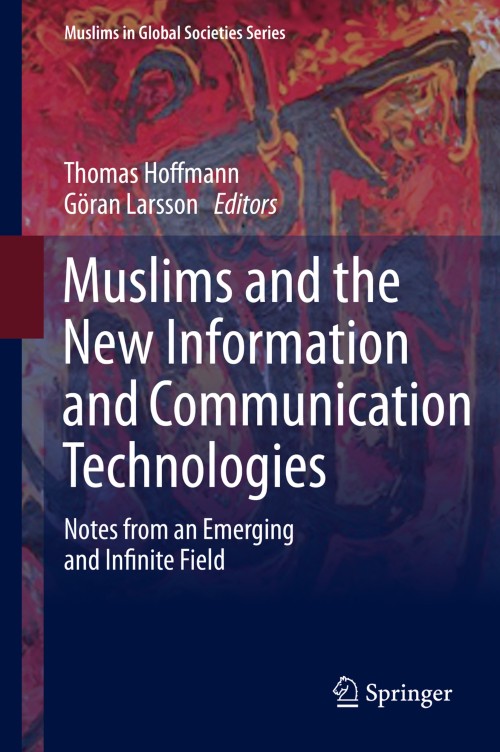
Muslims and the New Information and Communication Technologies [electronic resource] : Notes from an Emerging and Infinite Field / edited by Thomas Hoffmann, Göran Larsson.
Erişim Adresi
ISBN
9789400772472
Dil Kodu
İngilizce
Yer Numarası
DK/12793
Basım Bildirimi
1st ed. 2013.
Yayın Bilgisi
Dordrecht : Springer Netherlands : Imprint: Springer, 2013.
Fiziksel Niteleme
VI, 189 p. online resource.
Dizi
Muslims in Global Societies Series, 2543-053X ; 7
İçindekiler Notu
Muslims and the New Information and Communication Technologies: notes from an emerging and infinite field, T. Hoffman, G. Larsson -- “Little Mosque on the Prairie” and Modern Convivencia: An Intervention in to Canadian Muslim Identities, F. V. Greifenhagen -- Islam Online Guides Spouses towards Marital Bliss: Arabic Vs. English Counselling Perspectives on Marital Communication, M. Abdel-Fadil -- Muslims on StudiVZ.de: An empirical Perspective on Religious Affiliation and National Belonging in Times of Web 2.0, D. Schlicht -- A “virtual club” of Lithuanian converts to Islam, E. Račius -- Pop culture and class distinction in Lebanon, S. Haugbolle -- ITZ BIDAH BRO!!!!! GT ME?? - YouTube Mawlid and voices of praise and blame, J. Svensson -- Friend or Foe? Contemporary debates on Islam and Muslim immigrants among Swedish identitarians, N. Bernsand -- Geert Wilders and the anti-Muslim movie Fitna*, G. Larsson.
Özet, vb.
This volume deals with the so-called new Information and Communication Technologies (ICT) and their interrelationship with Muslims and the interpretation of Islam. This volume taps into what has been labelled Media Studies 2.0, which has been characterized by an intensified focus on everyday meanings and ‘lay’ users – in contrast to earlier emphases on experts or self-acclaimed experts. This lay adoption of ICT and the subsequent digital ‘literacy’ is not least noticeable among Muslim communities. According to some global estimates, one in ten internet users is a Muslim. This volume offers an ethnography of ICT in Muslim communities. The contributors to this volume also demonstrate a new kind of moderation with regard to more sweeping and avant-gardistic claims, which have characterized the study of ICT previously. This moderation has been combined with a keen attention to the empirical material but also deliberations on new quantitative and qualitative approaches to ICT, Muslims and Islam, for instance the digital challenges and changes wrought on the Qur’an, Islam’s sacred scripture. As such this volume will also be relevant for people interested in the study of ICT and the blooming field of digital humanities. Scholars of Islam and the Islamic world have always be engaged and entangled in their object of study. The developments within ICT have also affected how scholars take part in and influence public Islamic and academic discussions. This complicated issue provides basis for a number of meta-reflexive studies in this volume. It will be essential for students and scholars within Islamic studies but will also be of interest for anthropologists, sociologists and others with a humanistic interest in ICT, religion and Islam.
Konu
Religion.
Anthropology.
Computers and civilization.
Religion.
Anthropology.
Computers and Society.
Anthropology.
Computers and civilization.
Religion.
Anthropology.
Computers and Society.
Diğer Yazarlar
Kurum Adı
Eseri Alıntıla
Referansları kullanmadan önce gözden geçirmeniz ve varsa gerekli düzeltmeleri yapmanız önerilir.
Dijital Kaynak
MARC Görünümü
LEADER 04645nam a22005295i 4500
001 811534
003 TR_AnAIT
005 20260131005504
007 cr nn 008mamaa
008 140110s2013 ne | s |||| 0|eng d
020 |a9789400772472|9978-94-007-7247-2
024 7 |a10.1007/978-94-007-7247-2|2doi
041 |aeng
049 |aTürk Tarih Kurumu Kütüphanesi
050 4|aBL
072 7|aHRA|2bicssc
072 7|aREL000000|2bisacsh
072 7|aQRA|2thema
082 04|a200|223
090 |aDK/12793
245 10|aMuslims and the New Information and Communication Technologies|h[electronic resource] :|bNotes from an Emerging and Infinite Field /|cedited by Thomas Hoffmann, Göran Larsson.
250 |a1st ed. 2013.
264 1|aDordrecht :|bSpringer Netherlands :|bImprint: Springer,|c2013.
300 |aVI, 189 p.|bonline resource.
336 |atext|btxt|2rdacontent
337 |acomputer|bc|2rdamedia
338 |aonline resource|bcr|2rdacarrier
347 |atext file|bPDF|2rda
490 1 |aMuslims in Global Societies Series,|x2543-053X ;|v7
505 0 |aMuslims and the New Information and Communication Technologies: notes from an emerging and infinite field, T. Hoffman, G. Larsson -- “Little Mosque on the Prairie” and Modern Convivencia: An Intervention in to Canadian Muslim Identities, F. V. Greifenhagen -- Islam Online Guides Spouses towards Marital Bliss: Arabic Vs. English Counselling Perspectives on Marital Communication, M. Abdel-Fadil -- Muslims on StudiVZ.de: An empirical Perspective on Religious Affiliation and National Belonging in Times of Web 2.0, D. Schlicht -- A “virtual club” of Lithuanian converts to Islam, E. Račius -- Pop culture and class distinction in Lebanon, S. Haugbolle -- ITZ BIDAH BRO!!!!! GT ME?? - YouTube Mawlid and voices of praise and blame, J. Svensson -- Friend or Foe? Contemporary debates on Islam and Muslim immigrants among Swedish identitarians, N. Bernsand -- Geert Wilders and the anti-Muslim movie Fitna*, G. Larsson.
520 |aThis volume deals with the so-called new Information and Communication Technologies (ICT) and their interrelationship with Muslims and the interpretation of Islam. This volume taps into what has been labelled Media Studies 2.0, which has been characterized by an intensified focus on everyday meanings and ‘lay’ users – in contrast to earlier emphases on experts or self-acclaimed experts. This lay adoption of ICT and the subsequent digital ‘literacy’ is not least noticeable among Muslim communities. According to some global estimates, one in ten internet users is a Muslim. This volume offers an ethnography of ICT in Muslim communities. The contributors to this volume also demonstrate a new kind of moderation with regard to more sweeping and avant-gardistic claims, which have characterized the study of ICT previously. This moderation has been combined with a keen attention to the empirical material but also deliberations on new quantitative and qualitative approaches to ICT, Muslims and Islam, for instance the digital challenges and changes wrought on the Qur’an, Islam’s sacred scripture. As such this volume will also be relevant for people interested in the study of ICT and the blooming field of digital humanities. Scholars of Islam and the Islamic world have always be engaged and entangled in their object of study. The developments within ICT have also affected how scholars take part in and influence public Islamic and academic discussions. This complicated issue provides basis for a number of meta-reflexive studies in this volume. It will be essential for students and scholars within Islamic studies but will also be of interest for anthropologists, sociologists and others with a humanistic interest in ICT, religion and Islam.
650 0|aReligion.
650 0|aAnthropology.
650 0|aComputers and civilization.
650 14|aReligion.
650 24|aAnthropology.
650 24|aComputers and Society.
700 1 |aHoffmann, Thomas.|eeditor.|4edt|4http://id.loc.gov/vocabulary/relators/edt
700 1 |aLarsson, Göran.|eeditor.|4edt|4http://id.loc.gov/vocabulary/relators/edt
710 2 |aSpringerLink (Online service)
773 0 |tSpringer Nature eBook
776 08|iPrinted edition:|z9789400772465
776 08|iPrinted edition:|z9789400772489
776 08|iPrinted edition:|z9789402402315
830 0|aMuslims in Global Societies Series,|x2543-053X ;|v7
856 40|uhttps://doi.org/10.1007/978-94-007-7247-2
912 |aZDB-2-SHU
912 |aZDB-2-SXPR
950 |aHumanities, Social Sciences and Law (SpringerNature-11648)
950 |aPhilosophy and Religion (R0) (SpringerNature-43725)
001 811534
003 TR_AnAIT
005 20260131005504
007 cr nn 008mamaa
008 140110s2013 ne | s |||| 0|eng d
020 |a9789400772472|9978-94-007-7247-2
024 7 |a10.1007/978-94-007-7247-2|2doi
041 |aeng
049 |aTürk Tarih Kurumu Kütüphanesi
050 4|aBL
072 7|aHRA|2bicssc
072 7|aREL000000|2bisacsh
072 7|aQRA|2thema
082 04|a200|223
090 |aDK/12793
245 10|aMuslims and the New Information and Communication Technologies|h[electronic resource] :|bNotes from an Emerging and Infinite Field /|cedited by Thomas Hoffmann, Göran Larsson.
250 |a1st ed. 2013.
264 1|aDordrecht :|bSpringer Netherlands :|bImprint: Springer,|c2013.
300 |aVI, 189 p.|bonline resource.
336 |atext|btxt|2rdacontent
337 |acomputer|bc|2rdamedia
338 |aonline resource|bcr|2rdacarrier
347 |atext file|bPDF|2rda
490 1 |aMuslims in Global Societies Series,|x2543-053X ;|v7
505 0 |aMuslims and the New Information and Communication Technologies: notes from an emerging and infinite field, T. Hoffman, G. Larsson -- “Little Mosque on the Prairie” and Modern Convivencia: An Intervention in to Canadian Muslim Identities, F. V. Greifenhagen -- Islam Online Guides Spouses towards Marital Bliss: Arabic Vs. English Counselling Perspectives on Marital Communication, M. Abdel-Fadil -- Muslims on StudiVZ.de: An empirical Perspective on Religious Affiliation and National Belonging in Times of Web 2.0, D. Schlicht -- A “virtual club” of Lithuanian converts to Islam, E. Račius -- Pop culture and class distinction in Lebanon, S. Haugbolle -- ITZ BIDAH BRO!!!!! GT ME?? - YouTube Mawlid and voices of praise and blame, J. Svensson -- Friend or Foe? Contemporary debates on Islam and Muslim immigrants among Swedish identitarians, N. Bernsand -- Geert Wilders and the anti-Muslim movie Fitna*, G. Larsson.
520 |aThis volume deals with the so-called new Information and Communication Technologies (ICT) and their interrelationship with Muslims and the interpretation of Islam. This volume taps into what has been labelled Media Studies 2.0, which has been characterized by an intensified focus on everyday meanings and ‘lay’ users – in contrast to earlier emphases on experts or self-acclaimed experts. This lay adoption of ICT and the subsequent digital ‘literacy’ is not least noticeable among Muslim communities. According to some global estimates, one in ten internet users is a Muslim. This volume offers an ethnography of ICT in Muslim communities. The contributors to this volume also demonstrate a new kind of moderation with regard to more sweeping and avant-gardistic claims, which have characterized the study of ICT previously. This moderation has been combined with a keen attention to the empirical material but also deliberations on new quantitative and qualitative approaches to ICT, Muslims and Islam, for instance the digital challenges and changes wrought on the Qur’an, Islam’s sacred scripture. As such this volume will also be relevant for people interested in the study of ICT and the blooming field of digital humanities. Scholars of Islam and the Islamic world have always be engaged and entangled in their object of study. The developments within ICT have also affected how scholars take part in and influence public Islamic and academic discussions. This complicated issue provides basis for a number of meta-reflexive studies in this volume. It will be essential for students and scholars within Islamic studies but will also be of interest for anthropologists, sociologists and others with a humanistic interest in ICT, religion and Islam.
650 0|aReligion.
650 0|aAnthropology.
650 0|aComputers and civilization.
650 14|aReligion.
650 24|aAnthropology.
650 24|aComputers and Society.
700 1 |aHoffmann, Thomas.|eeditor.|4edt|4http://id.loc.gov/vocabulary/relators/edt
700 1 |aLarsson, Göran.|eeditor.|4edt|4http://id.loc.gov/vocabulary/relators/edt
710 2 |aSpringerLink (Online service)
773 0 |tSpringer Nature eBook
776 08|iPrinted edition:|z9789400772465
776 08|iPrinted edition:|z9789400772489
776 08|iPrinted edition:|z9789402402315
830 0|aMuslims in Global Societies Series,|x2543-053X ;|v7
856 40|uhttps://doi.org/10.1007/978-94-007-7247-2
912 |aZDB-2-SHU
912 |aZDB-2-SXPR
950 |aHumanities, Social Sciences and Law (SpringerNature-11648)
950 |aPhilosophy and Religion (R0) (SpringerNature-43725)
Materyaller
Depodan talep edilen materyal sadece kütüphane içerisinde kullanılmaktadır.
Materyal dışarıya ödünç verilmemektedir.
Materyal dışarıya ödünç verilmemektedir.
