

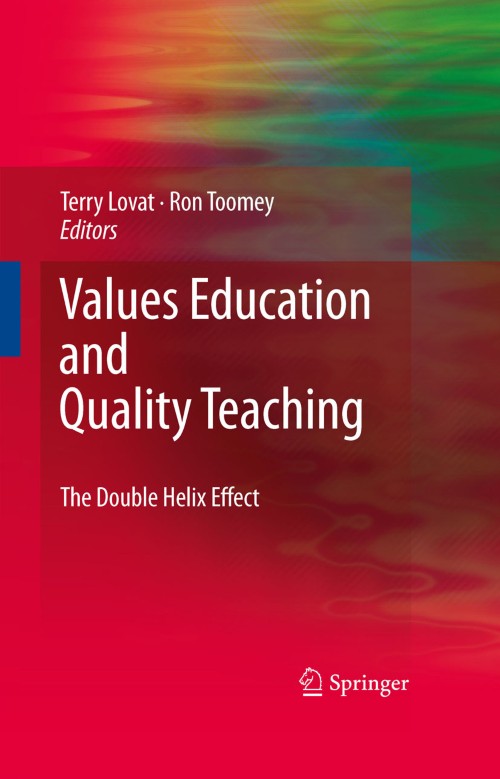
Values Education and Quality Teaching [electronic resource] : The Double Helix Effect / edited by Terence Lovat, Ron Toomey.
Erişim Adresi
ISBN
9781402099625
Dil Kodu
İngilizce
Yer Numarası
DK/12833
Basım Bildirimi
1st ed. 2009.
Yayın Bilgisi
Dordrecht : Springer Netherlands : Imprint: Springer, 2009.
Fiziksel Niteleme
XVIII, 172 p. online resource.
İçindekiler Notu
Values Education and Quality Teaching: Two Sides of the Learning Coin -- Perspectives from Research and Practice in Values Education -- Student Action Teams, Values Education and Quality Teaching and Learning—Case Study from the Manningham Cluster, Victoria -- Placing Values at the Centre of School Policy and Classroom Practice—A Case Study of Modbury School, South Australia -- Moving Values Beyond the Half Hour: Peer Leadership and School Vision—A Case Study of the Townsville Cluster, Queensland -- Valuing Diversity in Children’s Voice: A Case Study of Children, Stewardship and Mapping the Care of Special Places in the Western Australian Cluster -- Values and Quality Teaching at West Kidlington Primary School -- A Perfect Match: Living Values Educational Program and Aventura City of Excellence School, USA -- The Double Helix and Its Implications for the Professional Lifelong Learning of Teachers.
Özet, vb.
Values Education and Quality Teaching: The Double Helix Effect reports on the results of two of the major projects in the Australian Government’s Values Education Program. These results point to the fact that Values Education can no longer be seen as marginal to the main role of teaching and schooling nor as a venture merely for religious schooling. In contrast, the results show that Values Education sits at the centre of teaching and schooling wherever it occurs. The importance of Values Education is in its potential to re-focus teachers and schools on their essential purpose, namely the holistic betterment of the students in their care. The focus of Values Education coincides with the results of research into student achievement that illustrate the vital role played by relationships of care, trust and respect with teachers if students are to ‘do well’ both academically and more broadly. It picks up on a feature of Quality Teaching research concerned with the creation of the positive and supportive learning ambience. It is a feature that can be overlooked in the concern for technique and craft . Yet research tells us that it is this ambience, and especially the positive relationships that are part and parcel of it, that is one of the essential ingredients in student achievement. Furthermore, research tells us that student achievement is more assured when those values of care, respect and trust that underpin the learning relationship are made explicit in all aspects of teaching and schooling, including in the curriculum. In this sense, Values Education might be described as the ‘other side of the coin’ to Quality Teaching, as its sometimes ‘missing link’or, to borrow from the research fi eld of Genetics, as co-existing with Quality Teaching in a ‘double helix’ relationship. It is this latter description that the authors have chosen as most appropriately describing the results of the studies on which the book reports.
Konu
Learning, Psychology of.
Educational psychology.
Teachers __ Training of.
Educational sociology.
Instructional Psychology.
Educational Psychology.
Teaching and Teacher Education.
Sociology of Education.
Educational psychology.
Teachers __ Training of.
Educational sociology.
Instructional Psychology.
Educational Psychology.
Teaching and Teacher Education.
Sociology of Education.
Diğer Yazarlar
Kurum Adı
Eseri Alıntıla
Referansları kullanmadan önce gözden geçirmeniz ve varsa gerekli düzeltmeleri yapmanız önerilir.
Dijital Kaynak
MARC Görünümü
LEADER 04780nam a22005295i 4500
001 811574
003 TR_AnAIT
005 20260131005235
007 cr nn 008mamaa
008 100301s2009 ne | s |||| 0|eng d
020 |a9781402099625|9978-1-4020-9962-5
024 7 |a10.1007/978-1-4020-9962-5|2doi
041 |aeng
049 |aTürk Tarih Kurumu Kütüphanesi
050 4|aLB1060-1077
072 7|aJNC|2bicssc
072 7|aEDU009000|2bisacsh
072 7|aJNC|2thema
082 04|a370.15|223
090 |aDK/12833
245 10|aValues Education and Quality Teaching|h[electronic resource] :|bThe Double Helix Effect /|cedited by Terence Lovat, Ron Toomey.
250 |a1st ed. 2009.
264 1|aDordrecht :|bSpringer Netherlands :|bImprint: Springer,|c2009.
300 |aXVIII, 172 p.|bonline resource.
336 |atext|btxt|2rdacontent
337 |acomputer|bc|2rdamedia
338 |aonline resource|bcr|2rdacarrier
347 |atext file|bPDF|2rda
505 0 |aValues Education and Quality Teaching: Two Sides of the Learning Coin -- Perspectives from Research and Practice in Values Education -- Student Action Teams, Values Education and Quality Teaching and Learning—Case Study from the Manningham Cluster, Victoria -- Placing Values at the Centre of School Policy and Classroom Practice—A Case Study of Modbury School, South Australia -- Moving Values Beyond the Half Hour: Peer Leadership and School Vision—A Case Study of the Townsville Cluster, Queensland -- Valuing Diversity in Children’s Voice: A Case Study of Children, Stewardship and Mapping the Care of Special Places in the Western Australian Cluster -- Values and Quality Teaching at West Kidlington Primary School -- A Perfect Match: Living Values Educational Program and Aventura City of Excellence School, USA -- The Double Helix and Its Implications for the Professional Lifelong Learning of Teachers.
520 |aValues Education and Quality Teaching: The Double Helix Effect reports on the results of two of the major projects in the Australian Government’s Values Education Program. These results point to the fact that Values Education can no longer be seen as marginal to the main role of teaching and schooling nor as a venture merely for religious schooling. In contrast, the results show that Values Education sits at the centre of teaching and schooling wherever it occurs. The importance of Values Education is in its potential to re-focus teachers and schools on their essential purpose, namely the holistic betterment of the students in their care. The focus of Values Education coincides with the results of research into student achievement that illustrate the vital role played by relationships of care, trust and respect with teachers if students are to ‘do well’ both academically and more broadly. It picks up on a feature of Quality Teaching research concerned with the creation of the positive and supportive learning ambience. It is a feature that can be overlooked in the concern for technique and craft . Yet research tells us that it is this ambience, and especially the positive relationships that are part and parcel of it, that is one of the essential ingredients in student achievement. Furthermore, research tells us that student achievement is more assured when those values of care, respect and trust that underpin the learning relationship are made explicit in all aspects of teaching and schooling, including in the curriculum. In this sense, Values Education might be described as the ‘other side of the coin’ to Quality Teaching, as its sometimes ‘missing link’or, to borrow from the research fi eld of Genetics, as co-existing with Quality Teaching in a ‘double helix’ relationship. It is this latter description that the authors have chosen as most appropriately describing the results of the studies on which the book reports.
650 0|aLearning, Psychology of.
650 0|aEducational psychology.
650 0|aTeachers|xTraining of.
650 0|aEducational sociology.
650 14|aInstructional Psychology.
650 24|aEducational Psychology.
650 24|aTeaching and Teacher Education.
650 24|aSociology of Education.
700 1 |aLovat, Terence.|eeditor.|4edt|4http://id.loc.gov/vocabulary/relators/edt
700 1 |aToomey, Ron.|eeditor.|4edt|4http://id.loc.gov/vocabulary/relators/edt
710 2 |aSpringerLink (Online service)
773 0 |tSpringer Nature eBook
776 08|iPrinted edition:|z9781402099618
776 08|iPrinted edition:|z9789048127085
776 08|iPrinted edition:|z9789048182305
856 40|uhttps://doi.org/10.1007/978-1-4020-9962-5
912 |aZDB-2-SHU
912 |aZDB-2-SXED
950 |aHumanities, Social Sciences and Law (SpringerNature-11648)
950 |aEducation (R0) (SpringerNature-43721)
001 811574
003 TR_AnAIT
005 20260131005235
007 cr nn 008mamaa
008 100301s2009 ne | s |||| 0|eng d
020 |a9781402099625|9978-1-4020-9962-5
024 7 |a10.1007/978-1-4020-9962-5|2doi
041 |aeng
049 |aTürk Tarih Kurumu Kütüphanesi
050 4|aLB1060-1077
072 7|aJNC|2bicssc
072 7|aEDU009000|2bisacsh
072 7|aJNC|2thema
082 04|a370.15|223
090 |aDK/12833
245 10|aValues Education and Quality Teaching|h[electronic resource] :|bThe Double Helix Effect /|cedited by Terence Lovat, Ron Toomey.
250 |a1st ed. 2009.
264 1|aDordrecht :|bSpringer Netherlands :|bImprint: Springer,|c2009.
300 |aXVIII, 172 p.|bonline resource.
336 |atext|btxt|2rdacontent
337 |acomputer|bc|2rdamedia
338 |aonline resource|bcr|2rdacarrier
347 |atext file|bPDF|2rda
505 0 |aValues Education and Quality Teaching: Two Sides of the Learning Coin -- Perspectives from Research and Practice in Values Education -- Student Action Teams, Values Education and Quality Teaching and Learning—Case Study from the Manningham Cluster, Victoria -- Placing Values at the Centre of School Policy and Classroom Practice—A Case Study of Modbury School, South Australia -- Moving Values Beyond the Half Hour: Peer Leadership and School Vision—A Case Study of the Townsville Cluster, Queensland -- Valuing Diversity in Children’s Voice: A Case Study of Children, Stewardship and Mapping the Care of Special Places in the Western Australian Cluster -- Values and Quality Teaching at West Kidlington Primary School -- A Perfect Match: Living Values Educational Program and Aventura City of Excellence School, USA -- The Double Helix and Its Implications for the Professional Lifelong Learning of Teachers.
520 |aValues Education and Quality Teaching: The Double Helix Effect reports on the results of two of the major projects in the Australian Government’s Values Education Program. These results point to the fact that Values Education can no longer be seen as marginal to the main role of teaching and schooling nor as a venture merely for religious schooling. In contrast, the results show that Values Education sits at the centre of teaching and schooling wherever it occurs. The importance of Values Education is in its potential to re-focus teachers and schools on their essential purpose, namely the holistic betterment of the students in their care. The focus of Values Education coincides with the results of research into student achievement that illustrate the vital role played by relationships of care, trust and respect with teachers if students are to ‘do well’ both academically and more broadly. It picks up on a feature of Quality Teaching research concerned with the creation of the positive and supportive learning ambience. It is a feature that can be overlooked in the concern for technique and craft . Yet research tells us that it is this ambience, and especially the positive relationships that are part and parcel of it, that is one of the essential ingredients in student achievement. Furthermore, research tells us that student achievement is more assured when those values of care, respect and trust that underpin the learning relationship are made explicit in all aspects of teaching and schooling, including in the curriculum. In this sense, Values Education might be described as the ‘other side of the coin’ to Quality Teaching, as its sometimes ‘missing link’or, to borrow from the research fi eld of Genetics, as co-existing with Quality Teaching in a ‘double helix’ relationship. It is this latter description that the authors have chosen as most appropriately describing the results of the studies on which the book reports.
650 0|aLearning, Psychology of.
650 0|aEducational psychology.
650 0|aTeachers|xTraining of.
650 0|aEducational sociology.
650 14|aInstructional Psychology.
650 24|aEducational Psychology.
650 24|aTeaching and Teacher Education.
650 24|aSociology of Education.
700 1 |aLovat, Terence.|eeditor.|4edt|4http://id.loc.gov/vocabulary/relators/edt
700 1 |aToomey, Ron.|eeditor.|4edt|4http://id.loc.gov/vocabulary/relators/edt
710 2 |aSpringerLink (Online service)
773 0 |tSpringer Nature eBook
776 08|iPrinted edition:|z9781402099618
776 08|iPrinted edition:|z9789048127085
776 08|iPrinted edition:|z9789048182305
856 40|uhttps://doi.org/10.1007/978-1-4020-9962-5
912 |aZDB-2-SHU
912 |aZDB-2-SXED
950 |aHumanities, Social Sciences and Law (SpringerNature-11648)
950 |aEducation (R0) (SpringerNature-43721)
Materyaller
Depodan talep edilen materyal sadece kütüphane içerisinde kullanılmaktadır.
Materyal dışarıya ödünç verilmemektedir.
Materyal dışarıya ödünç verilmemektedir.
