

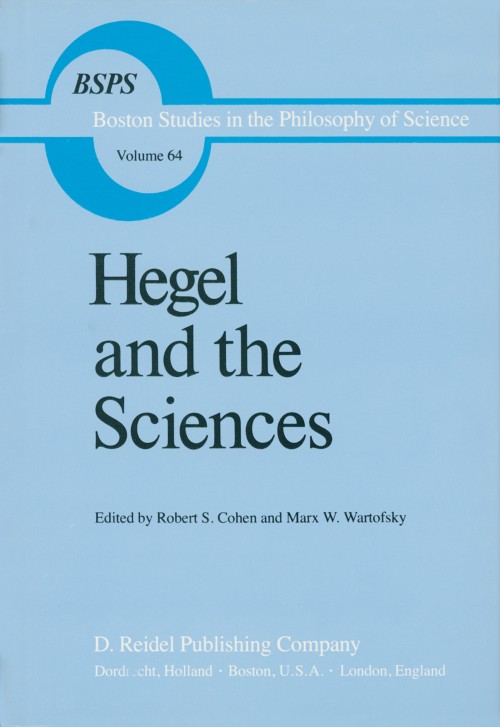
Hegel and the Sciences [electronic resource] / edited by Robert S. Cohen, Marx W. Wartofsky.
Erişim Adresi
ISBN
9789400962330
Dil Kodu
İngilizce
Yer Numarası
DK/12908
Basım Bildirimi
1st ed. 1984.
Yayın Bilgisi
Dordrecht : Springer Netherlands : Imprint: Springer, 1984.
Fiziksel Niteleme
IX, 374 p. online resource.
Dizi
Boston Studies in the Philosophy and History of Science, 2214-7942 ; 64
İçindekiler Notu
Introductory Remarks to the Symposium on Hegel and the Sciences -- The Scholar, the Liberal Ideal, and the Philosophy of Science -- I. The Sciences -- Conceptual Analysis and Scientific Theory in Hegel’s Philosophy of Nature (with Special Reference to Hegel’s Optics) -- A Comment on Buchdahl’s Paper -- The Chemical System of Substances, Forces and Processes in Hegel’s Philosophy of Nature and the Science of His Time -- Hegel and the Celestial Mechanics of Newton and Einstein -- The Hegelian Treatment of Biology and Life -- More Comments on the Place of the Organic in Hegel’s Philosophy of Nature -- Hegel and the Organic View of Nature -- Hegel’s Philosophical Understanding of Illness -- On Hegel’s Significance for the Social Sciences -- Hegel’s Conception of Psychology -- II. Philosophy and Methodology of Science -- The Dialectical Structure of Scientific Thinking -- Is the Progress of Science Dialectical? -- Some ‘Moments’ of Hegel’s Relation to the Sciences -- Hegel’s ‘Deduction of the Concept of Science’ -- Theory and Praxis and the Beginning of Science -- The First American Interpretation of Hegel in J. B. Stallo’s Philosophy of Science -- III. Dialectics and Logic -- Hegel’s Logic from a Logical Point of View -- The Dynamics of Hegelian Dialectics, and Non-Linearity in the Sciences -- Mathematical Dialectics, Scientific Logic and the Psychoanalysis of Thinking [Comment on Kosok and Gauthier] -- Comments on Kosok’s Interpretation of Hegel’s Logic -- Bibliographical Note -- Index of Names.
Özet, vb.
To the scientists and philosophers of our time, Hegel has been either a ne glected or a provocative thinker, a source of irrelevant dark metaphysics or of complex but insightful analysis. His influence upon the work of natural scientists has seemed minimal, in the main; and his stimulus to the nascent sciences of society and to psychology has seemed to be as often an obstacle as an encouragement. Nevertheless his philosophical analysis of knowledge and the knowing process, of concepts and their evolutionary formation, of rationality in its forms and histories, of the stages of empirical awareness and human practice, all set within his endless inquiries into cultural formations from the entire sweep of human experience, must, we believe, be confronted by anyone who wants to understand the scientific consciousness. Indeed, we may wish to situate the changing theories of nature, and of humankind in nature, within a philosophical account of men and women as social practi tioners and as sensing, thinking, feeling centers of privacy; and then we will see the work of Hegel as a major effort to mediate between the purest of epistemological investigations and the most practical of the political and the religious. This book, long delayed to our deep regret, derives from a Symposium on Hegel and the Sciences which was sponsored jointly by the Hegel Society of America and the Boston University Center for Philosophy and History of Science a decade ago.
Konu
Science __ Philosophy.
Knowledge, Theory of.
History.
Philosophy of Science.
Epistemology.
History.
Knowledge, Theory of.
History.
Philosophy of Science.
Epistemology.
History.
Diğer Yazarlar
Kurum Adı
Eseri Alıntıla
Referansları kullanmadan önce gözden geçirmeniz ve varsa gerekli düzeltmeleri yapmanız önerilir.
Dijital Kaynak
MARC Görünümü
LEADER 05746nam a22006015i 4500
001 811650
003 TR_AnAIT
005 20260131005014
007 cr nn 008mamaa
008 121227s1984 ne | s |||| 0|eng d
020 |a9789400962330|9978-94-009-6233-0
024 7 |a10.1007/978-94-009-6233-0|2doi
041 |aeng
049 |aTürk Tarih Kurumu Kütüphanesi
050 4|aQ174-175.3
050 4|aB67
072 7|aPDA|2bicssc
072 7|aSCI075000|2bisacsh
072 7|aPDA|2thema
082 04|a501|223
090 |aDK/12908
245 10|aHegel and the Sciences|h[electronic resource] /|cedited by Robert S. Cohen, Marx W. Wartofsky.
250 |a1st ed. 1984.
264 1|aDordrecht :|bSpringer Netherlands :|bImprint: Springer,|c1984.
300 |aIX, 374 p.|bonline resource.
336 |atext|btxt|2rdacontent
337 |acomputer|bc|2rdamedia
338 |aonline resource|bcr|2rdacarrier
347 |atext file|bPDF|2rda
490 1 |aBoston Studies in the Philosophy and History of Science,|x2214-7942 ;|v64
505 0 |aIntroductory Remarks to the Symposium on Hegel and the Sciences -- The Scholar, the Liberal Ideal, and the Philosophy of Science -- I. The Sciences -- Conceptual Analysis and Scientific Theory in Hegel’s Philosophy of Nature (with Special Reference to Hegel’s Optics) -- A Comment on Buchdahl’s Paper -- The Chemical System of Substances, Forces and Processes in Hegel’s Philosophy of Nature and the Science of His Time -- Hegel and the Celestial Mechanics of Newton and Einstein -- The Hegelian Treatment of Biology and Life -- More Comments on the Place of the Organic in Hegel’s Philosophy of Nature -- Hegel and the Organic View of Nature -- Hegel’s Philosophical Understanding of Illness -- On Hegel’s Significance for the Social Sciences -- Hegel’s Conception of Psychology -- II. Philosophy and Methodology of Science -- The Dialectical Structure of Scientific Thinking -- Is the Progress of Science Dialectical? -- Some ‘Moments’ of Hegel’s Relation to the Sciences -- Hegel’s ‘Deduction of the Concept of Science’ -- Theory and Praxis and the Beginning of Science -- The First American Interpretation of Hegel in J. B. Stallo’s Philosophy of Science -- III. Dialectics and Logic -- Hegel’s Logic from a Logical Point of View -- The Dynamics of Hegelian Dialectics, and Non-Linearity in the Sciences -- Mathematical Dialectics, Scientific Logic and the Psychoanalysis of Thinking [Comment on Kosok and Gauthier] -- Comments on Kosok’s Interpretation of Hegel’s Logic -- Bibliographical Note -- Index of Names.
520 |aTo the scientists and philosophers of our time, Hegel has been either a ne glected or a provocative thinker, a source of irrelevant dark metaphysics or of complex but insightful analysis. His influence upon the work of natural scientists has seemed minimal, in the main; and his stimulus to the nascent sciences of society and to psychology has seemed to be as often an obstacle as an encouragement. Nevertheless his philosophical analysis of knowledge and the knowing process, of concepts and their evolutionary formation, of rationality in its forms and histories, of the stages of empirical awareness and human practice, all set within his endless inquiries into cultural formations from the entire sweep of human experience, must, we believe, be confronted by anyone who wants to understand the scientific consciousness. Indeed, we may wish to situate the changing theories of nature, and of humankind in nature, within a philosophical account of men and women as social practi tioners and as sensing, thinking, feeling centers of privacy; and then we will see the work of Hegel as a major effort to mediate between the purest of epistemological investigations and the most practical of the political and the religious. This book, long delayed to our deep regret, derives from a Symposium on Hegel and the Sciences which was sponsored jointly by the Hegel Society of America and the Boston University Center for Philosophy and History of Science a decade ago.
532 8 |aAccessibility summary: This PDF is not accessible. It is based on scanned pages and does not support features such as screen reader compatibility or described non-text content (images, graphs etc). However, it likely supports searchable and selectable text based on OCR (Optical Character Recognition). Users with accessibility needs may not be able to use this content effectively. Please contact us at accessibilitysupport@springernature.com if you require assistance or an alternative format.
532 8 |aInaccessible, or known limited accessibility
532 8 |aNo reading system accessibility options actively disabled
532 8 |aPublisher contact for further accessibility information: accessibilitysupport@springernature.com
650 0|aScience|xPhilosophy.
650 0|aKnowledge, Theory of.
650 0|aHistory.
650 14|aPhilosophy of Science.
650 24|aEpistemology.
650 24|aHistory.
700 1 |aCohen, Robert S.|eeditor.|4edt|4http://id.loc.gov/vocabulary/relators/edt
700 1 |aWartofsky, Marx W.|eeditor.|4edt|4http://id.loc.gov/vocabulary/relators/edt
710 2 |aSpringerLink (Online service)
773 0 |tSpringer Nature eBook
776 08|iPrinted edition:|z9789027707260
776 08|iPrinted edition:|z9789400962347
776 08|iPrinted edition:|z9789400962354
830 0|aBoston Studies in the Philosophy and History of Science,|x2214-7942 ;|v64
856 40|uhttps://doi.org/10.1007/978-94-009-6233-0
912 |aZDB-2-SHU
912 |aZDB-2-SXPR
912 |aZDB-2-BAE
950 |aHumanities, Social Sciences and Law (SpringerNature-11648)
950 |aPhilosophy and Religion (R0) (SpringerNature-43725)
001 811650
003 TR_AnAIT
005 20260131005014
007 cr nn 008mamaa
008 121227s1984 ne | s |||| 0|eng d
020 |a9789400962330|9978-94-009-6233-0
024 7 |a10.1007/978-94-009-6233-0|2doi
041 |aeng
049 |aTürk Tarih Kurumu Kütüphanesi
050 4|aQ174-175.3
050 4|aB67
072 7|aPDA|2bicssc
072 7|aSCI075000|2bisacsh
072 7|aPDA|2thema
082 04|a501|223
090 |aDK/12908
245 10|aHegel and the Sciences|h[electronic resource] /|cedited by Robert S. Cohen, Marx W. Wartofsky.
250 |a1st ed. 1984.
264 1|aDordrecht :|bSpringer Netherlands :|bImprint: Springer,|c1984.
300 |aIX, 374 p.|bonline resource.
336 |atext|btxt|2rdacontent
337 |acomputer|bc|2rdamedia
338 |aonline resource|bcr|2rdacarrier
347 |atext file|bPDF|2rda
490 1 |aBoston Studies in the Philosophy and History of Science,|x2214-7942 ;|v64
505 0 |aIntroductory Remarks to the Symposium on Hegel and the Sciences -- The Scholar, the Liberal Ideal, and the Philosophy of Science -- I. The Sciences -- Conceptual Analysis and Scientific Theory in Hegel’s Philosophy of Nature (with Special Reference to Hegel’s Optics) -- A Comment on Buchdahl’s Paper -- The Chemical System of Substances, Forces and Processes in Hegel’s Philosophy of Nature and the Science of His Time -- Hegel and the Celestial Mechanics of Newton and Einstein -- The Hegelian Treatment of Biology and Life -- More Comments on the Place of the Organic in Hegel’s Philosophy of Nature -- Hegel and the Organic View of Nature -- Hegel’s Philosophical Understanding of Illness -- On Hegel’s Significance for the Social Sciences -- Hegel’s Conception of Psychology -- II. Philosophy and Methodology of Science -- The Dialectical Structure of Scientific Thinking -- Is the Progress of Science Dialectical? -- Some ‘Moments’ of Hegel’s Relation to the Sciences -- Hegel’s ‘Deduction of the Concept of Science’ -- Theory and Praxis and the Beginning of Science -- The First American Interpretation of Hegel in J. B. Stallo’s Philosophy of Science -- III. Dialectics and Logic -- Hegel’s Logic from a Logical Point of View -- The Dynamics of Hegelian Dialectics, and Non-Linearity in the Sciences -- Mathematical Dialectics, Scientific Logic and the Psychoanalysis of Thinking [Comment on Kosok and Gauthier] -- Comments on Kosok’s Interpretation of Hegel’s Logic -- Bibliographical Note -- Index of Names.
520 |aTo the scientists and philosophers of our time, Hegel has been either a ne glected or a provocative thinker, a source of irrelevant dark metaphysics or of complex but insightful analysis. His influence upon the work of natural scientists has seemed minimal, in the main; and his stimulus to the nascent sciences of society and to psychology has seemed to be as often an obstacle as an encouragement. Nevertheless his philosophical analysis of knowledge and the knowing process, of concepts and their evolutionary formation, of rationality in its forms and histories, of the stages of empirical awareness and human practice, all set within his endless inquiries into cultural formations from the entire sweep of human experience, must, we believe, be confronted by anyone who wants to understand the scientific consciousness. Indeed, we may wish to situate the changing theories of nature, and of humankind in nature, within a philosophical account of men and women as social practi tioners and as sensing, thinking, feeling centers of privacy; and then we will see the work of Hegel as a major effort to mediate between the purest of epistemological investigations and the most practical of the political and the religious. This book, long delayed to our deep regret, derives from a Symposium on Hegel and the Sciences which was sponsored jointly by the Hegel Society of America and the Boston University Center for Philosophy and History of Science a decade ago.
532 8 |aAccessibility summary: This PDF is not accessible. It is based on scanned pages and does not support features such as screen reader compatibility or described non-text content (images, graphs etc). However, it likely supports searchable and selectable text based on OCR (Optical Character Recognition). Users with accessibility needs may not be able to use this content effectively. Please contact us at accessibilitysupport@springernature.com if you require assistance or an alternative format.
532 8 |aInaccessible, or known limited accessibility
532 8 |aNo reading system accessibility options actively disabled
532 8 |aPublisher contact for further accessibility information: accessibilitysupport@springernature.com
650 0|aScience|xPhilosophy.
650 0|aKnowledge, Theory of.
650 0|aHistory.
650 14|aPhilosophy of Science.
650 24|aEpistemology.
650 24|aHistory.
700 1 |aCohen, Robert S.|eeditor.|4edt|4http://id.loc.gov/vocabulary/relators/edt
700 1 |aWartofsky, Marx W.|eeditor.|4edt|4http://id.loc.gov/vocabulary/relators/edt
710 2 |aSpringerLink (Online service)
773 0 |tSpringer Nature eBook
776 08|iPrinted edition:|z9789027707260
776 08|iPrinted edition:|z9789400962347
776 08|iPrinted edition:|z9789400962354
830 0|aBoston Studies in the Philosophy and History of Science,|x2214-7942 ;|v64
856 40|uhttps://doi.org/10.1007/978-94-009-6233-0
912 |aZDB-2-SHU
912 |aZDB-2-SXPR
912 |aZDB-2-BAE
950 |aHumanities, Social Sciences and Law (SpringerNature-11648)
950 |aPhilosophy and Religion (R0) (SpringerNature-43725)
Materyaller
Depodan talep edilen materyal sadece kütüphane içerisinde kullanılmaktadır.
Materyal dışarıya ödünç verilmemektedir.
Materyal dışarıya ödünç verilmemektedir.
