

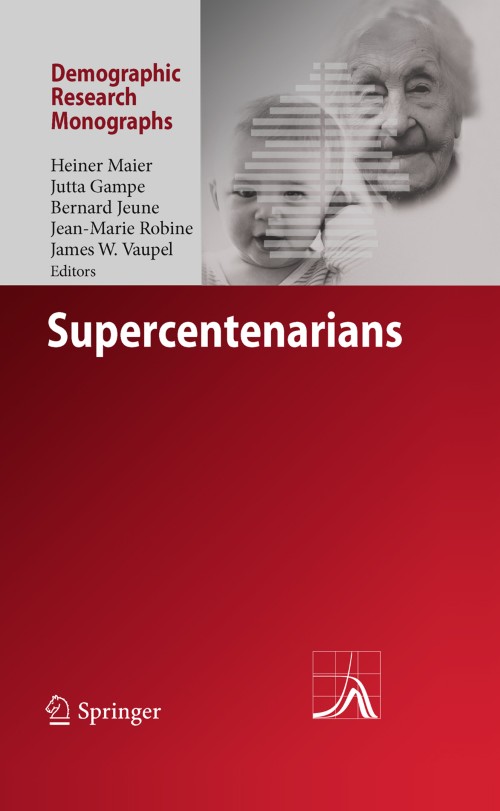
Supercentenarians [electronic resource] / edited by Heiner Maier, Jutta Gampe, Bernard Jeune, James W. Vaupel, Jean-Marie Robine.
Erişim Adresi
ISBN
9783642115202
Dil Kodu
İngilizce
Yer Numarası
DK/12923
Basım Bildirimi
1st ed. 2010.
Yayın Bilgisi
Berlin, Heidelberg : Springer Berlin Heidelberg : Imprint: Springer, 2010.
Fiziksel Niteleme
XV, 323 p. 52 illus. online resource.
Dizi
Demographic Research Monographs, A Series of the Max Planck Institute for Demographic Research, 2197-9286
İçindekiler Notu
General -- On the age validation of supercentenarians -- The International Database on Longevity: Structure and contents -- Country reports -- Supercentenarians in the United States -- The emergence of supercentenarians in Canada -- Supercentenarians in Japan -- Being very old in a young country: Centenarians and supercentenarians in Australia -- Supercentenarians in France -- Italian supercentenarians: Age validation of deaths from 1969 to 2000 -- Emergence and verification of supercentenarians in Spain -- Age validation of persons aged 105 and above in Germany -- The growth of high ages in England and Wales, 1635-2106 -- Supercentenarians in the Nordic Countries -- Research on supercentenarians -- Human mortality beyond age 110 -- Is it possible to measure life expectancy at 110 in France? -- Age 115 or more in the United States: Fact or fiction? -- Jeanne Calment and her successors. Biographical notes on the longest living humans.
Özet, vb.
Does human mortality after age 110 continue to rise, level off, or start to decline? This book describes a concerted, international research effort undertaken with the goal of establishing a database that allows the best possible description of the mortality trajectory beyond the age of 110. The International Database on Longevity (IDL) is the result of this ongoing effort. The IDL contains exhaustive information on validated cases of supercentenarians (people 110 years and older) and allows unbiased estimates of mortality after age 110. The main finding is remarkable: human mortality after age 110 is flat at a probability of death of 50% per year. The sixteen chapters of this book discuss age validation of exceptional longevity, data on supercentenarians in a series of countries, structure and contents of the IDL, and statistical analysis of human mortality after age 110. Several chapters include short accounts of specific supercentenarians that add life to demographic research.
Konu
Demography.
Population.
Aging.
Population __ Economic aspects.
Biometry.
Human geography.
Population and Demography.
Ageing.
Population Economics.
Biostatistics.
Human Geography.
Population.
Aging.
Population __ Economic aspects.
Biometry.
Human geography.
Population and Demography.
Ageing.
Population Economics.
Biostatistics.
Human Geography.
Kurum Adı
Eseri Alıntıla
Referansları kullanmadan önce gözden geçirmeniz ve varsa gerekli düzeltmeleri yapmanız önerilir.
Dijital Kaynak
MARC Görünümü
LEADER 04408nam a22006255i 4500
001 811665
003 TR_AnAIT
005 20260131004944
007 cr nn 008mamaa
008 100528s2010 gw | s |||| 0|eng d
020 |a9783642115202|9978-3-642-11520-2
024 7 |a10.1007/978-3-642-11520-2|2doi
041 |aeng
049 |aTürk Tarih Kurumu Kütüphanesi
050 4|aHB848-3697
072 7|aJHBD|2bicssc
072 7|aSOC006000|2bisacsh
072 7|aJHBD|2thema
082 04|a304.6|223
090 |aDK/12923
245 10|aSupercentenarians|h[electronic resource] /|cedited by Heiner Maier, Jutta Gampe, Bernard Jeune, James W. Vaupel, Jean-Marie Robine.
250 |a1st ed. 2010.
264 1|aBerlin, Heidelberg :|bSpringer Berlin Heidelberg :|bImprint: Springer,|c2010.
300 |aXV, 323 p. 52 illus.|bonline resource.
336 |atext|btxt|2rdacontent
337 |acomputer|bc|2rdamedia
338 |aonline resource|bcr|2rdacarrier
347 |atext file|bPDF|2rda
490 1 |aDemographic Research Monographs, A Series of the Max Planck Institute for Demographic Research,|x2197-9286
505 0 |aGeneral -- On the age validation of supercentenarians -- The International Database on Longevity: Structure and contents -- Country reports -- Supercentenarians in the United States -- The emergence of supercentenarians in Canada -- Supercentenarians in Japan -- Being very old in a young country: Centenarians and supercentenarians in Australia -- Supercentenarians in France -- Italian supercentenarians: Age validation of deaths from 1969 to 2000 -- Emergence and verification of supercentenarians in Spain -- Age validation of persons aged 105 and above in Germany -- The growth of high ages in England and Wales, 1635-2106 -- Supercentenarians in the Nordic Countries -- Research on supercentenarians -- Human mortality beyond age 110 -- Is it possible to measure life expectancy at 110 in France? -- Age 115 or more in the United States: Fact or fiction? -- Jeanne Calment and her successors. Biographical notes on the longest living humans.
520 |aDoes human mortality after age 110 continue to rise, level off, or start to decline? This book describes a concerted, international research effort undertaken with the goal of establishing a database that allows the best possible description of the mortality trajectory beyond the age of 110. The International Database on Longevity (IDL) is the result of this ongoing effort. The IDL contains exhaustive information on validated cases of supercentenarians (people 110 years and older) and allows unbiased estimates of mortality after age 110. The main finding is remarkable: human mortality after age 110 is flat at a probability of death of 50% per year. The sixteen chapters of this book discuss age validation of exceptional longevity, data on supercentenarians in a series of countries, structure and contents of the IDL, and statistical analysis of human mortality after age 110. Several chapters include short accounts of specific supercentenarians that add life to demographic research.
650 0|aDemography.
650 0|aPopulation.
650 0|aAging.
650 0|aPopulation|xEconomic aspects.
650 0|aBiometry.
650 0|aHuman geography.
650 14|aPopulation and Demography.
650 24|aAgeing.
650 24|aPopulation Economics.
650 24|aBiostatistics.
650 24|aHuman Geography.
700 1 |aMaier, Heiner.|eeditor.|4edt|4http://id.loc.gov/vocabulary/relators/edt
700 1 |aGampe, Jutta.|eeditor.|4edt|4http://id.loc.gov/vocabulary/relators/edt
700 1 |aJeune, Bernard.|eeditor.|4edt|4http://id.loc.gov/vocabulary/relators/edt
700 1 |aVaupel, James W.|eeditor.|4edt|4http://id.loc.gov/vocabulary/relators/edt
700 1 |aRobine, Jean-Marie.|eeditor.|4edt|4http://id.loc.gov/vocabulary/relators/edt
710 2 |aSpringerLink (Online service)
773 0 |tSpringer Nature eBook
776 08|iPrinted edition:|z9783642115196
776 08|iPrinted edition:|z9783642115516
776 08|iPrinted edition:|z9783642263477
830 0|aDemographic Research Monographs, A Series of the Max Planck Institute for Demographic Research,|x2197-9286
856 40|uhttps://doi.org/10.1007/978-3-642-11520-2
912 |aZDB-2-SHU
912 |aZDB-2-SXS
950 |aHumanities, Social Sciences and Law (SpringerNature-11648)
950 |aSocial Sciences (R0) (SpringerNature-43726)
001 811665
003 TR_AnAIT
005 20260131004944
007 cr nn 008mamaa
008 100528s2010 gw | s |||| 0|eng d
020 |a9783642115202|9978-3-642-11520-2
024 7 |a10.1007/978-3-642-11520-2|2doi
041 |aeng
049 |aTürk Tarih Kurumu Kütüphanesi
050 4|aHB848-3697
072 7|aJHBD|2bicssc
072 7|aSOC006000|2bisacsh
072 7|aJHBD|2thema
082 04|a304.6|223
090 |aDK/12923
245 10|aSupercentenarians|h[electronic resource] /|cedited by Heiner Maier, Jutta Gampe, Bernard Jeune, James W. Vaupel, Jean-Marie Robine.
250 |a1st ed. 2010.
264 1|aBerlin, Heidelberg :|bSpringer Berlin Heidelberg :|bImprint: Springer,|c2010.
300 |aXV, 323 p. 52 illus.|bonline resource.
336 |atext|btxt|2rdacontent
337 |acomputer|bc|2rdamedia
338 |aonline resource|bcr|2rdacarrier
347 |atext file|bPDF|2rda
490 1 |aDemographic Research Monographs, A Series of the Max Planck Institute for Demographic Research,|x2197-9286
505 0 |aGeneral -- On the age validation of supercentenarians -- The International Database on Longevity: Structure and contents -- Country reports -- Supercentenarians in the United States -- The emergence of supercentenarians in Canada -- Supercentenarians in Japan -- Being very old in a young country: Centenarians and supercentenarians in Australia -- Supercentenarians in France -- Italian supercentenarians: Age validation of deaths from 1969 to 2000 -- Emergence and verification of supercentenarians in Spain -- Age validation of persons aged 105 and above in Germany -- The growth of high ages in England and Wales, 1635-2106 -- Supercentenarians in the Nordic Countries -- Research on supercentenarians -- Human mortality beyond age 110 -- Is it possible to measure life expectancy at 110 in France? -- Age 115 or more in the United States: Fact or fiction? -- Jeanne Calment and her successors. Biographical notes on the longest living humans.
520 |aDoes human mortality after age 110 continue to rise, level off, or start to decline? This book describes a concerted, international research effort undertaken with the goal of establishing a database that allows the best possible description of the mortality trajectory beyond the age of 110. The International Database on Longevity (IDL) is the result of this ongoing effort. The IDL contains exhaustive information on validated cases of supercentenarians (people 110 years and older) and allows unbiased estimates of mortality after age 110. The main finding is remarkable: human mortality after age 110 is flat at a probability of death of 50% per year. The sixteen chapters of this book discuss age validation of exceptional longevity, data on supercentenarians in a series of countries, structure and contents of the IDL, and statistical analysis of human mortality after age 110. Several chapters include short accounts of specific supercentenarians that add life to demographic research.
650 0|aDemography.
650 0|aPopulation.
650 0|aAging.
650 0|aPopulation|xEconomic aspects.
650 0|aBiometry.
650 0|aHuman geography.
650 14|aPopulation and Demography.
650 24|aAgeing.
650 24|aPopulation Economics.
650 24|aBiostatistics.
650 24|aHuman Geography.
700 1 |aMaier, Heiner.|eeditor.|4edt|4http://id.loc.gov/vocabulary/relators/edt
700 1 |aGampe, Jutta.|eeditor.|4edt|4http://id.loc.gov/vocabulary/relators/edt
700 1 |aJeune, Bernard.|eeditor.|4edt|4http://id.loc.gov/vocabulary/relators/edt
700 1 |aVaupel, James W.|eeditor.|4edt|4http://id.loc.gov/vocabulary/relators/edt
700 1 |aRobine, Jean-Marie.|eeditor.|4edt|4http://id.loc.gov/vocabulary/relators/edt
710 2 |aSpringerLink (Online service)
773 0 |tSpringer Nature eBook
776 08|iPrinted edition:|z9783642115196
776 08|iPrinted edition:|z9783642115516
776 08|iPrinted edition:|z9783642263477
830 0|aDemographic Research Monographs, A Series of the Max Planck Institute for Demographic Research,|x2197-9286
856 40|uhttps://doi.org/10.1007/978-3-642-11520-2
912 |aZDB-2-SHU
912 |aZDB-2-SXS
950 |aHumanities, Social Sciences and Law (SpringerNature-11648)
950 |aSocial Sciences (R0) (SpringerNature-43726)
Materyaller
Depodan talep edilen materyal sadece kütüphane içerisinde kullanılmaktadır.
Materyal dışarıya ödünç verilmemektedir.
Materyal dışarıya ödünç verilmemektedir.
