LEADER 04301nam a22005775i 4500
001 811668
003 TR_AnAIT
005 20260131004936
007 cr nn 008mamaa
008 100301s2009 ne | s |||| 0|eng d
020 |a9789048125937|9978-90-481-2593-7
024 7 |a10.1007/978-90-481-2593-7|2doi
041 |aeng
049 |aTürk Tarih Kurumu Kütüphanesi
050 4|aBJ1-1725
072 7|aHPQ|2bicssc
072 7|aPHI005000|2bisacsh
072 7|aQDTQ|2thema
082 04|a170|223
090 |aDK/12926
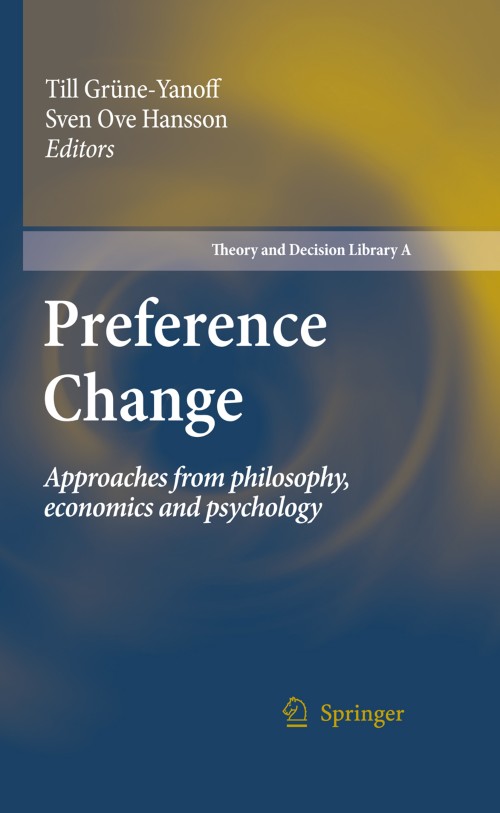
245 10|aPreference Change|h[electronic resource] :|bApproaches from philosophy, economics and psychology /|cedited by Till Grüne-Yanoff, Sven Ove Hansson.
250 |a1st ed. 2009.
264 1|aDordrecht :|bSpringer Netherlands :|bImprint: Springer,|c2009.
300 |aXII, 266 p.|bonline resource.
336 |atext|btxt|2rdacontent
337 |acomputer|bc|2rdamedia
338 |aonline resource|bcr|2rdacarrier
347 |atext file|bPDF|2rda
490 1 |aTheory and Decision Library A:, Rational Choice in Practical Philosophy and Philosophy of Science,|x2352-2119 ;|v42
505 0 |aPreference Change: An Introduction -- Three Analyses of Sour Grapes -- For Better or for Worse: Dynamic Logics of Preference -- Preference, Priorities and Belief -- Why the Received Models of Considering Preference Change Must Fail -- Exploitable Preference Changes -- Recursive Self-prediction in Self-control and Its Failure -- From Belief Revision to Preference Change -- Preference Utilitarianism by Way of Preference Change? -- The Ethics of Nudge -- Preference Kinematics -- Population-Dependent Costs of Detecting Trustworthiness: An Indirect Evolutionary Analysis.
520 |aThe fact that preferences change is a pressing but unresolved problem for philosophy and the social sciences. Social scientists use preferences to explain agents’ behaviour; philosophers use preferences to explicate value judgements. A lot of empirical research is invested into identifying people’s preferences. However, the success of these endeavours is seriously threatened, because precise accounts of when and why preferences change are lacking. This volume answers to this need by collecting new essays from an interdisciplinary group of experts in the field. These essays, especially written for this volume, survey the newest approaches to preference change developed in the social sciences and in philosophy, and will serve as a platform for future research. They review some standard material, including the neoclassical preference model and doxastic preference change, time preferences and the debate over policy evaluation under preference change. However, the focus is on new research that is not widely known, such as conditional utilities, non-monotonic logics, complex systems models, inter-temporal choice approaches, etc. The book serves three purposes. It introduces undergraduate students to the current state of research on preference change, it gives graduate students and researchers in-depth insights into the state-of-the-art modelling techniques of different disciplines; and it points out to experts the lacunae in the literature and directions for future research.
650 0|aEthics.
650 0|aLogic.
650 0|aEducation|xPhilosophy.
650 0|aPhilosophy and social sciences.
650 0|aMicroeconomics.
650 14|aMoral Philosophy and Applied Ethics.
650 24|aLogic.
650 24|aEducational Philosophy.
650 24|aPhilosophy of the Social Sciences.
650 24|aMicroeconomics.
700 1 |aGrüne-Yanoff, Till.|eeditor.|4edt|4http://id.loc.gov/vocabulary/relators/edt
700 1 |aHansson, Sven Ove.|eeditor.|4edt|4http://id.loc.gov/vocabulary/relators/edt
710 2 |aSpringerLink (Online service)
773 0 |tSpringer Nature eBook
776 08|iPrinted edition:|z9789048125920
776 08|iPrinted edition:|z9789048125944
776 08|iPrinted edition:|z9789048185061
830 0|aTheory and Decision Library A:, Rational Choice in Practical Philosophy and Philosophy of Science,|x2352-2119 ;|v42
856 40|uhttps://doi.org/10.1007/978-90-481-2593-7
912 |aZDB-2-SHU
912 |aZDB-2-SXPR
950 |aHumanities, Social Sciences and Law (SpringerNature-11648)
950 |aPhilosophy and Religion (R0) (SpringerNature-43725)