LEADER 04419nam a22005535i 4500
001 811708
003 TR_AnAIT
005 20260131004810
007 cr nn 008mamaa
008 121227s1985 ne | s |||| 0|eng d
020 |a9789400950757|9978-94-009-5075-7
024 7 |a10.1007/978-94-009-5075-7|2doi
041 |aeng
049 |aTürk Tarih Kurumu Kütüphanesi
050 4|aB1-5802
072 7|aHP|2bicssc
072 7|aPHI000000|2bisacsh
072 7|aQD|2thema
082 04|a100|223
090 |aDK/12966
100 1 |aBoucher, David.|eauthor.|4aut|4http://id.loc.gov/vocabulary/relators/aut
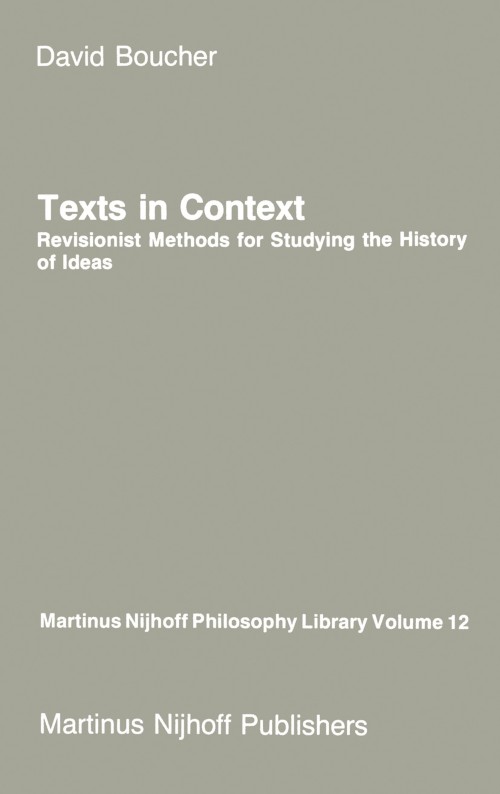
245 10|aTexts in Context|h[electronic resource] :|bRevisionist Methods for Studying the History of Ideas /|cby David Boucher.
250 |a1st ed. 1985.
264 1|aDordrecht :|bSpringer Netherlands :|bImprint: Springer,|c1985.
300 |aX, 281 p.|bonline resource.
336 |atext|btxt|2rdacontent
337 |acomputer|bc|2rdamedia
338 |aonline resource|bcr|2rdacarrier
347 |atext file|bPDF|2rda
490 1 |aMartinus Nijhoff Philosophy Library ;|v12
505 0 |aHistory, Historicism, and Hermeneutics -- One British Idealism and the Philosophy of History: Sources of Sustenance -- Two Historians of Political Thought and Their Critics: Sources of Anxiety -- Three Philosophical History: W.H. Greenleaf and the Study of the History of Political Thought -- Four The Priority of Paradigms: The Pocock Alternative -- Five The View from the Inside: Skinner and the Priority of Retrieving Authorial Intentions -- Assessment and Conclusion.
520 |aThe methodology of the study of the history of political thought is an area of study which has occupied my interests for nearly a decade. I was introduced to the subject in University College, Swansea. My teachers there provided me with an excellent grounding in political studies. I am particularly indebted to Bruce Haddock, Peter Nicholson and W. H. Greenleaf. Professor Greenleaf was kind enough to supply me with a copy of his bibliography and copies of two of his unpublished papers. I continued to pursue my interest in methodology at the London School of Economics and Political Science. I am indebted to Ken Minogue and Robert Orr who taught me there. My greatest debt is to Dr. Joseph Femia ofthe University of Liverpool who devoted a great deal of time to considering the arguments presented here. His criticisms and suggestions for improvement proved to be invaluable. I would also like to thank Alan Ryan for his general comments and encouraging advice. It would be remiss of me if I neglected to express my gratitude to Dewi Beynon who was my first teacher of politics. The research for this project was carried out in the following places; The British Library of Political Science, London; The Sidney Jones Library, University of Liverpool; The National Library of Scotland, Edinburgh; The Main Library, University of Edinburgh; The Arts and Social Science Library, University College, Cardiff; and the Bodleian Library, Oxford.
532 8 |aAccessibility summary: This PDF is not accessible. It is based on scanned pages and does not support features such as screen reader compatibility or described non-text content (images, graphs etc). However, it likely supports searchable and selectable text based on OCR (Optical Character Recognition). Users with accessibility needs may not be able to use this content effectively. Please contact us at accessibilitysupport@springernature.com if you require assistance or an alternative format.
532 8 |aInaccessible, or known limited accessibility
532 8 |aNo reading system accessibility options actively disabled
532 8 |aPublisher contact for further accessibility information: accessibilitysupport@springernature.com
650 0|aPhilosophy.
650 0|aPhilosophy, Modern.
650 14|aPhilosophy.
650 24|aEarly Modern Philosophy.
710 2 |aSpringerLink (Online service)
773 0 |tSpringer Nature eBook
776 08|iPrinted edition:|z9789024731213
776 08|iPrinted edition:|z9789400950764
776 08|iPrinted edition:|z9789401087452
830 0|aMartinus Nijhoff Philosophy Library ;|v12
856 40|uhttps://doi.org/10.1007/978-94-009-5075-7
912 |aZDB-2-SHU
912 |aZDB-2-SXPR
912 |aZDB-2-BAE
950 |aHumanities, Social Sciences and Law (SpringerNature-11648)
950 |aPhilosophy and Religion (R0) (SpringerNature-43725)