

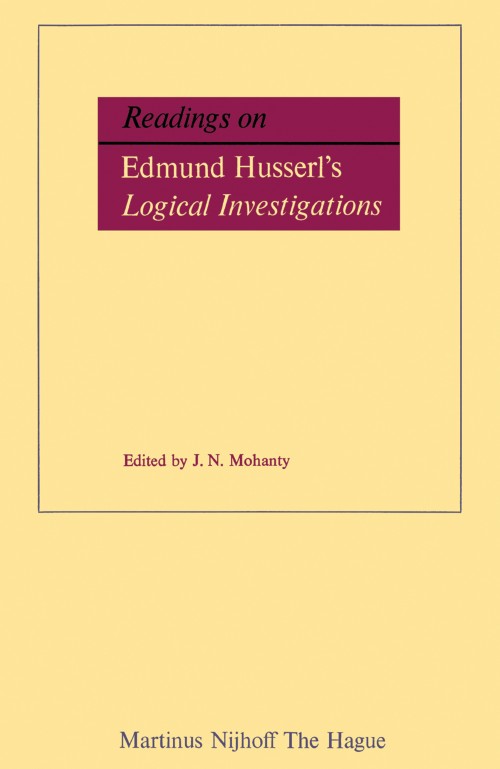
Readings on Edmund Husserl’s Logical Investigations [electronic resource] / edited by J.N. Mohanty.
Erişim Adresi
ISBN
9789401010559
Dil Kodu
İngilizce
Yer Numarası
DK/13002
Basım Bildirimi
1st ed. 1977.
Yayın Bilgisi
Dordrecht : Springer Netherlands : Imprint: Springer, 1977.
Fiziksel Niteleme
VI, 220 p. online resource.
İçindekiler Notu
Editor’s Introduction -- Review of Dr. E. Husserl’s Philosophy of Arithmetic. -- Husserl and Frege: A New Look at their Relationship -- A Reply to a Critic of my Refutation of Logical Psychologism -- The Paradox of Logical Psychologism: Husserl’s Way Out -- On the Question of Logical Method -- Husserl on the Apodictic Evidence of Ideal Laws -- Husserl’s Thesis of the Ideality of Meanings -- Husserl on Signification and Object -- The Logic of Parts and Wholes in Husserl’s Investigations -- Outlines of a Theory of “Essentially Occasional Expressions” -- Husserl’s Conception of a Purely Logical Grammar -- Husserl’s Conception of ‘The Grammatical’ and Contemporary Linguistics -- On Husserl’s Approach to Necessary Truth -- Husserl on Truth and Evidence -- The Task and the Significance of the Logical Investigations -- Suggestions for Further Reading.
Özet, vb.
I Edmund Husserl's Logische Untersuchungen is, by any standard and also by nearly common consent, a great philosophical work. Within the phenom enological movement, it is generally recognised that the breakthrough to pure phenomenology - not merely to eidetic phenomenology, but also to transcendental phenomenology - was first made in these investiga tions. But in the context of philosophy of logic and also of theory of know ledge in general, these investigations took decisive steps forward. Amongst their major achievements generally recognised are of course: the final death-blow to psychologism as a theory of logic in the Prolegomena, a new conception of analyticity which vastly improves upon Kant's, a theory of meaning which is many-sided in scope and widely ramified in its appli cations, a conception of pure logical grammar that eventually became epoch-making, a powerful restatement of the conception of truth in terms of 'evidence' and a theory of knowledge in terms of the dynamic movement from empty intention to graduated fulfillment. There are many other detailed arguments, counter-arguments, conceptual distinctions and phenomenolo gical descriptions which deserve the utmost attention, examination and assimilation on the part of any serious investigator. With the publication of J. N. Findlay's English translation of the Untersuchungen, it is expected that this work will find its proper place in the curriculum of the graduate programs in philosophy in the English speaking world.
Konu
Phenomenology .
Phenomenology.
Phenomenology.
Diğer Yazarlar
Kurum Adı
Eseri Alıntıla
Referansları kullanmadan önce gözden geçirmeniz ve varsa gerekli düzeltmeleri yapmanız önerilir.
Dijital Kaynak
MARC Görünümü
LEADER 04666nam a22004935i 4500
001 811744
003 TR_AnAIT
005 20260131004712
007 cr nn 008mamaa
008 121227s1977 ne | s |||| 0|eng d
020 |a9789401010559|9978-94-010-1055-9
024 7 |a10.1007/978-94-010-1055-9|2doi
041 |aeng
049 |aTürk Tarih Kurumu Kütüphanesi
050 4|aB829.5.A-Z
072 7|aHPCF3|2bicssc
072 7|aPHI018000|2bisacsh
072 7|aQDHR5|2thema
082 04|a142.7|223
090 |aDK/13002
245 10|aReadings on Edmund Husserl’s Logical Investigations|h[electronic resource] /|cedited by J.N. Mohanty.
250 |a1st ed. 1977.
264 1|aDordrecht :|bSpringer Netherlands :|bImprint: Springer,|c1977.
300 |aVI, 220 p.|bonline resource.
336 |atext|btxt|2rdacontent
337 |acomputer|bc|2rdamedia
338 |aonline resource|bcr|2rdacarrier
347 |atext file|bPDF|2rda
505 0 |aEditor’s Introduction -- Review of Dr. E. Husserl’s Philosophy of Arithmetic. -- Husserl and Frege: A New Look at their Relationship -- A Reply to a Critic of my Refutation of Logical Psychologism -- The Paradox of Logical Psychologism: Husserl’s Way Out -- On the Question of Logical Method -- Husserl on the Apodictic Evidence of Ideal Laws -- Husserl’s Thesis of the Ideality of Meanings -- Husserl on Signification and Object -- The Logic of Parts and Wholes in Husserl’s Investigations -- Outlines of a Theory of “Essentially Occasional Expressions” -- Husserl’s Conception of a Purely Logical Grammar -- Husserl’s Conception of ‘The Grammatical’ and Contemporary Linguistics -- On Husserl’s Approach to Necessary Truth -- Husserl on Truth and Evidence -- The Task and the Significance of the Logical Investigations -- Suggestions for Further Reading.
520 |aI Edmund Husserl's Logische Untersuchungen is, by any standard and also by nearly common consent, a great philosophical work. Within the phenom enological movement, it is generally recognised that the breakthrough to pure phenomenology - not merely to eidetic phenomenology, but also to transcendental phenomenology - was first made in these investiga tions. But in the context of philosophy of logic and also of theory of know ledge in general, these investigations took decisive steps forward. Amongst their major achievements generally recognised are of course: the final death-blow to psychologism as a theory of logic in the Prolegomena, a new conception of analyticity which vastly improves upon Kant's, a theory of meaning which is many-sided in scope and widely ramified in its appli cations, a conception of pure logical grammar that eventually became epoch-making, a powerful restatement of the conception of truth in terms of 'evidence' and a theory of knowledge in terms of the dynamic movement from empty intention to graduated fulfillment. There are many other detailed arguments, counter-arguments, conceptual distinctions and phenomenolo gical descriptions which deserve the utmost attention, examination and assimilation on the part of any serious investigator. With the publication of J. N. Findlay's English translation of the Untersuchungen, it is expected that this work will find its proper place in the curriculum of the graduate programs in philosophy in the English speaking world.
532 8 |aAccessibility summary: This PDF is not accessible. It is based on scanned pages and does not support features such as screen reader compatibility or described non-text content (images, graphs etc). However, it likely supports searchable and selectable text based on OCR (Optical Character Recognition). Users with accessibility needs may not be able to use this content effectively. Please contact us at accessibilitysupport@springernature.com if you require assistance or an alternative format.
532 8 |aInaccessible, or known limited accessibility
532 8 |aNo reading system accessibility options actively disabled
532 8 |aPublisher contact for further accessibility information: accessibilitysupport@springernature.com
650 0|aPhenomenology .
650 14|aPhenomenology.
700 1 |aMohanty, J.N.|eeditor.|4edt|4http://id.loc.gov/vocabulary/relators/edt
710 2 |aSpringerLink (Online service)
773 0 |tSpringer Nature eBook
776 08|iPrinted edition:|z9789024719280
776 08|iPrinted edition:|z9789401010566
856 40|uhttps://doi.org/10.1007/978-94-010-1055-9
912 |aZDB-2-SHU
912 |aZDB-2-SXPR
912 |aZDB-2-BAE
950 |aHumanities, Social Sciences and Law (SpringerNature-11648)
950 |aPhilosophy and Religion (R0) (SpringerNature-43725)
001 811744
003 TR_AnAIT
005 20260131004712
007 cr nn 008mamaa
008 121227s1977 ne | s |||| 0|eng d
020 |a9789401010559|9978-94-010-1055-9
024 7 |a10.1007/978-94-010-1055-9|2doi
041 |aeng
049 |aTürk Tarih Kurumu Kütüphanesi
050 4|aB829.5.A-Z
072 7|aHPCF3|2bicssc
072 7|aPHI018000|2bisacsh
072 7|aQDHR5|2thema
082 04|a142.7|223
090 |aDK/13002
245 10|aReadings on Edmund Husserl’s Logical Investigations|h[electronic resource] /|cedited by J.N. Mohanty.
250 |a1st ed. 1977.
264 1|aDordrecht :|bSpringer Netherlands :|bImprint: Springer,|c1977.
300 |aVI, 220 p.|bonline resource.
336 |atext|btxt|2rdacontent
337 |acomputer|bc|2rdamedia
338 |aonline resource|bcr|2rdacarrier
347 |atext file|bPDF|2rda
505 0 |aEditor’s Introduction -- Review of Dr. E. Husserl’s Philosophy of Arithmetic. -- Husserl and Frege: A New Look at their Relationship -- A Reply to a Critic of my Refutation of Logical Psychologism -- The Paradox of Logical Psychologism: Husserl’s Way Out -- On the Question of Logical Method -- Husserl on the Apodictic Evidence of Ideal Laws -- Husserl’s Thesis of the Ideality of Meanings -- Husserl on Signification and Object -- The Logic of Parts and Wholes in Husserl’s Investigations -- Outlines of a Theory of “Essentially Occasional Expressions” -- Husserl’s Conception of a Purely Logical Grammar -- Husserl’s Conception of ‘The Grammatical’ and Contemporary Linguistics -- On Husserl’s Approach to Necessary Truth -- Husserl on Truth and Evidence -- The Task and the Significance of the Logical Investigations -- Suggestions for Further Reading.
520 |aI Edmund Husserl's Logische Untersuchungen is, by any standard and also by nearly common consent, a great philosophical work. Within the phenom enological movement, it is generally recognised that the breakthrough to pure phenomenology - not merely to eidetic phenomenology, but also to transcendental phenomenology - was first made in these investiga tions. But in the context of philosophy of logic and also of theory of know ledge in general, these investigations took decisive steps forward. Amongst their major achievements generally recognised are of course: the final death-blow to psychologism as a theory of logic in the Prolegomena, a new conception of analyticity which vastly improves upon Kant's, a theory of meaning which is many-sided in scope and widely ramified in its appli cations, a conception of pure logical grammar that eventually became epoch-making, a powerful restatement of the conception of truth in terms of 'evidence' and a theory of knowledge in terms of the dynamic movement from empty intention to graduated fulfillment. There are many other detailed arguments, counter-arguments, conceptual distinctions and phenomenolo gical descriptions which deserve the utmost attention, examination and assimilation on the part of any serious investigator. With the publication of J. N. Findlay's English translation of the Untersuchungen, it is expected that this work will find its proper place in the curriculum of the graduate programs in philosophy in the English speaking world.
532 8 |aAccessibility summary: This PDF is not accessible. It is based on scanned pages and does not support features such as screen reader compatibility or described non-text content (images, graphs etc). However, it likely supports searchable and selectable text based on OCR (Optical Character Recognition). Users with accessibility needs may not be able to use this content effectively. Please contact us at accessibilitysupport@springernature.com if you require assistance or an alternative format.
532 8 |aInaccessible, or known limited accessibility
532 8 |aNo reading system accessibility options actively disabled
532 8 |aPublisher contact for further accessibility information: accessibilitysupport@springernature.com
650 0|aPhenomenology .
650 14|aPhenomenology.
700 1 |aMohanty, J.N.|eeditor.|4edt|4http://id.loc.gov/vocabulary/relators/edt
710 2 |aSpringerLink (Online service)
773 0 |tSpringer Nature eBook
776 08|iPrinted edition:|z9789024719280
776 08|iPrinted edition:|z9789401010566
856 40|uhttps://doi.org/10.1007/978-94-010-1055-9
912 |aZDB-2-SHU
912 |aZDB-2-SXPR
912 |aZDB-2-BAE
950 |aHumanities, Social Sciences and Law (SpringerNature-11648)
950 |aPhilosophy and Religion (R0) (SpringerNature-43725)
Materyaller
Depodan talep edilen materyal sadece kütüphane içerisinde kullanılmaktadır.
Materyal dışarıya ödünç verilmemektedir.
Materyal dışarıya ödünç verilmemektedir.
