

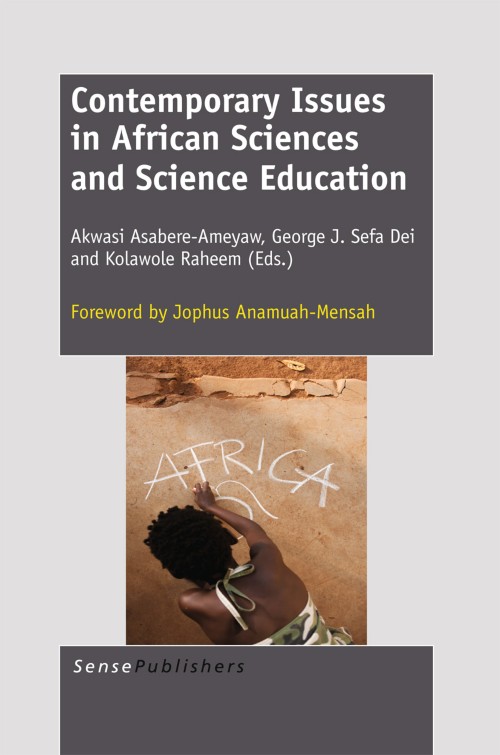
Contemporary Issues in African Sciences and Science Education [electronic resource] / edited by Akwasi Asabere-Ameyaw, George J. Sefa Dei, Kolawole Raheem.
Erişim Adresi
ISBN
9789460917028
Dil Kodu
İngilizce
Yer Numarası
DK/13018
Basım Bildirimi
1st ed. 2012.
Yayın Bilgisi
Rotterdam : SensePublishers : Imprint: SensePublishers, 2012.
Fiziksel Niteleme
XII, 238 p. online resource.
Özet, vb.
In this careful articulation of science, the editors provide an intellectual marriage of Indigenous science and science education in the African context as a way of revising schooling and education. They define science broadly to include both the science of the natural/physical/biological and the ‘science of the social’. It is noted that the current policy direction of African education continues to be a subject of intense intellectual discussion. Science education is very much at the heart of much current debates about reforming African schooling. Among the ways to counter-vision contemporary African education this book points to how we promote Indigenous science education to improve upon African science and technology development in general. The book also notes a long-standing push to re-examine local cultural resource knowings in order to appreciate and understand the nature, content and context of Indigenous knowledge science as a starting foundation for promoting African science and technology studies in general. It is argued that these interests and concerns are not mutually exclusive of each other but as a matter of fact interwoven and interdependent. The breadth of coverage of the collection reflect papers in science, Indigeneity, identity and knowledge production and the possibilities of creating a truly African-centred education. It is argued that such extensive coverage will engage and excite readers on the path of what has been termed ‘African educational recovery’. While the book is careful in avoiding stale debates about the ‘Eurocentricity of Western scientific knowledge’ and the positing of ‘Eurocentric science’ as the only science worthy of engagement, it nonetheless caution against constructing a binary between Indigenous/local science and knowledges and Western ‘scientific’ knowledge. After all, Western scientific knowledge is itself a form of local knowledge, born out of a particular social and historical context.Engaging science in a more global context will bring to the fore critical questions of how we create spaces for the study of Indigenous science knowledge in our schools. How is Indigenous science to be read, understood and theorized? And, how do educators gather/collect and interpret Indigenous science knowledges for the purposes of teaching young learners. These are critical questions for contemporary African education?
Konu
Education.
Education.
Education.
Diğer Yazarlar
Kurum Adı
Eseri Alıntıla
Referansları kullanmadan önce gözden geçirmeniz ve varsa gerekli düzeltmeleri yapmanız önerilir.
Dijital Kaynak
MARC Görünümü
LEADER 04745nam a22004455i 4500
001 811760
003 TR_AnAIT
005 20260131004642
007 cr nn 008mamaa
008 120905s2012 ne | s |||| 0|eng d
020 |a9789460917028|9978-94-6091-702-8
024 7 |a10.1007/978-94-6091-702-8|2doi
041 |aeng
049 |aTürk Tarih Kurumu Kütüphanesi
050 4|aL1-991
072 7|aJN|2bicssc
072 7|aEDU000000|2bisacsh
072 7|aJN|2thema
082 04|a370|223
090 |aDK/13018
245 10|aContemporary Issues in African Sciences and Science Education|h[electronic resource] /|cedited by Akwasi Asabere-Ameyaw, George J. Sefa Dei, Kolawole Raheem.
250 |a1st ed. 2012.
264 1|aRotterdam :|bSensePublishers :|bImprint: SensePublishers,|c2012.
300 |aXII, 238 p.|bonline resource.
336 |atext|btxt|2rdacontent
337 |acomputer|bc|2rdamedia
338 |aonline resource|bcr|2rdacarrier
347 |atext file|bPDF|2rda
520 |aIn this careful articulation of science, the editors provide an intellectual marriage of Indigenous science and science education in the African context as a way of revising schooling and education. They define science broadly to include both the science of the natural/physical/biological and the ‘science of the social’. It is noted that the current policy direction of African education continues to be a subject of intense intellectual discussion. Science education is very much at the heart of much current debates about reforming African schooling. Among the ways to counter-vision contemporary African education this book points to how we promote Indigenous science education to improve upon African science and technology development in general. The book also notes a long-standing push to re-examine local cultural resource knowings in order to appreciate and understand the nature, content and context of Indigenous knowledge science as a starting foundation for promoting African science and technology studies in general. It is argued that these interests and concerns are not mutually exclusive of each other but as a matter of fact interwoven and interdependent. The breadth of coverage of the collection reflect papers in science, Indigeneity, identity and knowledge production and the possibilities of creating a truly African-centred education. It is argued that such extensive coverage will engage and excite readers on the path of what has been termed ‘African educational recovery’. While the book is careful in avoiding stale debates about the ‘Eurocentricity of Western scientific knowledge’ and the positing of ‘Eurocentric science’ as the only science worthy of engagement, it nonetheless caution against constructing a binary between Indigenous/local science and knowledges and Western ‘scientific’ knowledge. After all, Western scientific knowledge is itself a form of local knowledge, born out of a particular social and historical context.Engaging science in a more global context will bring to the fore critical questions of how we create spaces for the study of Indigenous science knowledge in our schools. How is Indigenous science to be read, understood and theorized? And, how do educators gather/collect and interpret Indigenous science knowledges for the purposes of teaching young learners. These are critical questions for contemporary African education?
532 8 |aAccessibility summary: This PDF eBook is produced by a third-party. We have requested that the file be made accessible and compliant with the European Accessibility Act (EAA). However, we have not been able to fully verify its compliance with recognized accessibility standards (such as PDF/UA or WCAG). For detailed accessibility information, please refer to the original publisher’s website. If you require an accessible version of this content, please contact accessibilitysupport@springernature.com. We are committed to improving accessibility and will work with the publisher to meet your needs wherever possible.
532 8 |aPublisher contact for further accessibility information: accessibilitysupport@springernature.com
650 0|aEducation.
650 14|aEducation.
700 1 |aAsabere-Ameyaw, Akwasi.|eeditor.|4edt|4http://id.loc.gov/vocabulary/relators/edt
700 1 |aSefa Dei, George J.|eeditor.|4edt|4http://id.loc.gov/vocabulary/relators/edt
700 1 |aRaheem, Kolawole.|eeditor.|4edt|4http://id.loc.gov/vocabulary/relators/edt
710 2 |aSpringerLink (Online service)
773 0 |tSpringer Nature eBook
856 40|uhttps://doi.org/10.1007/978-94-6091-702-8
912 |aZDB-2-SHU
912 |aZDB-2-SXED
950 |aHumanities, Social Sciences and Law (SpringerNature-11648)
950 |aEducation (R0) (SpringerNature-43721)
001 811760
003 TR_AnAIT
005 20260131004642
007 cr nn 008mamaa
008 120905s2012 ne | s |||| 0|eng d
020 |a9789460917028|9978-94-6091-702-8
024 7 |a10.1007/978-94-6091-702-8|2doi
041 |aeng
049 |aTürk Tarih Kurumu Kütüphanesi
050 4|aL1-991
072 7|aJN|2bicssc
072 7|aEDU000000|2bisacsh
072 7|aJN|2thema
082 04|a370|223
090 |aDK/13018
245 10|aContemporary Issues in African Sciences and Science Education|h[electronic resource] /|cedited by Akwasi Asabere-Ameyaw, George J. Sefa Dei, Kolawole Raheem.
250 |a1st ed. 2012.
264 1|aRotterdam :|bSensePublishers :|bImprint: SensePublishers,|c2012.
300 |aXII, 238 p.|bonline resource.
336 |atext|btxt|2rdacontent
337 |acomputer|bc|2rdamedia
338 |aonline resource|bcr|2rdacarrier
347 |atext file|bPDF|2rda
520 |aIn this careful articulation of science, the editors provide an intellectual marriage of Indigenous science and science education in the African context as a way of revising schooling and education. They define science broadly to include both the science of the natural/physical/biological and the ‘science of the social’. It is noted that the current policy direction of African education continues to be a subject of intense intellectual discussion. Science education is very much at the heart of much current debates about reforming African schooling. Among the ways to counter-vision contemporary African education this book points to how we promote Indigenous science education to improve upon African science and technology development in general. The book also notes a long-standing push to re-examine local cultural resource knowings in order to appreciate and understand the nature, content and context of Indigenous knowledge science as a starting foundation for promoting African science and technology studies in general. It is argued that these interests and concerns are not mutually exclusive of each other but as a matter of fact interwoven and interdependent. The breadth of coverage of the collection reflect papers in science, Indigeneity, identity and knowledge production and the possibilities of creating a truly African-centred education. It is argued that such extensive coverage will engage and excite readers on the path of what has been termed ‘African educational recovery’. While the book is careful in avoiding stale debates about the ‘Eurocentricity of Western scientific knowledge’ and the positing of ‘Eurocentric science’ as the only science worthy of engagement, it nonetheless caution against constructing a binary between Indigenous/local science and knowledges and Western ‘scientific’ knowledge. After all, Western scientific knowledge is itself a form of local knowledge, born out of a particular social and historical context.Engaging science in a more global context will bring to the fore critical questions of how we create spaces for the study of Indigenous science knowledge in our schools. How is Indigenous science to be read, understood and theorized? And, how do educators gather/collect and interpret Indigenous science knowledges for the purposes of teaching young learners. These are critical questions for contemporary African education?
532 8 |aAccessibility summary: This PDF eBook is produced by a third-party. We have requested that the file be made accessible and compliant with the European Accessibility Act (EAA). However, we have not been able to fully verify its compliance with recognized accessibility standards (such as PDF/UA or WCAG). For detailed accessibility information, please refer to the original publisher’s website. If you require an accessible version of this content, please contact accessibilitysupport@springernature.com. We are committed to improving accessibility and will work with the publisher to meet your needs wherever possible.
532 8 |aPublisher contact for further accessibility information: accessibilitysupport@springernature.com
650 0|aEducation.
650 14|aEducation.
700 1 |aAsabere-Ameyaw, Akwasi.|eeditor.|4edt|4http://id.loc.gov/vocabulary/relators/edt
700 1 |aSefa Dei, George J.|eeditor.|4edt|4http://id.loc.gov/vocabulary/relators/edt
700 1 |aRaheem, Kolawole.|eeditor.|4edt|4http://id.loc.gov/vocabulary/relators/edt
710 2 |aSpringerLink (Online service)
773 0 |tSpringer Nature eBook
856 40|uhttps://doi.org/10.1007/978-94-6091-702-8
912 |aZDB-2-SHU
912 |aZDB-2-SXED
950 |aHumanities, Social Sciences and Law (SpringerNature-11648)
950 |aEducation (R0) (SpringerNature-43721)
Materyaller
Depodan talep edilen materyal sadece kütüphane içerisinde kullanılmaktadır.
Materyal dışarıya ödünç verilmemektedir.
Materyal dışarıya ödünç verilmemektedir.
