

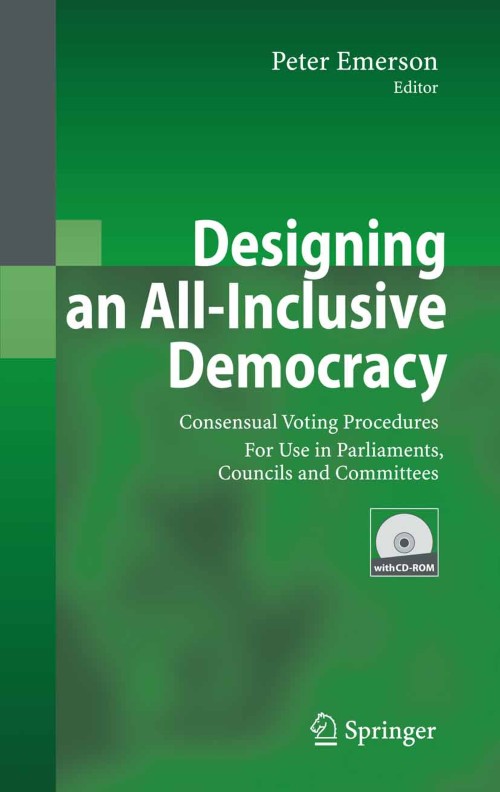
Designing an All-Inclusive Democracy [electronic resource] : Consensual Voting Procedures for Use in Parliaments, Councils and Committees / edited by Peter Emerson.
Erişim Adresi
ISBN
9783540331643
Dil Kodu
İngilizce
Yer Numarası
DK/13019
Basım Bildirimi
1st ed. 2007.
Yayın Bilgisi
Berlin, Heidelberg : Springer Berlin Heidelberg : Imprint: Springer, 2007.
Fiziksel Niteleme
XV, 187 p. online resource.
İçindekiler Notu
Designing an All-Inclusive Democracy -- Collective Decision-making The Modified Borda Count, MBC -- A Pluralist Parliament for a Plural Society The Quota Borda System, QBS -- Electing a Power-sharing Executive The Matrix Vote -- The Art or Science of Manipulation -- A Critique -- The Theory of Voting and the Borda Systems -- Assessing Borda’s Rule and Its Modifications -- Human Rights and Voting Procedures in Plural Societies -- Inclusive Decision-making in Mediation and Politics -- Conclusion -- The Realpolitik of Consensus Voting Peter Emerson with Assistance from Elizabeth Meehan.
Özet, vb.
Democracy is for everybody, not just a majority. This book describes the voting procedures by which majority rule may be replaced by a more consensual system of governance. In a word, such an inclusive polity can be achieved by asking the voters or, more usually, their representatives in councils and parliaments, to state their preferences, so to facilitate the identification of that option which gains the highest average preference score. The first part of the book describes three different voting procedures, the Modified Borda Count, the Quota Borda System and the Matrix Vote, and gives a number of hypothetical examples, all clearly depicted in tables. In the second part, the voting mechanisms are discussed against the background of the theory of voting, social choice theory, human rights and mediation practice. The book includes a foreword by Sir Michael Dummett and contributions by Elizabeth Meehan, Hannu Nurmi and Maurice Salles, among others.
Konu
Political science.
Microeconomics.
Political Science.
Microeconomics.
Microeconomics.
Political Science.
Microeconomics.
Diğer Yazarlar
Kurum Adı
