

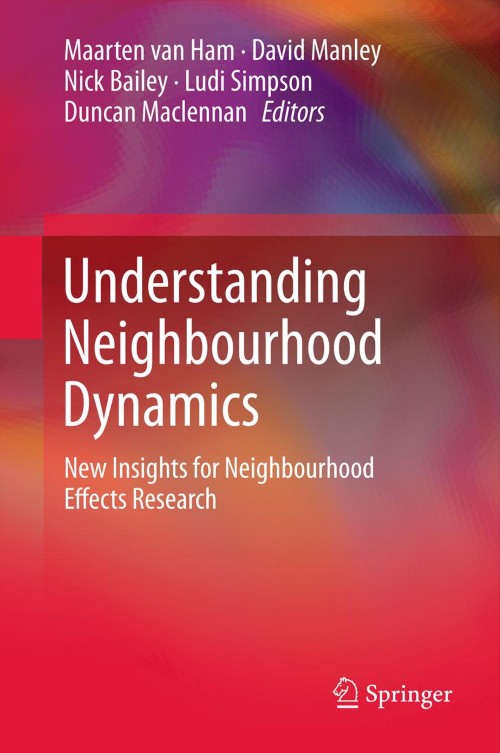
Understanding Neighbourhood Dynamics [electronic resource] : New Insights for Neighbourhood Effects Research / edited by Maarten van Ham, David Manley, Nick Bailey, Ludi Simpson, Duncan Maclennan.
Erişim Adresi
ISBN
9789400748545
Dil Kodu
İngilizce
Yer Numarası
DK/13054
Basım Bildirimi
1st ed. 2013.
Yayın Bilgisi
Dordrecht : Springer Netherlands : Imprint: Springer, 2013.
Fiziksel Niteleme
XII, 284 p. online resource.
İçindekiler Notu
1: Understanding neighbourhood dynamics: new insights for neighbourhood effects research: Maarten van Ham, David Manley, Nick Bailey, Ludi Simpson and Duncan Maclennan -- 2: Understanding neighbourhood population dynamics for neighbourhood effects research: a review of recent evidence and data source developments: Nick Bailey, Helen Barnes, Mark Livingston and David Mclennan -- 3: The Causes of Long-Term Neighbourhood Change: Geoffrey Meen, Christian Nygaard and Julia Meen -- 4: How do mortgage lenders influence neighbourhood dynamics? Redlining and Predatory Lending: Manuel B. Aalbers -- 5: Urban restructuring, displaced households and neighbour-hood change: results from three Dutch cities: Hanneke Posthumus, Gideon Bolt and Ronald van Kempen -- 6: The effects of neighbourhood regeneration on the neighbourhood hierarchy of the city – A case study in Sweden: Åsa Bråmå -- 7: Neighbourhood social capital and residential mobility: Beate Volker, Gerald Mollenhorst, & Veronique Schutjens -- 8: Neighbourhood reputations, moving behaviour and neighbourhood dynamics: Matthieu Permentier -- 9: The components of socioeconomic neighbourhood change: an analysis of School Census data at varying spatial scales in England: Stephen Jivraj -- 10: How ethnic mix changes: typologising neighbourhood population dynamics of ethnic groups: Nissa Finney -- 11: Testing the racial proxy hypothesis: What is it that residents don’t like about their neighbourhood?: Karien Dekker -- 12: Community Choice in Large Cities: Selectivity and Ethnic Sorting Across Neighbourhoods: William A.V. Clark and Natasha Rivers.
Özet, vb.
This rare interdisciplinary combination of research into neighbourhood dynamics and effects attempts to unravel the complex relationship between disadvantaged neighbourhoods and the life outcomes of the residents who live therein. It seeks to overcome the notorious difficulties of establishing an empirical causal relationship between living in a disadvantaged area and the poorer health and well-being often found in such places. There remains a widespread belief in neighbourhood effects: that living in a poorer area can adversely affect residents’ life chances. These chapters caution that neighbourhood effects cannot be fully understood without a profound understanding of the changes to, and selective mobility into and out of, these areas. Featuring fresh research findings from a number of countries and data sources, including from the UK, Australia, Sweden and the USA, this book offers fresh perspectives on neighbourhood choice and dynamics, as well as new material for social scientists, geographers and policy makers alike. It enriches neighbourhood effects research with insights from the closely related, but currently largely separate, literature on neighbourhood dynamics.
Konu
Human geography.
Medical sciences.
Quality of life.
Population __ Economic aspects.
Human Geography.
Health Sciences.
Quality of Life Research.
Population Economics.
Medical sciences.
Quality of life.
Population __ Economic aspects.
Human Geography.
Health Sciences.
Quality of Life Research.
Population Economics.
Kurum Adı
Eseri Alıntıla
Referansları kullanmadan önce gözden geçirmeniz ve varsa gerekli düzeltmeleri yapmanız önerilir.
Dijital Kaynak
MARC Görünümü
LEADER 05002nam a22005655i 4500
001 811796
003 TR_AnAIT
005 20260131004550
007 cr nn 008mamaa
008 120928s2013 ne | s |||| 0|eng d
020 |a9789400748545|9978-94-007-4854-5
024 7 |a10.1007/978-94-007-4854-5|2doi
041 |aeng
049 |aTürk Tarih Kurumu Kütüphanesi
050 4|aGF
072 7|aRGC|2bicssc
072 7|aSOC015000|2bisacsh
072 7|aRGC|2thema
082 04|a304.2|223
090 |aDK/13054
245 10|aUnderstanding Neighbourhood Dynamics|h[electronic resource] :|bNew Insights for Neighbourhood Effects Research /|cedited by Maarten van Ham, David Manley, Nick Bailey, Ludi Simpson, Duncan Maclennan.
250 |a1st ed. 2013.
264 1|aDordrecht :|bSpringer Netherlands :|bImprint: Springer,|c2013.
300 |aXII, 284 p.|bonline resource.
336 |atext|btxt|2rdacontent
337 |acomputer|bc|2rdamedia
338 |aonline resource|bcr|2rdacarrier
347 |atext file|bPDF|2rda
505 0 |a1: Understanding neighbourhood dynamics: new insights for neighbourhood effects research: Maarten van Ham, David Manley, Nick Bailey, Ludi Simpson and Duncan Maclennan -- 2: Understanding neighbourhood population dynamics for neighbourhood effects research: a review of recent evidence and data source developments: Nick Bailey, Helen Barnes, Mark Livingston and David Mclennan -- 3: The Causes of Long-Term Neighbourhood Change: Geoffrey Meen, Christian Nygaard and Julia Meen -- 4: How do mortgage lenders influence neighbourhood dynamics? Redlining and Predatory Lending: Manuel B. Aalbers -- 5: Urban restructuring, displaced households and neighbour-hood change: results from three Dutch cities: Hanneke Posthumus, Gideon Bolt and Ronald van Kempen -- 6: The effects of neighbourhood regeneration on the neighbourhood hierarchy of the city – A case study in Sweden: Åsa Bråmå -- 7: Neighbourhood social capital and residential mobility: Beate Volker, Gerald Mollenhorst, & Veronique Schutjens -- 8: Neighbourhood reputations, moving behaviour and neighbourhood dynamics: Matthieu Permentier -- 9: The components of socioeconomic neighbourhood change: an analysis of School Census data at varying spatial scales in England: Stephen Jivraj -- 10: How ethnic mix changes: typologising neighbourhood population dynamics of ethnic groups: Nissa Finney -- 11: Testing the racial proxy hypothesis: What is it that residents don’t like about their neighbourhood?: Karien Dekker -- 12: Community Choice in Large Cities: Selectivity and Ethnic Sorting Across Neighbourhoods: William A.V. Clark and Natasha Rivers.
520 |aThis rare interdisciplinary combination of research into neighbourhood dynamics and effects attempts to unravel the complex relationship between disadvantaged neighbourhoods and the life outcomes of the residents who live therein. It seeks to overcome the notorious difficulties of establishing an empirical causal relationship between living in a disadvantaged area and the poorer health and well-being often found in such places. There remains a widespread belief in neighbourhood effects: that living in a poorer area can adversely affect residents’ life chances. These chapters caution that neighbourhood effects cannot be fully understood without a profound understanding of the changes to, and selective mobility into and out of, these areas. Featuring fresh research findings from a number of countries and data sources, including from the UK, Australia, Sweden and the USA, this book offers fresh perspectives on neighbourhood choice and dynamics, as well as new material for social scientists, geographers and policy makers alike. It enriches neighbourhood effects research with insights from the closely related, but currently largely separate, literature on neighbourhood dynamics.
650 0|aHuman geography.
650 0|aMedical sciences.
650 0|aQuality of life.
650 0|aPopulation|xEconomic aspects.
650 14|aHuman Geography.
650 24|aHealth Sciences.
650 24|aQuality of Life Research.
650 24|aPopulation Economics.
700 1 |avan Ham, Maarten.|eeditor.|4edt|4http://id.loc.gov/vocabulary/relators/edt
700 1 |aManley, David.|eeditor.|4edt|4http://id.loc.gov/vocabulary/relators/edt
700 1 |aBailey, Nick.|eeditor.|4edt|4http://id.loc.gov/vocabulary/relators/edt
700 1 |aSimpson, Ludi.|eeditor.|4edt|4http://id.loc.gov/vocabulary/relators/edt
700 1 |aMaclennan, Duncan.|eeditor.|4edt|4http://id.loc.gov/vocabulary/relators/edt
710 2 |aSpringerLink (Online service)
773 0 |tSpringer Nature eBook
776 08|iPrinted edition:|z9789400748538
776 08|iPrinted edition:|z9789400748552
776 08|iPrinted edition:|z9789400798250
856 40|uhttps://doi.org/10.1007/978-94-007-4854-5
912 |aZDB-2-SHU
912 |aZDB-2-SXS
950 |aHumanities, Social Sciences and Law (SpringerNature-11648)
950 |aSocial Sciences (R0) (SpringerNature-43726)
001 811796
003 TR_AnAIT
005 20260131004550
007 cr nn 008mamaa
008 120928s2013 ne | s |||| 0|eng d
020 |a9789400748545|9978-94-007-4854-5
024 7 |a10.1007/978-94-007-4854-5|2doi
041 |aeng
049 |aTürk Tarih Kurumu Kütüphanesi
050 4|aGF
072 7|aRGC|2bicssc
072 7|aSOC015000|2bisacsh
072 7|aRGC|2thema
082 04|a304.2|223
090 |aDK/13054
245 10|aUnderstanding Neighbourhood Dynamics|h[electronic resource] :|bNew Insights for Neighbourhood Effects Research /|cedited by Maarten van Ham, David Manley, Nick Bailey, Ludi Simpson, Duncan Maclennan.
250 |a1st ed. 2013.
264 1|aDordrecht :|bSpringer Netherlands :|bImprint: Springer,|c2013.
300 |aXII, 284 p.|bonline resource.
336 |atext|btxt|2rdacontent
337 |acomputer|bc|2rdamedia
338 |aonline resource|bcr|2rdacarrier
347 |atext file|bPDF|2rda
505 0 |a1: Understanding neighbourhood dynamics: new insights for neighbourhood effects research: Maarten van Ham, David Manley, Nick Bailey, Ludi Simpson and Duncan Maclennan -- 2: Understanding neighbourhood population dynamics for neighbourhood effects research: a review of recent evidence and data source developments: Nick Bailey, Helen Barnes, Mark Livingston and David Mclennan -- 3: The Causes of Long-Term Neighbourhood Change: Geoffrey Meen, Christian Nygaard and Julia Meen -- 4: How do mortgage lenders influence neighbourhood dynamics? Redlining and Predatory Lending: Manuel B. Aalbers -- 5: Urban restructuring, displaced households and neighbour-hood change: results from three Dutch cities: Hanneke Posthumus, Gideon Bolt and Ronald van Kempen -- 6: The effects of neighbourhood regeneration on the neighbourhood hierarchy of the city – A case study in Sweden: Åsa Bråmå -- 7: Neighbourhood social capital and residential mobility: Beate Volker, Gerald Mollenhorst, & Veronique Schutjens -- 8: Neighbourhood reputations, moving behaviour and neighbourhood dynamics: Matthieu Permentier -- 9: The components of socioeconomic neighbourhood change: an analysis of School Census data at varying spatial scales in England: Stephen Jivraj -- 10: How ethnic mix changes: typologising neighbourhood population dynamics of ethnic groups: Nissa Finney -- 11: Testing the racial proxy hypothesis: What is it that residents don’t like about their neighbourhood?: Karien Dekker -- 12: Community Choice in Large Cities: Selectivity and Ethnic Sorting Across Neighbourhoods: William A.V. Clark and Natasha Rivers.
520 |aThis rare interdisciplinary combination of research into neighbourhood dynamics and effects attempts to unravel the complex relationship between disadvantaged neighbourhoods and the life outcomes of the residents who live therein. It seeks to overcome the notorious difficulties of establishing an empirical causal relationship between living in a disadvantaged area and the poorer health and well-being often found in such places. There remains a widespread belief in neighbourhood effects: that living in a poorer area can adversely affect residents’ life chances. These chapters caution that neighbourhood effects cannot be fully understood without a profound understanding of the changes to, and selective mobility into and out of, these areas. Featuring fresh research findings from a number of countries and data sources, including from the UK, Australia, Sweden and the USA, this book offers fresh perspectives on neighbourhood choice and dynamics, as well as new material for social scientists, geographers and policy makers alike. It enriches neighbourhood effects research with insights from the closely related, but currently largely separate, literature on neighbourhood dynamics.
650 0|aHuman geography.
650 0|aMedical sciences.
650 0|aQuality of life.
650 0|aPopulation|xEconomic aspects.
650 14|aHuman Geography.
650 24|aHealth Sciences.
650 24|aQuality of Life Research.
650 24|aPopulation Economics.
700 1 |avan Ham, Maarten.|eeditor.|4edt|4http://id.loc.gov/vocabulary/relators/edt
700 1 |aManley, David.|eeditor.|4edt|4http://id.loc.gov/vocabulary/relators/edt
700 1 |aBailey, Nick.|eeditor.|4edt|4http://id.loc.gov/vocabulary/relators/edt
700 1 |aSimpson, Ludi.|eeditor.|4edt|4http://id.loc.gov/vocabulary/relators/edt
700 1 |aMaclennan, Duncan.|eeditor.|4edt|4http://id.loc.gov/vocabulary/relators/edt
710 2 |aSpringerLink (Online service)
773 0 |tSpringer Nature eBook
776 08|iPrinted edition:|z9789400748538
776 08|iPrinted edition:|z9789400748552
776 08|iPrinted edition:|z9789400798250
856 40|uhttps://doi.org/10.1007/978-94-007-4854-5
912 |aZDB-2-SHU
912 |aZDB-2-SXS
950 |aHumanities, Social Sciences and Law (SpringerNature-11648)
950 |aSocial Sciences (R0) (SpringerNature-43726)
Materyaller
Depodan talep edilen materyal sadece kütüphane içerisinde kullanılmaktadır.
Materyal dışarıya ödünç verilmemektedir.
Materyal dışarıya ödünç verilmemektedir.
