

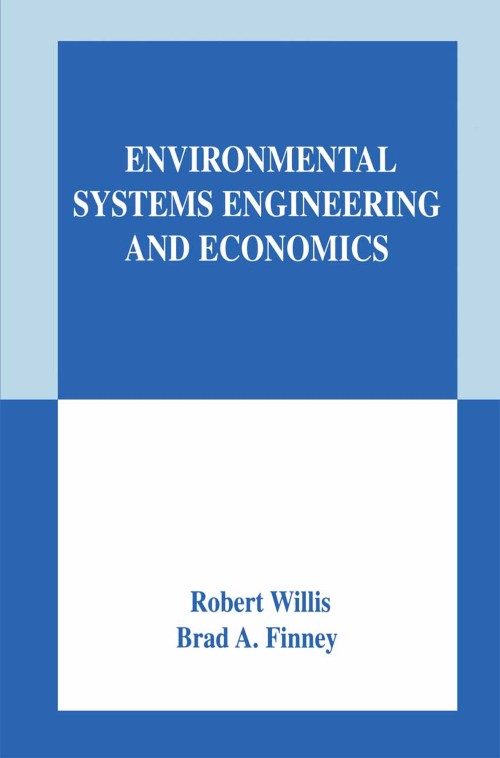
Environmental Systems Engineering and Economics [electronic resource] / by Robert Willis, Brad A. Finney.
Erişim Adresi
ISBN
9781461504795
Dil Kodu
İngilizce
Yer Numarası
DK/13072
Yazar
Basım Bildirimi
1st ed. 2004.
Yayın Bilgisi
New York, NY : Springer US : Imprint: Springer, 2004.
Fiziksel Niteleme
XIII, 468 p. online resource.
İçindekiler Notu
1. Introduction to Environmental Systems Engineering -- 1.1 Introduction -- 1.2 Systems Engineering -- 1.3 Mathematical Models -- 1.4 The Systems Engineering Problem -- 1.5 Systems Engineering Problems -- 1.6 The Model Building Process -- 1.7 Simulation Modeling -- 1.8 Optimization Modeling -- References -- Problems -- 2. An Introduction to Optimization Theory -- 2.1 Introduction -- 2.2 Classification of Optimization Models -- 2.3 Geometry of the Mathematical Optimization Problem -- 2.4 Nonlinear Optimization and Types of Maxima -- 2.5 Convex Sets and Functions -- 2.6 Weierstrass Theorems -- 2.7 The Local-Global Theorem -- 2.8 The Kuhn-Tucker Conditions -- 2.9 The Kuhn-Tucker Theorem -- 2.10 Interpretation of the Lagrange Multipliers -- 2.11 The Saddle Point Problem -- 2.12 Maximin Dual Problem -- References -- Problems -- 3. Microeconomics: Theory of Production -- 3.1 Introduction -- 3.2 The Competitive Economy -- 3.3 The Production Function -- 3.4 Theory of the Firm -- 3.5 Maximum Output Model -- 3.6 Production Optimization -- 3.7 Comparative Statics of the Firm -- 3.8 Public Project Evaluation -- 3.9 Case Study 1— Agricultural Benefits -- References -- Problems -- 4. Microeconomics: Theory of the Household -- 4.1 Introduction -- 4.2 Commodity Space and Preference Relations -- 4.3 Theory of the Household -- 4.4 Comparative Statics -- 4.5 General Equilibrium -- 4.6 Market Equilibrium -- References -- Problems -- 5. Engineering Economics -- 5.1 Introduction -- 5.2 The Time Value of Money -- 5.3 Engineering Economic Formulas -- 5.4 Evaluation of Alternatives -- 5.5 Present Worth Method -- 5.6 Annual Worth Method -- 5.7 Benefit Cost Ratio -- 5.8 Internal Rate of Return -- 5.9 Depreciation and Income Tax Analysis -- 5.10 Inflation -- References -- Problems -- 6. Linear Programming -- 6.1 Introduction -- 6.2 Optimality of LinearProgramming Problems -- 6.3 Standard Form -- 6.4 Basic and Basic Feasible Solutions -- 6.5 The Simplex Algorithm -- 6.6 The Simplex Tableau -- 6.7 The Two-Phase Method -- 6.8 General Summary of the Simplex Algorithm -- 6.9 Duality -- 6.10 Matrix Representation of the Simplex Method -- 6.11 Economic Interpretation of the Dual Problem -- 6.12 The Revised Simplex Method -- 6.13 Sensitivity Analysis -- 6.14 Large-Scale Linear Programming Models -- 6.15 Case Study 1 Groundwater Planning -- References -- Problems -- 7. Nonlinear Programming -- 7.1 Introduction -- 7.2 Unconstrained Optimization Methods -- 7.3 Gradient-Based Methods -- 7.4 Constrained Optimization Methods -- 7.5 Case Study 1 North China Plain Water Management -- 7.6 Dynamic Programming -- 7.7 Case Study 2 Water Quality Management -- 7.8 linked Simulation-Optimization Methodology -- 7.9 Case Study 3 Management of Saltwater Intrusion -- 7.10 Case Study 4 Groundwater Remediation -- 7.11 Multiobjective Optimization -- 7.12 Case Study 5 Equity in Water Quality Management -- References -- Problems -- Appendix A. Review of Mathematics -- A.1 Introduction -- A.2 Analysis -- A.3 Vectors and Matrices -- A.4 Matrix Operations -- A.5 Determinants and the Matrix Inverse -- A.6 Quadratic Forms -- A.7 Scalar, Vector, and Matrix Derivatives -- A.8 Directional Derivative -- A.9 Eigenvalues and Eigenvectors -- A.10 Implicit Function Theorem -- A.ll Taylor Series -- A.12 Leibnitz’s Rule -- References -- Appendix B. Classical Optimization -- B.1 Introduction -- B.2 The Unconstrained Optimization Problem -- B.3 The Lagrange Multiplier Method -- B.4 The Lagrange Multiplier -- References.
Özet, vb.
Environmental Systems Engineering and Economics emphasizes the application of optimization, economics, and systems engineering to problems in environmental resources management. This senior level/graduate textbook introduces optimization theory and algorithms that have been successful in resolving water quality and groundwater management problems. Both linear programming and nonlinear optimization are presented. Multiobjective optimization and the linked simulation-optimization (LSO) methodology are also introduced. The basic principles of economics and engineering economics are also discussed to provide a framework for economic decision making. This text contains numerous example problems. Case studies are presented that address water resources management issues in the north China plain, the control of saltwater intrusion in Jakarta, Indonesia, and groundwater resources management in the Yun Lin basin, Taiwan.
Konu
Philosophy.
Pollution.
Environmental economics.
Dynamics.
Nonlinear theories.
Geology.
Philosophy.
Pollution.
Environmental Economics.
Applied Dynamical Systems.
Geology.
Pollution.
Environmental economics.
Dynamics.
Nonlinear theories.
Geology.
Philosophy.
Pollution.
Environmental Economics.
Applied Dynamical Systems.
Geology.
Diğer Yazarlar
Kurum Adı
Eseri Alıntıla
Referansları kullanmadan önce gözden geçirmeniz ve varsa gerekli düzeltmeleri yapmanız önerilir.
Dijital Kaynak
MARC Görünümü
LEADER 07115nam a22006255i 4500
001 811814
003 TR_AnAIT
005 20260131004521
007 cr nn 008mamaa
008 121227s2004 xxu| s |||| 0|eng d
020 |a9781461504795|9978-1-4615-0479-5
024 7 |a10.1007/978-1-4615-0479-5|2doi
041 |aeng
049 |aTürk Tarih Kurumu Kütüphanesi
050 4|aB1-5802
072 7|aHP|2bicssc
072 7|aPHI000000|2bisacsh
072 7|aQD|2thema
082 04|a100|223
090 |aDK/13072
100 1 |aWillis, Robert.|eauthor.|4aut|4http://id.loc.gov/vocabulary/relators/aut
245 10|aEnvironmental Systems Engineering and Economics|h[electronic resource] /|cby Robert Willis, Brad A. Finney.
250 |a1st ed. 2004.
264 1|aNew York, NY :|bSpringer US :|bImprint: Springer,|c2004.
300 |aXIII, 468 p.|bonline resource.
336 |atext|btxt|2rdacontent
337 |acomputer|bc|2rdamedia
338 |aonline resource|bcr|2rdacarrier
347 |atext file|bPDF|2rda
505 0 |a1. Introduction to Environmental Systems Engineering -- 1.1 Introduction -- 1.2 Systems Engineering -- 1.3 Mathematical Models -- 1.4 The Systems Engineering Problem -- 1.5 Systems Engineering Problems -- 1.6 The Model Building Process -- 1.7 Simulation Modeling -- 1.8 Optimization Modeling -- References -- Problems -- 2. An Introduction to Optimization Theory -- 2.1 Introduction -- 2.2 Classification of Optimization Models -- 2.3 Geometry of the Mathematical Optimization Problem -- 2.4 Nonlinear Optimization and Types of Maxima -- 2.5 Convex Sets and Functions -- 2.6 Weierstrass Theorems -- 2.7 The Local-Global Theorem -- 2.8 The Kuhn-Tucker Conditions -- 2.9 The Kuhn-Tucker Theorem -- 2.10 Interpretation of the Lagrange Multipliers -- 2.11 The Saddle Point Problem -- 2.12 Maximin Dual Problem -- References -- Problems -- 3. Microeconomics: Theory of Production -- 3.1 Introduction -- 3.2 The Competitive Economy -- 3.3 The Production Function -- 3.4 Theory of the Firm -- 3.5 Maximum Output Model -- 3.6 Production Optimization -- 3.7 Comparative Statics of the Firm -- 3.8 Public Project Evaluation -- 3.9 Case Study 1— Agricultural Benefits -- References -- Problems -- 4. Microeconomics: Theory of the Household -- 4.1 Introduction -- 4.2 Commodity Space and Preference Relations -- 4.3 Theory of the Household -- 4.4 Comparative Statics -- 4.5 General Equilibrium -- 4.6 Market Equilibrium -- References -- Problems -- 5. Engineering Economics -- 5.1 Introduction -- 5.2 The Time Value of Money -- 5.3 Engineering Economic Formulas -- 5.4 Evaluation of Alternatives -- 5.5 Present Worth Method -- 5.6 Annual Worth Method -- 5.7 Benefit Cost Ratio -- 5.8 Internal Rate of Return -- 5.9 Depreciation and Income Tax Analysis -- 5.10 Inflation -- References -- Problems -- 6. Linear Programming -- 6.1 Introduction -- 6.2 Optimality of LinearProgramming Problems -- 6.3 Standard Form -- 6.4 Basic and Basic Feasible Solutions -- 6.5 The Simplex Algorithm -- 6.6 The Simplex Tableau -- 6.7 The Two-Phase Method -- 6.8 General Summary of the Simplex Algorithm -- 6.9 Duality -- 6.10 Matrix Representation of the Simplex Method -- 6.11 Economic Interpretation of the Dual Problem -- 6.12 The Revised Simplex Method -- 6.13 Sensitivity Analysis -- 6.14 Large-Scale Linear Programming Models -- 6.15 Case Study 1 Groundwater Planning -- References -- Problems -- 7. Nonlinear Programming -- 7.1 Introduction -- 7.2 Unconstrained Optimization Methods -- 7.3 Gradient-Based Methods -- 7.4 Constrained Optimization Methods -- 7.5 Case Study 1 North China Plain Water Management -- 7.6 Dynamic Programming -- 7.7 Case Study 2 Water Quality Management -- 7.8 linked Simulation-Optimization Methodology -- 7.9 Case Study 3 Management of Saltwater Intrusion -- 7.10 Case Study 4 Groundwater Remediation -- 7.11 Multiobjective Optimization -- 7.12 Case Study 5 Equity in Water Quality Management -- References -- Problems -- Appendix A. Review of Mathematics -- A.1 Introduction -- A.2 Analysis -- A.3 Vectors and Matrices -- A.4 Matrix Operations -- A.5 Determinants and the Matrix Inverse -- A.6 Quadratic Forms -- A.7 Scalar, Vector, and Matrix Derivatives -- A.8 Directional Derivative -- A.9 Eigenvalues and Eigenvectors -- A.10 Implicit Function Theorem -- A.ll Taylor Series -- A.12 Leibnitz’s Rule -- References -- Appendix B. Classical Optimization -- B.1 Introduction -- B.2 The Unconstrained Optimization Problem -- B.3 The Lagrange Multiplier Method -- B.4 The Lagrange Multiplier -- References.
520 |aEnvironmental Systems Engineering and Economics emphasizes the application of optimization, economics, and systems engineering to problems in environmental resources management. This senior level/graduate textbook introduces optimization theory and algorithms that have been successful in resolving water quality and groundwater management problems. Both linear programming and nonlinear optimization are presented. Multiobjective optimization and the linked simulation-optimization (LSO) methodology are also introduced. The basic principles of economics and engineering economics are also discussed to provide a framework for economic decision making. This text contains numerous example problems. Case studies are presented that address water resources management issues in the north China plain, the control of saltwater intrusion in Jakarta, Indonesia, and groundwater resources management in the Yun Lin basin, Taiwan.
532 8 |aAccessibility summary: This PDF is not accessible. It is based on scanned pages and does not support features such as screen reader compatibility or described non-text content (images, graphs etc). However, it likely supports searchable and selectable text based on OCR (Optical Character Recognition). Users with accessibility needs may not be able to use this content effectively. Please contact us at accessibilitysupport@springernature.com if you require assistance or an alternative format.
532 8 |aInaccessible, or known limited accessibility
532 8 |aNo reading system accessibility options actively disabled
532 8 |aPublisher contact for further accessibility information: accessibilitysupport@springernature.com
650 0|aPhilosophy.
650 0|aPollution.
650 0|aEnvironmental economics.
650 0|aDynamics.
650 0|aNonlinear theories.
650 0|aGeology.
650 14|aPhilosophy.
650 24|aPollution.
650 24|aEnvironmental Economics.
650 24|aApplied Dynamical Systems.
650 24|aGeology.
700 1 |aFinney, Brad A.|eauthor.|4aut|4http://id.loc.gov/vocabulary/relators/aut
710 2 |aSpringerLink (Online service)
773 0 |tSpringer Nature eBook
776 08|iPrinted edition:|z9781402076695
776 08|iPrinted edition:|z9781461504801
776 08|iPrinted edition:|z9781461350972
856 40|uhttps://doi.org/10.1007/978-1-4615-0479-5
912 |aZDB-2-SHU
912 |aZDB-2-SXPR
912 |aZDB-2-BAE
950 |aHumanities, Social Sciences and Law (SpringerNature-11648)
950 |aPhilosophy and Religion (R0) (SpringerNature-43725)
001 811814
003 TR_AnAIT
005 20260131004521
007 cr nn 008mamaa
008 121227s2004 xxu| s |||| 0|eng d
020 |a9781461504795|9978-1-4615-0479-5
024 7 |a10.1007/978-1-4615-0479-5|2doi
041 |aeng
049 |aTürk Tarih Kurumu Kütüphanesi
050 4|aB1-5802
072 7|aHP|2bicssc
072 7|aPHI000000|2bisacsh
072 7|aQD|2thema
082 04|a100|223
090 |aDK/13072
100 1 |aWillis, Robert.|eauthor.|4aut|4http://id.loc.gov/vocabulary/relators/aut
245 10|aEnvironmental Systems Engineering and Economics|h[electronic resource] /|cby Robert Willis, Brad A. Finney.
250 |a1st ed. 2004.
264 1|aNew York, NY :|bSpringer US :|bImprint: Springer,|c2004.
300 |aXIII, 468 p.|bonline resource.
336 |atext|btxt|2rdacontent
337 |acomputer|bc|2rdamedia
338 |aonline resource|bcr|2rdacarrier
347 |atext file|bPDF|2rda
505 0 |a1. Introduction to Environmental Systems Engineering -- 1.1 Introduction -- 1.2 Systems Engineering -- 1.3 Mathematical Models -- 1.4 The Systems Engineering Problem -- 1.5 Systems Engineering Problems -- 1.6 The Model Building Process -- 1.7 Simulation Modeling -- 1.8 Optimization Modeling -- References -- Problems -- 2. An Introduction to Optimization Theory -- 2.1 Introduction -- 2.2 Classification of Optimization Models -- 2.3 Geometry of the Mathematical Optimization Problem -- 2.4 Nonlinear Optimization and Types of Maxima -- 2.5 Convex Sets and Functions -- 2.6 Weierstrass Theorems -- 2.7 The Local-Global Theorem -- 2.8 The Kuhn-Tucker Conditions -- 2.9 The Kuhn-Tucker Theorem -- 2.10 Interpretation of the Lagrange Multipliers -- 2.11 The Saddle Point Problem -- 2.12 Maximin Dual Problem -- References -- Problems -- 3. Microeconomics: Theory of Production -- 3.1 Introduction -- 3.2 The Competitive Economy -- 3.3 The Production Function -- 3.4 Theory of the Firm -- 3.5 Maximum Output Model -- 3.6 Production Optimization -- 3.7 Comparative Statics of the Firm -- 3.8 Public Project Evaluation -- 3.9 Case Study 1— Agricultural Benefits -- References -- Problems -- 4. Microeconomics: Theory of the Household -- 4.1 Introduction -- 4.2 Commodity Space and Preference Relations -- 4.3 Theory of the Household -- 4.4 Comparative Statics -- 4.5 General Equilibrium -- 4.6 Market Equilibrium -- References -- Problems -- 5. Engineering Economics -- 5.1 Introduction -- 5.2 The Time Value of Money -- 5.3 Engineering Economic Formulas -- 5.4 Evaluation of Alternatives -- 5.5 Present Worth Method -- 5.6 Annual Worth Method -- 5.7 Benefit Cost Ratio -- 5.8 Internal Rate of Return -- 5.9 Depreciation and Income Tax Analysis -- 5.10 Inflation -- References -- Problems -- 6. Linear Programming -- 6.1 Introduction -- 6.2 Optimality of LinearProgramming Problems -- 6.3 Standard Form -- 6.4 Basic and Basic Feasible Solutions -- 6.5 The Simplex Algorithm -- 6.6 The Simplex Tableau -- 6.7 The Two-Phase Method -- 6.8 General Summary of the Simplex Algorithm -- 6.9 Duality -- 6.10 Matrix Representation of the Simplex Method -- 6.11 Economic Interpretation of the Dual Problem -- 6.12 The Revised Simplex Method -- 6.13 Sensitivity Analysis -- 6.14 Large-Scale Linear Programming Models -- 6.15 Case Study 1 Groundwater Planning -- References -- Problems -- 7. Nonlinear Programming -- 7.1 Introduction -- 7.2 Unconstrained Optimization Methods -- 7.3 Gradient-Based Methods -- 7.4 Constrained Optimization Methods -- 7.5 Case Study 1 North China Plain Water Management -- 7.6 Dynamic Programming -- 7.7 Case Study 2 Water Quality Management -- 7.8 linked Simulation-Optimization Methodology -- 7.9 Case Study 3 Management of Saltwater Intrusion -- 7.10 Case Study 4 Groundwater Remediation -- 7.11 Multiobjective Optimization -- 7.12 Case Study 5 Equity in Water Quality Management -- References -- Problems -- Appendix A. Review of Mathematics -- A.1 Introduction -- A.2 Analysis -- A.3 Vectors and Matrices -- A.4 Matrix Operations -- A.5 Determinants and the Matrix Inverse -- A.6 Quadratic Forms -- A.7 Scalar, Vector, and Matrix Derivatives -- A.8 Directional Derivative -- A.9 Eigenvalues and Eigenvectors -- A.10 Implicit Function Theorem -- A.ll Taylor Series -- A.12 Leibnitz’s Rule -- References -- Appendix B. Classical Optimization -- B.1 Introduction -- B.2 The Unconstrained Optimization Problem -- B.3 The Lagrange Multiplier Method -- B.4 The Lagrange Multiplier -- References.
520 |aEnvironmental Systems Engineering and Economics emphasizes the application of optimization, economics, and systems engineering to problems in environmental resources management. This senior level/graduate textbook introduces optimization theory and algorithms that have been successful in resolving water quality and groundwater management problems. Both linear programming and nonlinear optimization are presented. Multiobjective optimization and the linked simulation-optimization (LSO) methodology are also introduced. The basic principles of economics and engineering economics are also discussed to provide a framework for economic decision making. This text contains numerous example problems. Case studies are presented that address water resources management issues in the north China plain, the control of saltwater intrusion in Jakarta, Indonesia, and groundwater resources management in the Yun Lin basin, Taiwan.
532 8 |aAccessibility summary: This PDF is not accessible. It is based on scanned pages and does not support features such as screen reader compatibility or described non-text content (images, graphs etc). However, it likely supports searchable and selectable text based on OCR (Optical Character Recognition). Users with accessibility needs may not be able to use this content effectively. Please contact us at accessibilitysupport@springernature.com if you require assistance or an alternative format.
532 8 |aInaccessible, or known limited accessibility
532 8 |aNo reading system accessibility options actively disabled
532 8 |aPublisher contact for further accessibility information: accessibilitysupport@springernature.com
650 0|aPhilosophy.
650 0|aPollution.
650 0|aEnvironmental economics.
650 0|aDynamics.
650 0|aNonlinear theories.
650 0|aGeology.
650 14|aPhilosophy.
650 24|aPollution.
650 24|aEnvironmental Economics.
650 24|aApplied Dynamical Systems.
650 24|aGeology.
700 1 |aFinney, Brad A.|eauthor.|4aut|4http://id.loc.gov/vocabulary/relators/aut
710 2 |aSpringerLink (Online service)
773 0 |tSpringer Nature eBook
776 08|iPrinted edition:|z9781402076695
776 08|iPrinted edition:|z9781461504801
776 08|iPrinted edition:|z9781461350972
856 40|uhttps://doi.org/10.1007/978-1-4615-0479-5
912 |aZDB-2-SHU
912 |aZDB-2-SXPR
912 |aZDB-2-BAE
950 |aHumanities, Social Sciences and Law (SpringerNature-11648)
950 |aPhilosophy and Religion (R0) (SpringerNature-43725)
Materyaller
Depodan talep edilen materyal sadece kütüphane içerisinde kullanılmaktadır.
Materyal dışarıya ödünç verilmemektedir.
Materyal dışarıya ödünç verilmemektedir.
