

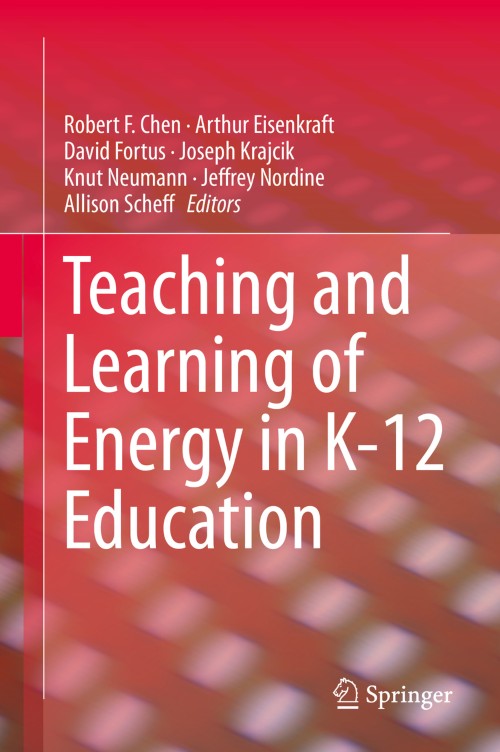
Teaching and Learning of Energy in K – 12 Education [electronic resource] / edited by Robert F. Chen, Arthur Eisenkraft, David Fortus, Joseph Krajcik, Knut Neumann, Jeffrey Nordine, Allison Scheff.
Erişim Adresi
ISBN
9783319050171
Dil Kodu
İngilizce
Yer Numarası
DK/13124
Basım Bildirimi
1st ed. 2014.
Yayın Bilgisi
Cham : Springer International Publishing : Imprint: Springer, 2014.
Fiziksel Niteleme
IX, 379 p. 35 illus., 16 illus. in color. online resource.
İçindekiler Notu
Introduction -- A Physicist’s Musings on Teaching about Energy -- A Space Physicist’s Perspective on Energy Transformations and Implications for Teaching about Energy at All Levels -- Conservation of Energy: An Analytical Tool for Student Accounts of Carbon-Transforming Processes -- Developing Energy Conception of Students in Chemistry: Research on the Learning and Teaching of Energy -- Teaching and Learning the Physics Energy Concept -- Mapping Energy in the Boston Public Schools Curriculum -- Developing and Using Distractor-Driven Multiple-Choice Assessments Aligned to Ideas about Energy Forms, Transformation, Transfer, and Conservations -- Towards a Research-Informed Teaching Sequence for Energy -- Contextual Dimensions of the Energy Concept and Implications for Energy Teaching and Learning -- A Tale of Two Energies: What Do History, Language, and Research Tell Us about Students’ Understanding of Energy? -- Distinctive Features and Underlying Rationale of a Philosophically-Informed Approach for Energy Teaching -- Repairing Engineering Students’ Misconceptions about Energy and Thermodynamics -- Looking through the Energy Lens: A Proposed Learning Progression for Energy in Grades 3-5 -- Opportunities for Reasoning about Energy within Elementary School Engineering Experiences -- The Energy Project: Constructing a Sustainable Foundation for Thinking and Learning about Energy in the 21st Century -- Launching the Space Shuttle by Making Water: The Chemists View of Energy -- Several Often-Neglected Perspectives of Energy in Chemical Education -- Energy in Chemical Systems -- Conclusion and Future Directions.
Özet, vb.
This volume presents current thoughts, research, and findings that were presented at a summit focusing on energy as a cross-cutting concept in education, involving scientists, science education researchers and science educators from across the world. The chapters cover four key questions: what should students know about energy, what can we learn from research on teaching and learning about energy, what are the challenges we are currently facing in teaching students this knowledge, and what needs be done to meet these challenges in the future? Energy is one of the most important ideas in all of science and it is useful for predicting and explaining phenomena within every scientific discipline. The challenge for teachers is to respond to recent policies requiring them to teach not only about energy as a disciplinary idea but also about energy as an analytical framework that cuts across disciplines. Teaching energy as a crosscutting concept can equip a new generation of scientistsand engineers to think about the latest cross-disciplinary problems, and it requires a new approach to the idea of energy. This book examines the latest challenges of K-12 teaching about energy, including how a comprehensive understanding of energy can be developed. The authors present innovative strategies for learning and teaching about energy, revealing overlapping and diverging views from scientists and science educators. The reader will discover investigations into the learning progression of energy, how understanding of energy can be examined, and proposals for future directions for work in this arena. Science teachers and educators, science education researchers and scientists themselves will all find the discussions and research presented in this book engaging and informative. .
Konu
Science __ Study and teaching.
Energy policy.
Energy and state.
Learning, Psychology of.
Science Education.
Energy Policy, Economics and Management.
Instructional Psychology.
Energy policy.
Energy and state.
Learning, Psychology of.
Science Education.
Energy Policy, Economics and Management.
Instructional Psychology.
Diğer Yazarlar
Kurum Adı
Eseri Alıntıla
Referansları kullanmadan önce gözden geçirmeniz ve varsa gerekli düzeltmeleri yapmanız önerilir.
Dijital Kaynak
MARC Görünümü
LEADER 05896nam a22006015i 4500
001 811866
003 TR_AnAIT
005 20260131004339
007 cr nn 008mamaa
008 140409s2014 sz | s |||| 0|eng d
020 |a9783319050171|9978-3-319-05017-1
024 7 |a10.1007/978-3-319-05017-1|2doi
041 |aeng
049 |aTürk Tarih Kurumu Kütüphanesi
050 4|aQ181-183.4
072 7|aJNU|2bicssc
072 7|aPD|2bicssc
072 7|aSCI063000|2bisacsh
072 7|aJNU|2thema
072 7|aPD|2thema
082 04|a507.1|223
090 |aDK/13124
245 10|aTeaching and Learning of Energy in K – 12 Education|h[electronic resource] /|cedited by Robert F. Chen, Arthur Eisenkraft, David Fortus, Joseph Krajcik, Knut Neumann, Jeffrey Nordine, Allison Scheff.
250 |a1st ed. 2014.
264 1|aCham :|bSpringer International Publishing :|bImprint: Springer,|c2014.
300 |aIX, 379 p. 35 illus., 16 illus. in color.|bonline resource.
336 |atext|btxt|2rdacontent
337 |acomputer|bc|2rdamedia
338 |aonline resource|bcr|2rdacarrier
347 |atext file|bPDF|2rda
505 0 |aIntroduction -- A Physicist’s Musings on Teaching about Energy -- A Space Physicist’s Perspective on Energy Transformations and Implications for Teaching about Energy at All Levels -- Conservation of Energy: An Analytical Tool for Student Accounts of Carbon-Transforming Processes -- Developing Energy Conception of Students in Chemistry: Research on the Learning and Teaching of Energy -- Teaching and Learning the Physics Energy Concept -- Mapping Energy in the Boston Public Schools Curriculum -- Developing and Using Distractor-Driven Multiple-Choice Assessments Aligned to Ideas about Energy Forms, Transformation, Transfer, and Conservations -- Towards a Research-Informed Teaching Sequence for Energy -- Contextual Dimensions of the Energy Concept and Implications for Energy Teaching and Learning -- A Tale of Two Energies: What Do History, Language, and Research Tell Us about Students’ Understanding of Energy? -- Distinctive Features and Underlying Rationale of a Philosophically-Informed Approach for Energy Teaching -- Repairing Engineering Students’ Misconceptions about Energy and Thermodynamics -- Looking through the Energy Lens: A Proposed Learning Progression for Energy in Grades 3-5 -- Opportunities for Reasoning about Energy within Elementary School Engineering Experiences -- The Energy Project: Constructing a Sustainable Foundation for Thinking and Learning about Energy in the 21st Century -- Launching the Space Shuttle by Making Water: The Chemists View of Energy -- Several Often-Neglected Perspectives of Energy in Chemical Education -- Energy in Chemical Systems -- Conclusion and Future Directions.
520 |aThis volume presents current thoughts, research, and findings that were presented at a summit focusing on energy as a cross-cutting concept in education, involving scientists, science education researchers and science educators from across the world. The chapters cover four key questions: what should students know about energy, what can we learn from research on teaching and learning about energy, what are the challenges we are currently facing in teaching students this knowledge, and what needs be done to meet these challenges in the future? Energy is one of the most important ideas in all of science and it is useful for predicting and explaining phenomena within every scientific discipline. The challenge for teachers is to respond to recent policies requiring them to teach not only about energy as a disciplinary idea but also about energy as an analytical framework that cuts across disciplines. Teaching energy as a crosscutting concept can equip a new generation of scientistsand engineers to think about the latest cross-disciplinary problems, and it requires a new approach to the idea of energy. This book examines the latest challenges of K-12 teaching about energy, including how a comprehensive understanding of energy can be developed. The authors present innovative strategies for learning and teaching about energy, revealing overlapping and diverging views from scientists and science educators. The reader will discover investigations into the learning progression of energy, how understanding of energy can be examined, and proposals for future directions for work in this arena. Science teachers and educators, science education researchers and scientists themselves will all find the discussions and research presented in this book engaging and informative. .
650 0|aScience|xStudy and teaching.
650 0|aEnergy policy.
650 0|aEnergy and state.
650 0|aLearning, Psychology of.
650 14|aScience Education.
650 24|aEnergy Policy, Economics and Management.
650 24|aInstructional Psychology.
700 1 |aChen, Robert F.|eeditor.|4edt|4http://id.loc.gov/vocabulary/relators/edt
700 1 |aEisenkraft, Arthur.|eeditor.|4edt|4http://id.loc.gov/vocabulary/relators/edt
700 1 |aFortus, David.|eeditor.|4edt|4http://id.loc.gov/vocabulary/relators/edt
700 1 |aKrajcik, Joseph.|eeditor.|4edt|4http://id.loc.gov/vocabulary/relators/edt
700 1 |aNeumann, Knut.|eeditor.|4edt|4http://id.loc.gov/vocabulary/relators/edt
700 1 |aNordine, Jeffrey.|eeditor.|4edt|4http://id.loc.gov/vocabulary/relators/edt
700 1 |aScheff, Allison.|eeditor.|4edt|4http://id.loc.gov/vocabulary/relators/edt
710 2 |aSpringerLink (Online service)
773 0 |tSpringer Nature eBook
776 08|iPrinted edition:|z9783319050164
776 08|iPrinted edition:|z9783319050188
776 08|iPrinted edition:|z9783319348032
856 40|uhttps://doi.org/10.1007/978-3-319-05017-1
912 |aZDB-2-SHU
912 |aZDB-2-SXED
950 |aHumanities, Social Sciences and Law (SpringerNature-11648)
950 |aEducation (R0) (SpringerNature-43721)
Materyaller
Depodan talep edilen materyal sadece kütüphane içerisinde kullanılmaktadır.
Materyal dışarıya ödünç verilmemektedir.
Materyal dışarıya ödünç verilmemektedir.
