

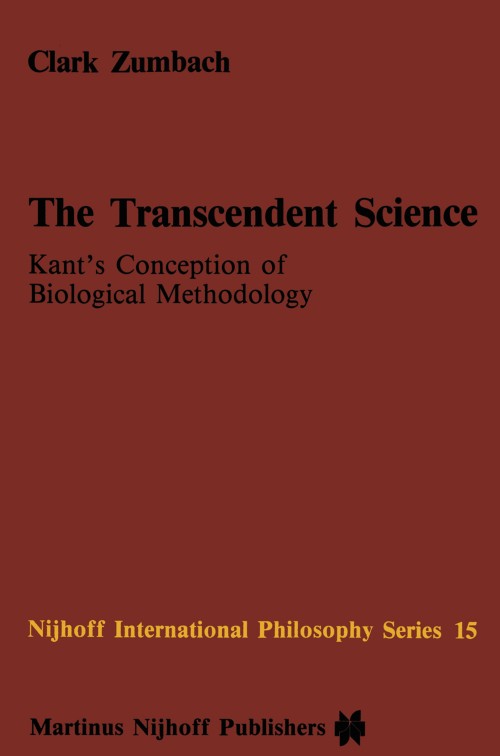
The Transcendent Science [electronic resource] : Kant’s Conception of Biological Methodology / by C. Zumbach.
Erişim Adresi
ISBN
9789400961043
Dil Kodu
İngilizce
Yer Numarası
DK/13138
Yazar
Basım Bildirimi
1st ed. 1984.
Yayın Bilgisi
Dordrecht : Springer Netherlands : Imprint: Springer, 1984.
Fiziksel Niteleme
180 p. online resource.
Dizi
Nijhoff International Philosophy Series ; 15
İçindekiler Notu
I: Teleological Phenomena -- 1. Teleology and reduction: Preliminaries -- 2. Purposiveness and designedness -- 3. Relative purposiveness -- 4. Internal purposiveness -- II: The Kantian Endeavor -- 1. The Critical methodology -- 2. The quest for unity and the Critique of Judgment -- 3. The Critique of Aesthetic Judgment and the Critique of Teleological Judgment -- III: Design in Nature -- 1. Is purposiveness designedness? -- 2. The empirical question -- 3. Two methodological objections -- IV: The Mechanism of Nature -- 1. Mechanism vs. vitalism, preformation vs. epigenesis -- 2. Reductionism in Kant -- 3. Kant’s anti-reductionism -- 4. The freedom of vital phenomena -- V: The Autonomy of Biology -- 1. Kant’s projectionism -- 2. Kant’s explanatory systematic unity -- 3. A natural dialectic -- 4. A noumenal question -- Appendix: Leibniz and the Second Analogy.
Özet, vb.
The most neglected sector of Kant's Critical Philosophy is his collec tion of remarks about biological phenomena in the second part of the Critique of Judgment, the Critique of Teleological Judgment. The reasons for this are numerous, but since in Kant, everything comes in threes, a three-fold collection will suffice. The Critique of Teleological Judgment itself is one reason. More than most of his writings, this segment of the Critical corpus suffers from what can most charitably be termed "mistakes of exposition. " In this part of the third Critique, it is commonplace to find sub-arguments in Kant's general position somewhere other than their logical niche. The result is that the general theme behind his remarks about living phenomena is obscured. This difficulty has done much to discourage even the most enthusiastic of Kant admirers from investing their time on this work. Secondly, in this century, until very recently, there has been little interest in philosophical questions about biology. Twenty-one out of thirty-one sections of the Critique of Teleological Judgment (sections #61 and 63-83) deal either directly or indirectly with issues of interest in the philosophy of biology. Finally, the Critique of Teleological Judgment has been placed among the last on that list "of writings thought to formulate Kant's Critical system. This is not merely because of its temporal position.
Konu
Biology __ Philosophy.
Life sciences.
Philosophy of Biology.
Life Sciences.
Life sciences.
Philosophy of Biology.
Life Sciences.
Kurum Adı
Eseri Alıntıla
Referansları kullanmadan önce gözden geçirmeniz ve varsa gerekli düzeltmeleri yapmanız önerilir.
Dijital Kaynak
MARC Görünümü
LEADER 04841nam a22005775i 4500
001 811880
003 TR_AnAIT
005 20260131004241
007 cr nn 008mamaa
008 121227s1984 ne | s |||| 0|eng d
020 |a9789400961043|9978-94-009-6104-3
024 7 |a10.1007/978-94-009-6104-3|2doi
041 |aeng
049 |aTürk Tarih Kurumu Kütüphanesi
050 4|aQH331
072 7|aHP|2bicssc
072 7|aPS|2bicssc
072 7|aSCI075000|2bisacsh
072 7|aQD|2thema
072 7|aPS|2thema
082 04|a570.1|223
090 |aDK/13138
100 1 |aZumbach, C.|eauthor.|4aut|4http://id.loc.gov/vocabulary/relators/aut
245 14|aThe Transcendent Science|h[electronic resource] :|bKant’s Conception of Biological Methodology /|cby C. Zumbach.
250 |a1st ed. 1984.
264 1|aDordrecht :|bSpringer Netherlands :|bImprint: Springer,|c1984.
300 |a180 p.|bonline resource.
336 |atext|btxt|2rdacontent
337 |acomputer|bc|2rdamedia
338 |aonline resource|bcr|2rdacarrier
347 |atext file|bPDF|2rda
490 1 |aNijhoff International Philosophy Series ;|v15
505 0 |aI: Teleological Phenomena -- 1. Teleology and reduction: Preliminaries -- 2. Purposiveness and designedness -- 3. Relative purposiveness -- 4. Internal purposiveness -- II: The Kantian Endeavor -- 1. The Critical methodology -- 2. The quest for unity and the Critique of Judgment -- 3. The Critique of Aesthetic Judgment and the Critique of Teleological Judgment -- III: Design in Nature -- 1. Is purposiveness designedness? -- 2. The empirical question -- 3. Two methodological objections -- IV: The Mechanism of Nature -- 1. Mechanism vs. vitalism, preformation vs. epigenesis -- 2. Reductionism in Kant -- 3. Kant’s anti-reductionism -- 4. The freedom of vital phenomena -- V: The Autonomy of Biology -- 1. Kant’s projectionism -- 2. Kant’s explanatory systematic unity -- 3. A natural dialectic -- 4. A noumenal question -- Appendix: Leibniz and the Second Analogy.
520 |aThe most neglected sector of Kant's Critical Philosophy is his collec tion of remarks about biological phenomena in the second part of the Critique of Judgment, the Critique of Teleological Judgment. The reasons for this are numerous, but since in Kant, everything comes in threes, a three-fold collection will suffice. The Critique of Teleological Judgment itself is one reason. More than most of his writings, this segment of the Critical corpus suffers from what can most charitably be termed "mistakes of exposition. " In this part of the third Critique, it is commonplace to find sub-arguments in Kant's general position somewhere other than their logical niche. The result is that the general theme behind his remarks about living phenomena is obscured. This difficulty has done much to discourage even the most enthusiastic of Kant admirers from investing their time on this work. Secondly, in this century, until very recently, there has been little interest in philosophical questions about biology. Twenty-one out of thirty-one sections of the Critique of Teleological Judgment (sections #61 and 63-83) deal either directly or indirectly with issues of interest in the philosophy of biology. Finally, the Critique of Teleological Judgment has been placed among the last on that list "of writings thought to formulate Kant's Critical system. This is not merely because of its temporal position.
532 8 |aAccessibility summary: This PDF is not accessible. It is based on scanned pages and does not support features such as screen reader compatibility or described non-text content (images, graphs etc). However, it likely supports searchable and selectable text based on OCR (Optical Character Recognition). Users with accessibility needs may not be able to use this content effectively. Please contact us at accessibilitysupport@springernature.com if you require assistance or an alternative format.
532 8 |aInaccessible, or known limited accessibility
532 8 |aNo reading system accessibility options actively disabled
532 8 |aPublisher contact for further accessibility information: accessibilitysupport@springernature.com
650 0|aBiology|xPhilosophy.
650 0|aLife sciences.
650 14|aPhilosophy of Biology.
650 24|aLife Sciences.
710 2 |aSpringerLink (Online service)
773 0 |tSpringer Nature eBook
776 08|iPrinted edition:|z9789024729043
776 08|iPrinted edition:|z9789400961050
776 08|iPrinted edition:|z9789400961067
830 0|aNijhoff International Philosophy Series ;|v15
856 40|uhttps://doi.org/10.1007/978-94-009-6104-3
912 |aZDB-2-SHU
912 |aZDB-2-SXPR
912 |aZDB-2-BAE
950 |aHumanities, Social Sciences and Law (SpringerNature-11648)
950 |aPhilosophy and Religion (R0) (SpringerNature-43725)
001 811880
003 TR_AnAIT
005 20260131004241
007 cr nn 008mamaa
008 121227s1984 ne | s |||| 0|eng d
020 |a9789400961043|9978-94-009-6104-3
024 7 |a10.1007/978-94-009-6104-3|2doi
041 |aeng
049 |aTürk Tarih Kurumu Kütüphanesi
050 4|aQH331
072 7|aHP|2bicssc
072 7|aPS|2bicssc
072 7|aSCI075000|2bisacsh
072 7|aQD|2thema
072 7|aPS|2thema
082 04|a570.1|223
090 |aDK/13138
100 1 |aZumbach, C.|eauthor.|4aut|4http://id.loc.gov/vocabulary/relators/aut
245 14|aThe Transcendent Science|h[electronic resource] :|bKant’s Conception of Biological Methodology /|cby C. Zumbach.
250 |a1st ed. 1984.
264 1|aDordrecht :|bSpringer Netherlands :|bImprint: Springer,|c1984.
300 |a180 p.|bonline resource.
336 |atext|btxt|2rdacontent
337 |acomputer|bc|2rdamedia
338 |aonline resource|bcr|2rdacarrier
347 |atext file|bPDF|2rda
490 1 |aNijhoff International Philosophy Series ;|v15
505 0 |aI: Teleological Phenomena -- 1. Teleology and reduction: Preliminaries -- 2. Purposiveness and designedness -- 3. Relative purposiveness -- 4. Internal purposiveness -- II: The Kantian Endeavor -- 1. The Critical methodology -- 2. The quest for unity and the Critique of Judgment -- 3. The Critique of Aesthetic Judgment and the Critique of Teleological Judgment -- III: Design in Nature -- 1. Is purposiveness designedness? -- 2. The empirical question -- 3. Two methodological objections -- IV: The Mechanism of Nature -- 1. Mechanism vs. vitalism, preformation vs. epigenesis -- 2. Reductionism in Kant -- 3. Kant’s anti-reductionism -- 4. The freedom of vital phenomena -- V: The Autonomy of Biology -- 1. Kant’s projectionism -- 2. Kant’s explanatory systematic unity -- 3. A natural dialectic -- 4. A noumenal question -- Appendix: Leibniz and the Second Analogy.
520 |aThe most neglected sector of Kant's Critical Philosophy is his collec tion of remarks about biological phenomena in the second part of the Critique of Judgment, the Critique of Teleological Judgment. The reasons for this are numerous, but since in Kant, everything comes in threes, a three-fold collection will suffice. The Critique of Teleological Judgment itself is one reason. More than most of his writings, this segment of the Critical corpus suffers from what can most charitably be termed "mistakes of exposition. " In this part of the third Critique, it is commonplace to find sub-arguments in Kant's general position somewhere other than their logical niche. The result is that the general theme behind his remarks about living phenomena is obscured. This difficulty has done much to discourage even the most enthusiastic of Kant admirers from investing their time on this work. Secondly, in this century, until very recently, there has been little interest in philosophical questions about biology. Twenty-one out of thirty-one sections of the Critique of Teleological Judgment (sections #61 and 63-83) deal either directly or indirectly with issues of interest in the philosophy of biology. Finally, the Critique of Teleological Judgment has been placed among the last on that list "of writings thought to formulate Kant's Critical system. This is not merely because of its temporal position.
532 8 |aAccessibility summary: This PDF is not accessible. It is based on scanned pages and does not support features such as screen reader compatibility or described non-text content (images, graphs etc). However, it likely supports searchable and selectable text based on OCR (Optical Character Recognition). Users with accessibility needs may not be able to use this content effectively. Please contact us at accessibilitysupport@springernature.com if you require assistance or an alternative format.
532 8 |aInaccessible, or known limited accessibility
532 8 |aNo reading system accessibility options actively disabled
532 8 |aPublisher contact for further accessibility information: accessibilitysupport@springernature.com
650 0|aBiology|xPhilosophy.
650 0|aLife sciences.
650 14|aPhilosophy of Biology.
650 24|aLife Sciences.
710 2 |aSpringerLink (Online service)
773 0 |tSpringer Nature eBook
776 08|iPrinted edition:|z9789024729043
776 08|iPrinted edition:|z9789400961050
776 08|iPrinted edition:|z9789400961067
830 0|aNijhoff International Philosophy Series ;|v15
856 40|uhttps://doi.org/10.1007/978-94-009-6104-3
912 |aZDB-2-SHU
912 |aZDB-2-SXPR
912 |aZDB-2-BAE
950 |aHumanities, Social Sciences and Law (SpringerNature-11648)
950 |aPhilosophy and Religion (R0) (SpringerNature-43725)
Materyaller
Depodan talep edilen materyal sadece kütüphane içerisinde kullanılmaktadır.
Materyal dışarıya ödünç verilmemektedir.
Materyal dışarıya ödünç verilmemektedir.
