

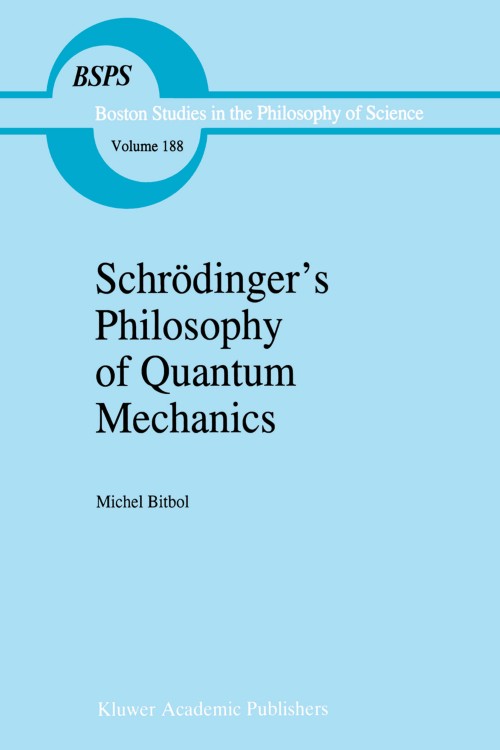
Schrödinger’s Philosophy of Quantum Mechanics [electronic resource] / by Michael Bitbol.
Erişim Adresi
ISBN
9789400917729
Dil Kodu
İngilizce
Yer Numarası
DK/13151
Yazar
Basım Bildirimi
1st ed. 1996.
Yayın Bilgisi
Dordrecht : Springer Netherlands : Imprint: Springer, 1996.
Fiziksel Niteleme
XII, 292 p. online resource.
Dizi
Boston Studies in the Philosophy and History of Science, 2214-7942 ; 188
İçindekiler Notu
1: The Controversy between Schrödinger and the Göttingen-Copenhagen Physicists in the 1950’s -- 1–1 Schrödinger’s successive interpretations of quantum mechanics according to the current views -- 1–2 Born’s and Heisenberg’s criticism of Schrödinger’s late interpretation of quantum mechanics -- 1–3 Historical flaws in the Born-Heisenberg critique of Schrödinger’s late interpretation of quantum mechanics -- 1–4 Misunderstandings about the concept of particle -- 1–5 Misunderstandings about the concept of “reality” -- 1–6 Misunderstandings about “causality” -- 1–7 Schrödinger’s over-revolutionary attitude -- 1–8 Modernity and post-modernity -- 1–9 The continuity of Schrödinger’s attitude towards quantum mechanics (an outline) -- 2: Schrödinger’s Theoretical Project -- 2–1 Reality and virtuality (1924) -- 2–2 Holism and wave-packets (1925) -- 2–3 Holism and the three dimensions of space (1926) -- 2–4 Wave interpretation versus electrodynamic interpretation: a prehistory of the empirical correspondence rules -- 2–5 The lack of pictures -- 2–6 The lack of continuity -- 3: The Analytical Stance -- 3–1 The ontological significance of the uncertainty relations -- 3–2 The state vector as a catalog of informations -- 4: Towards a New Ontology -- 4–1 The fading of the concept of particle -- 4–2 An ontology of state vectors -- 4–3 The “blind spot” of quantum mechanics -- 4–4 Neo-Schrödingerian views on the measurement problem. I-Everett’s interpretation -- 4–5 Neo-Schrödingerian views on the measurement problem II-Modal and critical interpretations -- 5: The “Thing” of Everyday Life -- 5–1 The three features of objects -- 5–2 The aspects and the “thing” -- 5–3 The “elements” of the construction (Mach, Russell,Schrödinger, Husserl) -- 5–4 Are the “basic data” really basic? -- 5–5 The construction of objects and the unconscious -- 5–6 The “thing” and the future -- 5–7 Possibilities and infinities -- 5–8 The “thing” as theory, and the theory as expectation -- 5–9 Realism and morals -- 5–10 Form and individuality -- 5–11 Wholeness and individuality -- 6: Complemetarity, Representation and Facts -- 6–1 Schrödinger’s criticism of Bohr’s complementarity -- 6–2 Bohr’s complementarities -- 6–3 Schrödinger’s “complementarities” -- 6–4 Two parallelisms -- 6–5 Being-in-a-body and being-in-the-world -- 6–6 The body, the world, and dualism -- 6–7 The body, the world, and monism -- 6–8 The body, the world, and anomalous parallelism -- Conclusion.
Özet, vb.
This book is the final outcome of two projects. My first project was to publish a set of texts written by Schrodinger at the beginning of the 1950's for his seminars and lectures at the Dublin Institute for Advanced Studies. These almost completely forgotten texts contained important insights into the interpretation of quantum mechanics, and they provided several ideas which were missing or elusively expressed in SchrOdinger's published papers and books of the same period. However, they were likely to be misinterpreted out of their context. The problem was that current scholarship could not help very much the reader of these writings to figure out their significance. The few available studies about SchrOdinger's interpretation of quantum mechanics are generally excellent, but almost entirely restricted to the initial period 1925-1927. Very little work has been done on Schrodinger's late views on the theory he contributed to create and develop. The generally accepted view is that he never really recovered from his interpretative failure of 1926-1927, and that his late reflections (during the 1950's) are little more than an expression of his rising nostalgia for the lost ideal of picturing the world, not to say for some favourite traditional picture. But the content and style of Schrodinger's texts of the 1950's do not agree at all with this melancholic appraisal; they rather set the stage for a thorough renewal of accepted representations. In order to elucidate this paradox, I adopted several strategies.
Konu
History.
Science __ Philosophy.
Physics __ Philosophy.
Quantum physics.
Knowledge, Theory of.
History.
Philosophy of Science.
Philosophical Foundations of Physics and Astronomy.
Quantum Physics.
Epistemology.
Science __ Philosophy.
Physics __ Philosophy.
Quantum physics.
Knowledge, Theory of.
History.
Philosophy of Science.
Philosophical Foundations of Physics and Astronomy.
Quantum Physics.
Epistemology.
Kurum Adı
Eseri Alıntıla
Referansları kullanmadan önce gözden geçirmeniz ve varsa gerekli düzeltmeleri yapmanız önerilir.
Dijital Kaynak
MARC Görünümü
LEADER 06974nam a22006495i 4500
001 811893
003 TR_AnAIT
005 20260131004214
007 cr nn 008mamaa
008 121227s1996 ne | s |||| 0|eng d
020 |a9789400917729|9978-94-009-1772-9
024 7 |a10.1007/978-94-009-1772-9|2doi
041 |aeng
049 |aTürk Tarih Kurumu Kütüphanesi
050 4|aD1-2027
072 7|aHB|2bicssc
072 7|aHBAH|2bicssc
072 7|aHIS000000|2bisacsh
072 7|aNH|2thema
072 7|aNHAH|2thema
082 04|a900|223
090 |aDK/13151
100 1 |aBitbol, Michael.|eauthor.|4aut|4http://id.loc.gov/vocabulary/relators/aut
245 10|aSchrödinger’s Philosophy of Quantum Mechanics|h[electronic resource] /|cby Michael Bitbol.
250 |a1st ed. 1996.
264 1|aDordrecht :|bSpringer Netherlands :|bImprint: Springer,|c1996.
300 |aXII, 292 p.|bonline resource.
336 |atext|btxt|2rdacontent
337 |acomputer|bc|2rdamedia
338 |aonline resource|bcr|2rdacarrier
347 |atext file|bPDF|2rda
490 1 |aBoston Studies in the Philosophy and History of Science,|x2214-7942 ;|v188
505 0 |a1: The Controversy between Schrödinger and the Göttingen-Copenhagen Physicists in the 1950’s -- 1–1 Schrödinger’s successive interpretations of quantum mechanics according to the current views -- 1–2 Born’s and Heisenberg’s criticism of Schrödinger’s late interpretation of quantum mechanics -- 1–3 Historical flaws in the Born-Heisenberg critique of Schrödinger’s late interpretation of quantum mechanics -- 1–4 Misunderstandings about the concept of particle -- 1–5 Misunderstandings about the concept of “reality” -- 1–6 Misunderstandings about “causality” -- 1–7 Schrödinger’s over-revolutionary attitude -- 1–8 Modernity and post-modernity -- 1–9 The continuity of Schrödinger’s attitude towards quantum mechanics (an outline) -- 2: Schrödinger’s Theoretical Project -- 2–1 Reality and virtuality (1924) -- 2–2 Holism and wave-packets (1925) -- 2–3 Holism and the three dimensions of space (1926) -- 2–4 Wave interpretation versus electrodynamic interpretation: a prehistory of the empirical correspondence rules -- 2–5 The lack of pictures -- 2–6 The lack of continuity -- 3: The Analytical Stance -- 3–1 The ontological significance of the uncertainty relations -- 3–2 The state vector as a catalog of informations -- 4: Towards a New Ontology -- 4–1 The fading of the concept of particle -- 4–2 An ontology of state vectors -- 4–3 The “blind spot” of quantum mechanics -- 4–4 Neo-Schrödingerian views on the measurement problem. I-Everett’s interpretation -- 4–5 Neo-Schrödingerian views on the measurement problem II-Modal and critical interpretations -- 5: The “Thing” of Everyday Life -- 5–1 The three features of objects -- 5–2 The aspects and the “thing” -- 5–3 The “elements” of the construction (Mach, Russell,Schrödinger, Husserl) -- 5–4 Are the “basic data” really basic? -- 5–5 The construction of objects and the unconscious -- 5–6 The “thing” and the future -- 5–7 Possibilities and infinities -- 5–8 The “thing” as theory, and the theory as expectation -- 5–9 Realism and morals -- 5–10 Form and individuality -- 5–11 Wholeness and individuality -- 6: Complemetarity, Representation and Facts -- 6–1 Schrödinger’s criticism of Bohr’s complementarity -- 6–2 Bohr’s complementarities -- 6–3 Schrödinger’s “complementarities” -- 6–4 Two parallelisms -- 6–5 Being-in-a-body and being-in-the-world -- 6–6 The body, the world, and dualism -- 6–7 The body, the world, and monism -- 6–8 The body, the world, and anomalous parallelism -- Conclusion.
520 |aThis book is the final outcome of two projects. My first project was to publish a set of texts written by Schrodinger at the beginning of the 1950's for his seminars and lectures at the Dublin Institute for Advanced Studies. These almost completely forgotten texts contained important insights into the interpretation of quantum mechanics, and they provided several ideas which were missing or elusively expressed in SchrOdinger's published papers and books of the same period. However, they were likely to be misinterpreted out of their context. The problem was that current scholarship could not help very much the reader of these writings to figure out their significance. The few available studies about SchrOdinger's interpretation of quantum mechanics are generally excellent, but almost entirely restricted to the initial period 1925-1927. Very little work has been done on Schrodinger's late views on the theory he contributed to create and develop. The generally accepted view is that he never really recovered from his interpretative failure of 1926-1927, and that his late reflections (during the 1950's) are little more than an expression of his rising nostalgia for the lost ideal of picturing the world, not to say for some favourite traditional picture. But the content and style of Schrodinger's texts of the 1950's do not agree at all with this melancholic appraisal; they rather set the stage for a thorough renewal of accepted representations. In order to elucidate this paradox, I adopted several strategies.
532 8 |aAccessibility summary: This PDF is not accessible. It is based on scanned pages and does not support features such as screen reader compatibility or described non-text content (images, graphs etc). However, it likely supports searchable and selectable text based on OCR (Optical Character Recognition). Users with accessibility needs may not be able to use this content effectively. Please contact us at accessibilitysupport@springernature.com if you require assistance or an alternative format.
532 8 |aInaccessible, or known limited accessibility
532 8 |aNo reading system accessibility options actively disabled
532 8 |aPublisher contact for further accessibility information: accessibilitysupport@springernature.com
650 0|aHistory.
650 0|aScience|xPhilosophy.
650 0|aPhysics|xPhilosophy.
650 0|aQuantum physics.
650 0|aKnowledge, Theory of.
650 14|aHistory.
650 24|aPhilosophy of Science.
650 24|aPhilosophical Foundations of Physics and Astronomy.
650 24|aQuantum Physics.
650 24|aEpistemology.
710 2 |aSpringerLink (Online service)
773 0 |tSpringer Nature eBook
776 08|iPrinted edition:|z9780792342663
776 08|iPrinted edition:|z9789400917736
776 08|iPrinted edition:|z9789401072915
830 0|aBoston Studies in the Philosophy and History of Science,|x2214-7942 ;|v188
856 40|uhttps://doi.org/10.1007/978-94-009-1772-9
912 |aZDB-2-SHU
912 |aZDB-2-SXH
912 |aZDB-2-BAE
950 |aHumanities, Social Sciences and Law (SpringerNature-11648)
950 |aHistory (R0) (SpringerNature-43722)
001 811893
003 TR_AnAIT
005 20260131004214
007 cr nn 008mamaa
008 121227s1996 ne | s |||| 0|eng d
020 |a9789400917729|9978-94-009-1772-9
024 7 |a10.1007/978-94-009-1772-9|2doi
041 |aeng
049 |aTürk Tarih Kurumu Kütüphanesi
050 4|aD1-2027
072 7|aHB|2bicssc
072 7|aHBAH|2bicssc
072 7|aHIS000000|2bisacsh
072 7|aNH|2thema
072 7|aNHAH|2thema
082 04|a900|223
090 |aDK/13151
100 1 |aBitbol, Michael.|eauthor.|4aut|4http://id.loc.gov/vocabulary/relators/aut
245 10|aSchrödinger’s Philosophy of Quantum Mechanics|h[electronic resource] /|cby Michael Bitbol.
250 |a1st ed. 1996.
264 1|aDordrecht :|bSpringer Netherlands :|bImprint: Springer,|c1996.
300 |aXII, 292 p.|bonline resource.
336 |atext|btxt|2rdacontent
337 |acomputer|bc|2rdamedia
338 |aonline resource|bcr|2rdacarrier
347 |atext file|bPDF|2rda
490 1 |aBoston Studies in the Philosophy and History of Science,|x2214-7942 ;|v188
505 0 |a1: The Controversy between Schrödinger and the Göttingen-Copenhagen Physicists in the 1950’s -- 1–1 Schrödinger’s successive interpretations of quantum mechanics according to the current views -- 1–2 Born’s and Heisenberg’s criticism of Schrödinger’s late interpretation of quantum mechanics -- 1–3 Historical flaws in the Born-Heisenberg critique of Schrödinger’s late interpretation of quantum mechanics -- 1–4 Misunderstandings about the concept of particle -- 1–5 Misunderstandings about the concept of “reality” -- 1–6 Misunderstandings about “causality” -- 1–7 Schrödinger’s over-revolutionary attitude -- 1–8 Modernity and post-modernity -- 1–9 The continuity of Schrödinger’s attitude towards quantum mechanics (an outline) -- 2: Schrödinger’s Theoretical Project -- 2–1 Reality and virtuality (1924) -- 2–2 Holism and wave-packets (1925) -- 2–3 Holism and the three dimensions of space (1926) -- 2–4 Wave interpretation versus electrodynamic interpretation: a prehistory of the empirical correspondence rules -- 2–5 The lack of pictures -- 2–6 The lack of continuity -- 3: The Analytical Stance -- 3–1 The ontological significance of the uncertainty relations -- 3–2 The state vector as a catalog of informations -- 4: Towards a New Ontology -- 4–1 The fading of the concept of particle -- 4–2 An ontology of state vectors -- 4–3 The “blind spot” of quantum mechanics -- 4–4 Neo-Schrödingerian views on the measurement problem. I-Everett’s interpretation -- 4–5 Neo-Schrödingerian views on the measurement problem II-Modal and critical interpretations -- 5: The “Thing” of Everyday Life -- 5–1 The three features of objects -- 5–2 The aspects and the “thing” -- 5–3 The “elements” of the construction (Mach, Russell,Schrödinger, Husserl) -- 5–4 Are the “basic data” really basic? -- 5–5 The construction of objects and the unconscious -- 5–6 The “thing” and the future -- 5–7 Possibilities and infinities -- 5–8 The “thing” as theory, and the theory as expectation -- 5–9 Realism and morals -- 5–10 Form and individuality -- 5–11 Wholeness and individuality -- 6: Complemetarity, Representation and Facts -- 6–1 Schrödinger’s criticism of Bohr’s complementarity -- 6–2 Bohr’s complementarities -- 6–3 Schrödinger’s “complementarities” -- 6–4 Two parallelisms -- 6–5 Being-in-a-body and being-in-the-world -- 6–6 The body, the world, and dualism -- 6–7 The body, the world, and monism -- 6–8 The body, the world, and anomalous parallelism -- Conclusion.
520 |aThis book is the final outcome of two projects. My first project was to publish a set of texts written by Schrodinger at the beginning of the 1950's for his seminars and lectures at the Dublin Institute for Advanced Studies. These almost completely forgotten texts contained important insights into the interpretation of quantum mechanics, and they provided several ideas which were missing or elusively expressed in SchrOdinger's published papers and books of the same period. However, they were likely to be misinterpreted out of their context. The problem was that current scholarship could not help very much the reader of these writings to figure out their significance. The few available studies about SchrOdinger's interpretation of quantum mechanics are generally excellent, but almost entirely restricted to the initial period 1925-1927. Very little work has been done on Schrodinger's late views on the theory he contributed to create and develop. The generally accepted view is that he never really recovered from his interpretative failure of 1926-1927, and that his late reflections (during the 1950's) are little more than an expression of his rising nostalgia for the lost ideal of picturing the world, not to say for some favourite traditional picture. But the content and style of Schrodinger's texts of the 1950's do not agree at all with this melancholic appraisal; they rather set the stage for a thorough renewal of accepted representations. In order to elucidate this paradox, I adopted several strategies.
532 8 |aAccessibility summary: This PDF is not accessible. It is based on scanned pages and does not support features such as screen reader compatibility or described non-text content (images, graphs etc). However, it likely supports searchable and selectable text based on OCR (Optical Character Recognition). Users with accessibility needs may not be able to use this content effectively. Please contact us at accessibilitysupport@springernature.com if you require assistance or an alternative format.
532 8 |aInaccessible, or known limited accessibility
532 8 |aNo reading system accessibility options actively disabled
532 8 |aPublisher contact for further accessibility information: accessibilitysupport@springernature.com
650 0|aHistory.
650 0|aScience|xPhilosophy.
650 0|aPhysics|xPhilosophy.
650 0|aQuantum physics.
650 0|aKnowledge, Theory of.
650 14|aHistory.
650 24|aPhilosophy of Science.
650 24|aPhilosophical Foundations of Physics and Astronomy.
650 24|aQuantum Physics.
650 24|aEpistemology.
710 2 |aSpringerLink (Online service)
773 0 |tSpringer Nature eBook
776 08|iPrinted edition:|z9780792342663
776 08|iPrinted edition:|z9789400917736
776 08|iPrinted edition:|z9789401072915
830 0|aBoston Studies in the Philosophy and History of Science,|x2214-7942 ;|v188
856 40|uhttps://doi.org/10.1007/978-94-009-1772-9
912 |aZDB-2-SHU
912 |aZDB-2-SXH
912 |aZDB-2-BAE
950 |aHumanities, Social Sciences and Law (SpringerNature-11648)
950 |aHistory (R0) (SpringerNature-43722)
Materyaller
Depodan talep edilen materyal sadece kütüphane içerisinde kullanılmaktadır.
Materyal dışarıya ödünç verilmemektedir.
Materyal dışarıya ödünç verilmemektedir.
