LEADER 03634nam a22004935i 4500
001 811909
003 TR_AnAIT
005 20260131004150
007 cr nn 008mamaa
008 111117s2012 ne | s |||| 0|eng d
020 |a9789400722446|9978-94-007-2244-6
024 7 |a10.1007/978-94-007-2244-6|2doi
041 |aeng
049 |aTürk Tarih Kurumu Kütüphanesi
050 4|aBJ1-1725
072 7|aHPQ|2bicssc
072 7|aPHI005000|2bisacsh
072 7|aQDTQ|2thema
082 04|a170|223
090 |aDK/13167
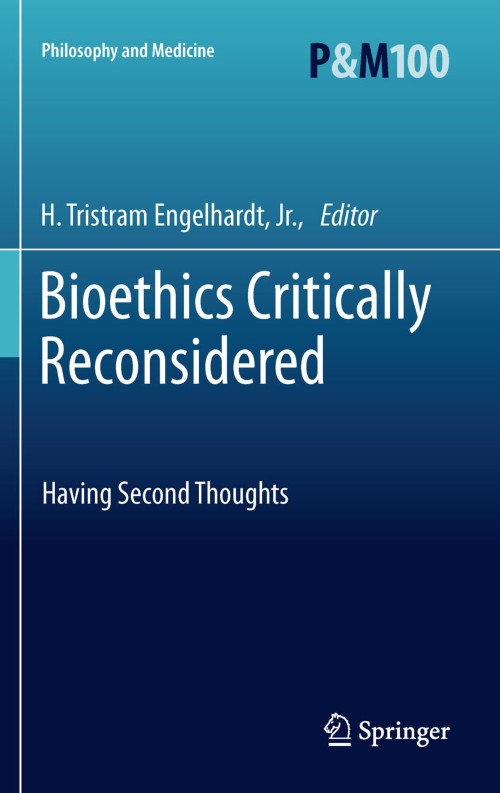
245 10|aBioethics Critically Reconsidered|h[electronic resource] :|bHaving Second Thoughts /|cedited by H. Tristram Engelhardt.
250 |a1st ed. 2012.
264 1|aDordrecht :|bSpringer Netherlands :|bImprint: Springer,|c2012.
300 |aX, 202 p.|bonline resource.
336 |atext|btxt|2rdacontent
337 |acomputer|bc|2rdamedia
338 |aonline resource|bcr|2rdacarrier
347 |atext file|bPDF|2rda
490 1 |aPhilosophy and Medicine,|x2215-0080 ;|v100
505 0 |aA Skeptical Introduction to Bioethics - H. Tristram Engelhardt, Jr. -- I. History of Bioethics: Four Perspectives -- Beginning Bioethics – Michael S. Yesley -- The Genesis of a Totalizing Ideology: Bioethics’ Inner Hippie – Griffin Trotter -- Bioethics and Professional Medical Ethics: Mapping and Managing an Uneasy Relationship – Laurence B. McCullough -- Two Rival Understandings of Autonomy: Paternalism, and Bioethical Principlism – Aaron E. Hinkley -- II. The Practice of Bioethics and Clinical Ethics Consultation: Three Views -- Bioethics as Political Ideology – Mark J. Cherry -- The “s” in Bioethics: Past, Present and Future – Ana S. Iltis and Adrienne Carpenter -- Why Clinical Bioethics So Rarely Gives Morally Normative Guidance: Some Critical Reflections – H. T. Engelhardt, Jr. -- III. The Incredible Search for Bioethical Professionalism: Some Final Critical Reflections on Circular Thinking -- On the Social Construction of Health Care Ethics Consultation - Jeffrey P. Bishop -- Notes on Contributors -- Index.
520 |aBioethics developed as an academic and clinical discipline during the later part of the 20th century due to a variety of factors. Crucial to this development was the increased secularization of American culture as well as the dissolution of medicine as a quasi-guild with its own professional ethics. In the context of this moral vacuum, bioethics came into existence. Its raison d’être was opposition to the alleged paternalism of the medical community and traditional moral frameworks, yet at the same time it set itself up as a source of moral authority with respect to biomedical decision making. Bioethics serves as biopolitics in so far as it attempts to make determinations about how individuals ought to make medical decisions and then attempts to codify that in law. Progressivism and secularism are ultimately the ideology of bioethics.
650 0|aEthics.
650 0|aBioethics.
650 14|aMoral Philosophy and Applied Ethics.
650 24|aBioethics.
700 1 |aEngelhardt, H. Tristram.|eeditor.|4edt|4http://id.loc.gov/vocabulary/relators/edt
710 2 |aSpringerLink (Online service)
773 0 |tSpringer Nature eBook
776 08|iPrinted edition:|z9789400722439
776 08|iPrinted edition:|z9789400722453
776 08|iPrinted edition:|z9789400794948
830 0|aPhilosophy and Medicine,|x2215-0080 ;|v100
856 40|uhttps://doi.org/10.1007/978-94-007-2244-6
912 |aZDB-2-SHU
912 |aZDB-2-SXPR
950 |aHumanities, Social Sciences and Law (SpringerNature-11648)
950 |aPhilosophy and Religion (R0) (SpringerNature-43725)