

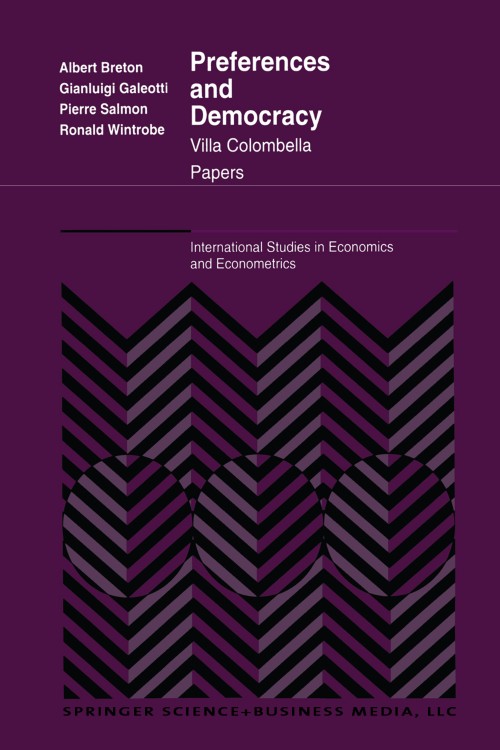
Preferences and Democracy [electronic resource] : Villa Colombella Papers / edited by Alb. Breton, P. Galeotti, P. Salmon, R. Wintrobe.
Erişim Adresi
ISBN
9789401121880
Dil Kodu
İngilizce
Yer Numarası
DK/13171
Basım Bildirimi
1st ed. 1993.
Yayın Bilgisi
Dordrecht : Springer Netherlands : Imprint: Springer, 1993.
Fiziksel Niteleme
IX, 388 p. online resource.
Dizi
International Studies in Economics and Econometrics ; 28
İçindekiler Notu
One: Unsatisfied Political Demands -- Unpopular Policies and The Theory of Representative Democracy -- Equilibrium Political Inaction in a Democracy -- Two: Bridges Between Demand and Supply -- A Theory of Demand for Governmentally Supplied Goods and Services -- Organized Groups and the (Mis?) transmission of Public Preferences -- Public Goods Provision Institutions -- Three: Equilibrium Political Platforms: Convergence and Divergence -- The Silent Revolution of Probabilistic Voting -- Pivotal Voters and Political Equilibria of Party Equilibrium -- Political Exchange and the Allocation of Surplus: A Model of Two-Party Competition -- Four: The Behaviour of Political Parties -- Fourteen Ways to Credibly Escape a Credible Commitment (and Still Get Re-Elected) -- Issues and Party Alignments: A Review with Canadian Examples -- Five: Redistribution -- The Demand for the Public Sector In the Rich Welfare State of Denmark: Two Polls from 1990 -- Voting Rights and the Demand for Public Expenditure: An Analysis of the Redistributive Impact of Universal Suffrage -- Coercive Redistribution and the Franchise: A Preliminary Investigation Using Computable General Equilibrium Modelling.
Özet, vb.
I. Until about a dozen years ago, the economic analysis of the relationship between political preferences and political demands was a rather straightforward, if dull, subject. The most common assumption was that the only political instrument available to citizens was the vote. Given this assumption, the analyst could express the outcome of the voting process in one of two ways. One possibility was to make the heroic assumptions necessary to obtain the median voter theorem, in which case, the political demands of the citizenry are simply the preferences of the median voter. The alternative was to make Arrow's Impossibility Theorem in which case even though individual preferences are well ordered, no collective preference function exists. On either of these approaches, institutions such as interest groups, political parties, or the structures ofpolitical representation played no role in the analysis. The work of "Chicago" scholars especially George Stigler, Gary Becker and Sam Peltzman took a different approach and emphasized the importanceoforganizationinmakingpoliticaldemandseffective, shifting thefocus from voting topolitical "pressure" byinterestgroups. However, in these models, voting as an instrument of political action simply disappears and the relationship between interest group pressures and electoral processes has never been clarified.
Konu
Political science.
Finance, Public.
Econometrics.
Political Science.
Public Economics.
Quantitative Economics.
Finance, Public.
Econometrics.
Political Science.
Public Economics.
Quantitative Economics.
Diğer Yazarlar
Kurum Adı
Eseri Alıntıla
Referansları kullanmadan önce gözden geçirmeniz ve varsa gerekli düzeltmeleri yapmanız önerilir.
Dijital Kaynak
MARC Görünümü
LEADER 05461nam a22006135i 4500
001 811913
003 TR_AnAIT
005 20260131004145
007 cr nn 008mamaa
008 121227s1993 ne | s |||| 0|eng d
020 |a9789401121880|9978-94-011-2188-0
024 7 |a10.1007/978-94-011-2188-0|2doi
041 |aeng
049 |aTürk Tarih Kurumu Kütüphanesi
050 4|aJA1-92
072 7|aJPA|2bicssc
072 7|aPOL000000|2bisacsh
072 7|aJPA|2thema
082 04|a320|223
090 |aDK/13171
245 10|aPreferences and Democracy|h[electronic resource] :|bVilla Colombella Papers /|cedited by Alb. Breton, P. Galeotti, P. Salmon, R. Wintrobe.
250 |a1st ed. 1993.
264 1|aDordrecht :|bSpringer Netherlands :|bImprint: Springer,|c1993.
300 |aIX, 388 p.|bonline resource.
336 |atext|btxt|2rdacontent
337 |acomputer|bc|2rdamedia
338 |aonline resource|bcr|2rdacarrier
347 |atext file|bPDF|2rda
490 1 |aInternational Studies in Economics and Econometrics ;|v28
505 0 |aOne: Unsatisfied Political Demands -- Unpopular Policies and The Theory of Representative Democracy -- Equilibrium Political Inaction in a Democracy -- Two: Bridges Between Demand and Supply -- A Theory of Demand for Governmentally Supplied Goods and Services -- Organized Groups and the (Mis?) transmission of Public Preferences -- Public Goods Provision Institutions -- Three: Equilibrium Political Platforms: Convergence and Divergence -- The Silent Revolution of Probabilistic Voting -- Pivotal Voters and Political Equilibria of Party Equilibrium -- Political Exchange and the Allocation of Surplus: A Model of Two-Party Competition -- Four: The Behaviour of Political Parties -- Fourteen Ways to Credibly Escape a Credible Commitment (and Still Get Re-Elected) -- Issues and Party Alignments: A Review with Canadian Examples -- Five: Redistribution -- The Demand for the Public Sector In the Rich Welfare State of Denmark: Two Polls from 1990 -- Voting Rights and the Demand for Public Expenditure: An Analysis of the Redistributive Impact of Universal Suffrage -- Coercive Redistribution and the Franchise: A Preliminary Investigation Using Computable General Equilibrium Modelling.
520 |aI. Until about a dozen years ago, the economic analysis of the relationship between political preferences and political demands was a rather straightforward, if dull, subject. The most common assumption was that the only political instrument available to citizens was the vote. Given this assumption, the analyst could express the outcome of the voting process in one of two ways. One possibility was to make the heroic assumptions necessary to obtain the median voter theorem, in which case, the political demands of the citizenry are simply the preferences of the median voter. The alternative was to make Arrow's Impossibility Theorem in which case even though individual preferences are well ordered, no collective preference function exists. On either of these approaches, institutions such as interest groups, political parties, or the structures ofpolitical representation played no role in the analysis. The work of "Chicago" scholars especially George Stigler, Gary Becker and Sam Peltzman took a different approach and emphasized the importanceoforganizationinmakingpoliticaldemandseffective, shifting thefocus from voting topolitical "pressure" byinterestgroups. However, in these models, voting as an instrument of political action simply disappears and the relationship between interest group pressures and electoral processes has never been clarified.
532 8 |aAccessibility summary: This PDF is not accessible. It is based on scanned pages and does not support features such as screen reader compatibility or described non-text content (images, graphs etc). However, it likely supports searchable and selectable text based on OCR (Optical Character Recognition). Users with accessibility needs may not be able to use this content effectively. Please contact us at accessibilitysupport@springernature.com if you require assistance or an alternative format.
532 8 |aInaccessible, or known limited accessibility
532 8 |aNo reading system accessibility options actively disabled
532 8 |aPublisher contact for further accessibility information: accessibilitysupport@springernature.com
650 0|aPolitical science.
650 0|aFinance, Public.
650 0|aEconometrics.
650 14|aPolitical Science.
650 24|aPublic Economics.
650 24|aQuantitative Economics.
700 1 |aBreton, Alb.|eeditor.|4edt|4http://id.loc.gov/vocabulary/relators/edt
700 1 |aGaleotti, P.|eeditor.|4edt|4http://id.loc.gov/vocabulary/relators/edt
700 1 |aSalmon, P.|eeditor.|4edt|4http://id.loc.gov/vocabulary/relators/edt
700 1 |aWintrobe, R.|eeditor.|4edt|4http://id.loc.gov/vocabulary/relators/edt
710 2 |aSpringerLink (Online service)
773 0 |tSpringer Nature eBook
776 08|iPrinted edition:|z9780792393214
776 08|iPrinted edition:|z9789401121897
776 08|iPrinted edition:|z9789401049696
830 0|aInternational Studies in Economics and Econometrics ;|v28
856 40|uhttps://doi.org/10.1007/978-94-011-2188-0
912 |aZDB-2-SHU
912 |aZDB-2-SXPI
912 |aZDB-2-BAE
950 |aHumanities, Social Sciences and Law (SpringerNature-11648)
950 |aPolitical Science and International Studies (R0) (SpringerNature-43724)
001 811913
003 TR_AnAIT
005 20260131004145
007 cr nn 008mamaa
008 121227s1993 ne | s |||| 0|eng d
020 |a9789401121880|9978-94-011-2188-0
024 7 |a10.1007/978-94-011-2188-0|2doi
041 |aeng
049 |aTürk Tarih Kurumu Kütüphanesi
050 4|aJA1-92
072 7|aJPA|2bicssc
072 7|aPOL000000|2bisacsh
072 7|aJPA|2thema
082 04|a320|223
090 |aDK/13171
245 10|aPreferences and Democracy|h[electronic resource] :|bVilla Colombella Papers /|cedited by Alb. Breton, P. Galeotti, P. Salmon, R. Wintrobe.
250 |a1st ed. 1993.
264 1|aDordrecht :|bSpringer Netherlands :|bImprint: Springer,|c1993.
300 |aIX, 388 p.|bonline resource.
336 |atext|btxt|2rdacontent
337 |acomputer|bc|2rdamedia
338 |aonline resource|bcr|2rdacarrier
347 |atext file|bPDF|2rda
490 1 |aInternational Studies in Economics and Econometrics ;|v28
505 0 |aOne: Unsatisfied Political Demands -- Unpopular Policies and The Theory of Representative Democracy -- Equilibrium Political Inaction in a Democracy -- Two: Bridges Between Demand and Supply -- A Theory of Demand for Governmentally Supplied Goods and Services -- Organized Groups and the (Mis?) transmission of Public Preferences -- Public Goods Provision Institutions -- Three: Equilibrium Political Platforms: Convergence and Divergence -- The Silent Revolution of Probabilistic Voting -- Pivotal Voters and Political Equilibria of Party Equilibrium -- Political Exchange and the Allocation of Surplus: A Model of Two-Party Competition -- Four: The Behaviour of Political Parties -- Fourteen Ways to Credibly Escape a Credible Commitment (and Still Get Re-Elected) -- Issues and Party Alignments: A Review with Canadian Examples -- Five: Redistribution -- The Demand for the Public Sector In the Rich Welfare State of Denmark: Two Polls from 1990 -- Voting Rights and the Demand for Public Expenditure: An Analysis of the Redistributive Impact of Universal Suffrage -- Coercive Redistribution and the Franchise: A Preliminary Investigation Using Computable General Equilibrium Modelling.
520 |aI. Until about a dozen years ago, the economic analysis of the relationship between political preferences and political demands was a rather straightforward, if dull, subject. The most common assumption was that the only political instrument available to citizens was the vote. Given this assumption, the analyst could express the outcome of the voting process in one of two ways. One possibility was to make the heroic assumptions necessary to obtain the median voter theorem, in which case, the political demands of the citizenry are simply the preferences of the median voter. The alternative was to make Arrow's Impossibility Theorem in which case even though individual preferences are well ordered, no collective preference function exists. On either of these approaches, institutions such as interest groups, political parties, or the structures ofpolitical representation played no role in the analysis. The work of "Chicago" scholars especially George Stigler, Gary Becker and Sam Peltzman took a different approach and emphasized the importanceoforganizationinmakingpoliticaldemandseffective, shifting thefocus from voting topolitical "pressure" byinterestgroups. However, in these models, voting as an instrument of political action simply disappears and the relationship between interest group pressures and electoral processes has never been clarified.
532 8 |aAccessibility summary: This PDF is not accessible. It is based on scanned pages and does not support features such as screen reader compatibility or described non-text content (images, graphs etc). However, it likely supports searchable and selectable text based on OCR (Optical Character Recognition). Users with accessibility needs may not be able to use this content effectively. Please contact us at accessibilitysupport@springernature.com if you require assistance or an alternative format.
532 8 |aInaccessible, or known limited accessibility
532 8 |aNo reading system accessibility options actively disabled
532 8 |aPublisher contact for further accessibility information: accessibilitysupport@springernature.com
650 0|aPolitical science.
650 0|aFinance, Public.
650 0|aEconometrics.
650 14|aPolitical Science.
650 24|aPublic Economics.
650 24|aQuantitative Economics.
700 1 |aBreton, Alb.|eeditor.|4edt|4http://id.loc.gov/vocabulary/relators/edt
700 1 |aGaleotti, P.|eeditor.|4edt|4http://id.loc.gov/vocabulary/relators/edt
700 1 |aSalmon, P.|eeditor.|4edt|4http://id.loc.gov/vocabulary/relators/edt
700 1 |aWintrobe, R.|eeditor.|4edt|4http://id.loc.gov/vocabulary/relators/edt
710 2 |aSpringerLink (Online service)
773 0 |tSpringer Nature eBook
776 08|iPrinted edition:|z9780792393214
776 08|iPrinted edition:|z9789401121897
776 08|iPrinted edition:|z9789401049696
830 0|aInternational Studies in Economics and Econometrics ;|v28
856 40|uhttps://doi.org/10.1007/978-94-011-2188-0
912 |aZDB-2-SHU
912 |aZDB-2-SXPI
912 |aZDB-2-BAE
950 |aHumanities, Social Sciences and Law (SpringerNature-11648)
950 |aPolitical Science and International Studies (R0) (SpringerNature-43724)
Materyaller
Depodan talep edilen materyal sadece kütüphane içerisinde kullanılmaktadır.
Materyal dışarıya ödünç verilmemektedir.
Materyal dışarıya ödünç verilmemektedir.
