

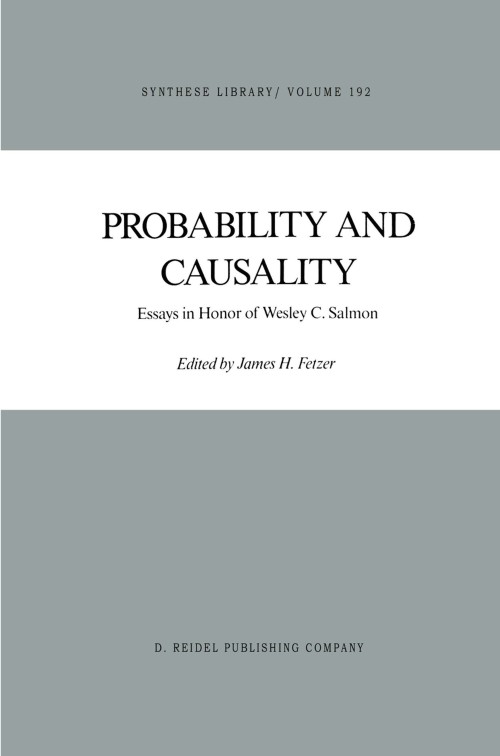
Probability and Causality [electronic resource] : Essays in Honor of Wesley C. Salmon / edited by J.H. Fetzer.
Erişim Adresi
ISBN
9789400939974
Dil Kodu
İngilizce
Yer Numarası
DK/13181
Basım Bildirimi
1st ed. 1988.
Yayın Bilgisi
Dordrecht : Springer Netherlands : Imprint: Springer, 1988.
Fiziksel Niteleme
XVIII, 362 p. online resource.
Dizi
Synthese Library, Studies in Epistemology, Logic, Methodology, and Philosophy of Science, 2542-8292 ; 192
İçindekiler Notu
Prologue -- Dynamic Rationality: Propensity, Probability, and Credence -- I: Probability, Causality, and Modality -- Hume’s Refutation of Inductive Probabilism -- An Adamite Derivation of the Principles of the Calculus of Probability -- Probability, Possibility, and Plenitude -- Probabilistic Metaphysics -- Probabilistic Theories of Causation -- Conditional Chance -- II: Probability, Causality, and Decision -- How to Tell a Common Cause: Generalizations of the Conjunctive Fork Criterion -- Probabilistic Causal Interaction and Disjunctive Causal Factors -- The Principle of the Common Cause -- On Raising the Chances of Effects -- How to Probabilize a Newcomb Problem -- Non-Nietzschean Decision Making -- Epilogue -- Publications: An Annotated Bibliography -- Index of Names -- Index of Subjects.
Özet, vb.
The contributions to this special collection concern issues and problems discussed in or related to the work of Wesley C. Salmon. Salmon has long been noted for his important work in the philosophy of science, which has included research on the interpretation of probability, the nature of explanation, the character of reasoning, the justification of induction, the structure of space/time and the paradoxes of Zeno, to mention only some of the most prominent. During a time of increasing preoccupation with historical and sociological approaches to under standing science (which characterize scientific developments as though they could be adequately analysed from the perspective of political movements, even mistaking the phenomena of conversion for the rational appraisal of scientific theories), Salmon has remained stead fastly devoted to isolating and justifying those normative standards distinguishing science from non-science - especially through the vindi cation of general principles of scientific procedure and the validation of specific examples of scientific theories - without which science itself cannot be (even remotely) adequately understood. In this respect, Salmon exemplifies and strengthens a splendid tradi tion whose most remarkable representatives include Hans Reichenbach, Rudolf Carnap and Carl G. Hempel, all of whom exerted a profound influence upon his own development.
Konu
Science __ Philosophy.
Philosophy of Science.
Philosophy of Science.
Diğer Yazarlar
Kurum Adı
Eseri Alıntıla
Referansları kullanmadan önce gözden geçirmeniz ve varsa gerekli düzeltmeleri yapmanız önerilir.
Dijital Kaynak
MARC Görünümü
LEADER 04816nam a22005415i 4500
001 811923
003 TR_AnAIT
005 20260131004129
007 cr nn 008mamaa
008 121227s1988 ne | s |||| 0|eng d
020 |a9789400939974|9978-94-009-3997-4
024 7 |a10.1007/978-94-009-3997-4|2doi
041 |aeng
049 |aTürk Tarih Kurumu Kütüphanesi
050 4|aQ174-175.3
050 4|aB67
072 7|aPDA|2bicssc
072 7|aSCI075000|2bisacsh
072 7|aPDA|2thema
082 04|a501|223
090 |aDK/13181
245 10|aProbability and Causality|h[electronic resource] :|bEssays in Honor of Wesley C. Salmon /|cedited by J.H. Fetzer.
250 |a1st ed. 1988.
264 1|aDordrecht :|bSpringer Netherlands :|bImprint: Springer,|c1988.
300 |aXVIII, 362 p.|bonline resource.
336 |atext|btxt|2rdacontent
337 |acomputer|bc|2rdamedia
338 |aonline resource|bcr|2rdacarrier
347 |atext file|bPDF|2rda
490 1 |aSynthese Library, Studies in Epistemology, Logic, Methodology, and Philosophy of Science,|x2542-8292 ;|v192
505 0 |aPrologue -- Dynamic Rationality: Propensity, Probability, and Credence -- I: Probability, Causality, and Modality -- Hume’s Refutation of Inductive Probabilism -- An Adamite Derivation of the Principles of the Calculus of Probability -- Probability, Possibility, and Plenitude -- Probabilistic Metaphysics -- Probabilistic Theories of Causation -- Conditional Chance -- II: Probability, Causality, and Decision -- How to Tell a Common Cause: Generalizations of the Conjunctive Fork Criterion -- Probabilistic Causal Interaction and Disjunctive Causal Factors -- The Principle of the Common Cause -- On Raising the Chances of Effects -- How to Probabilize a Newcomb Problem -- Non-Nietzschean Decision Making -- Epilogue -- Publications: An Annotated Bibliography -- Index of Names -- Index of Subjects.
520 |aThe contributions to this special collection concern issues and problems discussed in or related to the work of Wesley C. Salmon. Salmon has long been noted for his important work in the philosophy of science, which has included research on the interpretation of probability, the nature of explanation, the character of reasoning, the justification of induction, the structure of space/time and the paradoxes of Zeno, to mention only some of the most prominent. During a time of increasing preoccupation with historical and sociological approaches to under standing science (which characterize scientific developments as though they could be adequately analysed from the perspective of political movements, even mistaking the phenomena of conversion for the rational appraisal of scientific theories), Salmon has remained stead fastly devoted to isolating and justifying those normative standards distinguishing science from non-science - especially through the vindi cation of general principles of scientific procedure and the validation of specific examples of scientific theories - without which science itself cannot be (even remotely) adequately understood. In this respect, Salmon exemplifies and strengthens a splendid tradi tion whose most remarkable representatives include Hans Reichenbach, Rudolf Carnap and Carl G. Hempel, all of whom exerted a profound influence upon his own development.
532 8 |aAccessibility summary: This PDF is not accessible. It is based on scanned pages and does not support features such as screen reader compatibility or described non-text content (images, graphs etc). However, it likely supports searchable and selectable text based on OCR (Optical Character Recognition). Users with accessibility needs may not be able to use this content effectively. Please contact us at accessibilitysupport@springernature.com if you require assistance or an alternative format.
532 8 |aInaccessible, or known limited accessibility
532 8 |aNo reading system accessibility options actively disabled
532 8 |aPublisher contact for further accessibility information: accessibilitysupport@springernature.com
650 0|aScience|xPhilosophy.
650 14|aPhilosophy of Science.
700 1 |aFetzer, J.H.|eeditor.|4edt|4http://id.loc.gov/vocabulary/relators/edt
710 2 |aSpringerLink (Online service)
773 0 |tSpringer Nature eBook
776 08|iPrinted edition:|z9789027726070
776 08|iPrinted edition:|z9781556080524
776 08|iPrinted edition:|z9789400939981
830 0|aSynthese Library, Studies in Epistemology, Logic, Methodology, and Philosophy of Science,|x2542-8292 ;|v192
856 40|uhttps://doi.org/10.1007/978-94-009-3997-4
912 |aZDB-2-SHU
912 |aZDB-2-SXPR
912 |aZDB-2-BAE
950 |aHumanities, Social Sciences and Law (SpringerNature-11648)
950 |aPhilosophy and Religion (R0) (SpringerNature-43725)
001 811923
003 TR_AnAIT
005 20260131004129
007 cr nn 008mamaa
008 121227s1988 ne | s |||| 0|eng d
020 |a9789400939974|9978-94-009-3997-4
024 7 |a10.1007/978-94-009-3997-4|2doi
041 |aeng
049 |aTürk Tarih Kurumu Kütüphanesi
050 4|aQ174-175.3
050 4|aB67
072 7|aPDA|2bicssc
072 7|aSCI075000|2bisacsh
072 7|aPDA|2thema
082 04|a501|223
090 |aDK/13181
245 10|aProbability and Causality|h[electronic resource] :|bEssays in Honor of Wesley C. Salmon /|cedited by J.H. Fetzer.
250 |a1st ed. 1988.
264 1|aDordrecht :|bSpringer Netherlands :|bImprint: Springer,|c1988.
300 |aXVIII, 362 p.|bonline resource.
336 |atext|btxt|2rdacontent
337 |acomputer|bc|2rdamedia
338 |aonline resource|bcr|2rdacarrier
347 |atext file|bPDF|2rda
490 1 |aSynthese Library, Studies in Epistemology, Logic, Methodology, and Philosophy of Science,|x2542-8292 ;|v192
505 0 |aPrologue -- Dynamic Rationality: Propensity, Probability, and Credence -- I: Probability, Causality, and Modality -- Hume’s Refutation of Inductive Probabilism -- An Adamite Derivation of the Principles of the Calculus of Probability -- Probability, Possibility, and Plenitude -- Probabilistic Metaphysics -- Probabilistic Theories of Causation -- Conditional Chance -- II: Probability, Causality, and Decision -- How to Tell a Common Cause: Generalizations of the Conjunctive Fork Criterion -- Probabilistic Causal Interaction and Disjunctive Causal Factors -- The Principle of the Common Cause -- On Raising the Chances of Effects -- How to Probabilize a Newcomb Problem -- Non-Nietzschean Decision Making -- Epilogue -- Publications: An Annotated Bibliography -- Index of Names -- Index of Subjects.
520 |aThe contributions to this special collection concern issues and problems discussed in or related to the work of Wesley C. Salmon. Salmon has long been noted for his important work in the philosophy of science, which has included research on the interpretation of probability, the nature of explanation, the character of reasoning, the justification of induction, the structure of space/time and the paradoxes of Zeno, to mention only some of the most prominent. During a time of increasing preoccupation with historical and sociological approaches to under standing science (which characterize scientific developments as though they could be adequately analysed from the perspective of political movements, even mistaking the phenomena of conversion for the rational appraisal of scientific theories), Salmon has remained stead fastly devoted to isolating and justifying those normative standards distinguishing science from non-science - especially through the vindi cation of general principles of scientific procedure and the validation of specific examples of scientific theories - without which science itself cannot be (even remotely) adequately understood. In this respect, Salmon exemplifies and strengthens a splendid tradi tion whose most remarkable representatives include Hans Reichenbach, Rudolf Carnap and Carl G. Hempel, all of whom exerted a profound influence upon his own development.
532 8 |aAccessibility summary: This PDF is not accessible. It is based on scanned pages and does not support features such as screen reader compatibility or described non-text content (images, graphs etc). However, it likely supports searchable and selectable text based on OCR (Optical Character Recognition). Users with accessibility needs may not be able to use this content effectively. Please contact us at accessibilitysupport@springernature.com if you require assistance or an alternative format.
532 8 |aInaccessible, or known limited accessibility
532 8 |aNo reading system accessibility options actively disabled
532 8 |aPublisher contact for further accessibility information: accessibilitysupport@springernature.com
650 0|aScience|xPhilosophy.
650 14|aPhilosophy of Science.
700 1 |aFetzer, J.H.|eeditor.|4edt|4http://id.loc.gov/vocabulary/relators/edt
710 2 |aSpringerLink (Online service)
773 0 |tSpringer Nature eBook
776 08|iPrinted edition:|z9789027726070
776 08|iPrinted edition:|z9781556080524
776 08|iPrinted edition:|z9789400939981
830 0|aSynthese Library, Studies in Epistemology, Logic, Methodology, and Philosophy of Science,|x2542-8292 ;|v192
856 40|uhttps://doi.org/10.1007/978-94-009-3997-4
912 |aZDB-2-SHU
912 |aZDB-2-SXPR
912 |aZDB-2-BAE
950 |aHumanities, Social Sciences and Law (SpringerNature-11648)
950 |aPhilosophy and Religion (R0) (SpringerNature-43725)
Materyaller
Depodan talep edilen materyal sadece kütüphane içerisinde kullanılmaktadır.
Materyal dışarıya ödünç verilmemektedir.
Materyal dışarıya ödünç verilmemektedir.
