

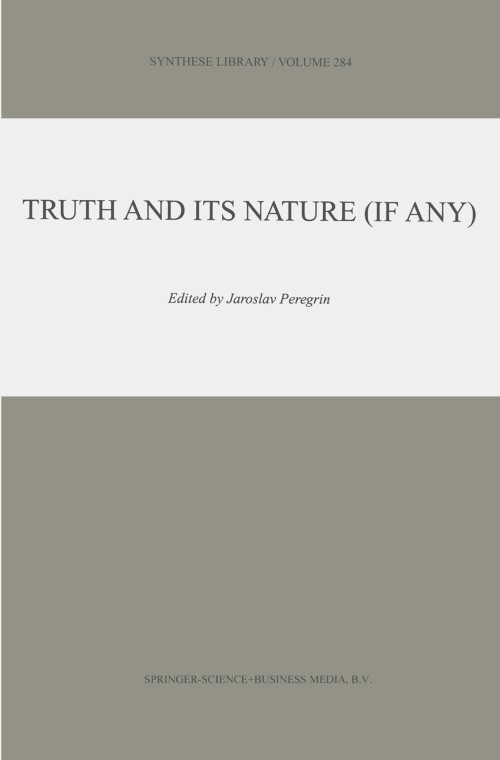
Truth and Its Nature (if Any) [electronic resource] / edited by J. Peregrin.
Erişim Adresi
ISBN
9789401592338
Dil Kodu
İngilizce
Yer Numarası
DK/13226
Basım Bildirimi
1st ed. 1999.
Yayın Bilgisi
Dordrecht : Springer Netherlands : Imprint: Springer, 1999.
Fiziksel Niteleme
XVIII, 221 p. online resource.
Dizi
Synthese Library, Studies in Epistemology, Logic, Methodology, and Philosophy of Science, 2542-8292 ; 284
İçindekiler Notu
I. Past Masters on Truth -- Frege: Assertion, Truth and Meaning -- Carnap, Syntax, and Truth -- James’s Conception of Truth -- II. Tarski and Correspondence -- Semantic Conception of Truth as a Philosophical Theory -- Truth, Correspondence, Satisfaction -- Do We Need Correspondence Truth? -- Tarskian Truth as Correspondence — Replies to Some Objections -- III. The Substantiality of Truth -- The Centrality of Truth -- Mapping the Structure of Truth: Davidson Contra Rorty -- The Explanatory Value of Truth Theoriesembodying the Semantic Conception -- Negative Truth and Knowledge -- IV. The Insubstantiality of Truth: The Pros and Cons of Deflationism -- Deflationary Truth, Aboutness and Meaning -- The Substance of Deflation -- Does the Strategy of Austerity Work? -- Rethinking the Concept of Truth: A Critique of Deflationism.
Özet, vb.
The question how to turn the principles implicitly governing the concept of truth into an explicit definition (or explication) of the concept hence coalesced with the question how to get a finite grip on the infinity of T-sentences. Tarski's famous and ingenious move was to introduce a new concept, satisfaction, which could be, on the one hand, recursively defined, and which, on the other hand, straightforwardly yielded an explication of truth. A surprising 'by-product' of Tarski's effort to bring truth under control was the breathtaking finding that truth is in a precisely defined sense ineffable, that no non trivial language can contain a truth-predicate which would be adequate for the very 4 language . This implied that truth (and consequently semantic concepts to which truth appeared to be reducible) proved itself to be strangely 'language-dependent': we can have a concept of truth-in-L for any language L, but we cannot have a concept of truth applicable to every language. In a sense, this means, as Quine (1969, p. 68) put it, that truth belongs to "transcendental metaphysics", and Tarski's 'scientific' investigations seem to lead us back towards a surprising proximity of some more traditional philosophical views on truth. 3. TARSKI'S THEORY AS A PARADIGM So far Tarski himself. Subsequent philosophers then had to find out what his considerations of the concept of truth really mean and what are their consequences; and this now seems to be an almost interminable task.
Konu
Language and languages __ Philosophy.
Knowledge, Theory of.
Logic.
Semiotics.
Philosophy, Modern.
Philosophy of Language.
Epistemology.
Logic.
Semiotics.
Early Modern Philosophy.
Knowledge, Theory of.
Logic.
Semiotics.
Philosophy, Modern.
Philosophy of Language.
Epistemology.
Logic.
Semiotics.
Early Modern Philosophy.
Diğer Yazarlar
Kurum Adı
Eseri Alıntıla
Referansları kullanmadan önce gözden geçirmeniz ve varsa gerekli düzeltmeleri yapmanız önerilir.
Dijital Kaynak
MARC Görünümü
LEADER 05142nam a22006255i 4500
001 811968
003 TR_AnAIT
005 20260131004010
007 cr nn 008mamaa
008 121230s1999 ne | s |||| 0|eng d
020 |a9789401592338|9978-94-015-9233-8
024 7 |a10.1007/978-94-015-9233-8|2doi
041 |aeng
049 |aTürk Tarih Kurumu Kütüphanesi
050 4|aP101-120
072 7|aCFA|2bicssc
072 7|aPHI038000|2bisacsh
072 7|aCFA|2thema
082 04|a149.94|223
090 |aDK/13226
245 10|aTruth and Its Nature (if Any)|h[electronic resource] /|cedited by J. Peregrin.
250 |a1st ed. 1999.
264 1|aDordrecht :|bSpringer Netherlands :|bImprint: Springer,|c1999.
300 |aXVIII, 221 p.|bonline resource.
336 |atext|btxt|2rdacontent
337 |acomputer|bc|2rdamedia
338 |aonline resource|bcr|2rdacarrier
347 |atext file|bPDF|2rda
490 1 |aSynthese Library, Studies in Epistemology, Logic, Methodology, and Philosophy of Science,|x2542-8292 ;|v284
505 0 |aI. Past Masters on Truth -- Frege: Assertion, Truth and Meaning -- Carnap, Syntax, and Truth -- James’s Conception of Truth -- II. Tarski and Correspondence -- Semantic Conception of Truth as a Philosophical Theory -- Truth, Correspondence, Satisfaction -- Do We Need Correspondence Truth? -- Tarskian Truth as Correspondence — Replies to Some Objections -- III. The Substantiality of Truth -- The Centrality of Truth -- Mapping the Structure of Truth: Davidson Contra Rorty -- The Explanatory Value of Truth Theoriesembodying the Semantic Conception -- Negative Truth and Knowledge -- IV. The Insubstantiality of Truth: The Pros and Cons of Deflationism -- Deflationary Truth, Aboutness and Meaning -- The Substance of Deflation -- Does the Strategy of Austerity Work? -- Rethinking the Concept of Truth: A Critique of Deflationism.
520 |aThe question how to turn the principles implicitly governing the concept of truth into an explicit definition (or explication) of the concept hence coalesced with the question how to get a finite grip on the infinity of T-sentences. Tarski's famous and ingenious move was to introduce a new concept, satisfaction, which could be, on the one hand, recursively defined, and which, on the other hand, straightforwardly yielded an explication of truth. A surprising 'by-product' of Tarski's effort to bring truth under control was the breathtaking finding that truth is in a precisely defined sense ineffable, that no non trivial language can contain a truth-predicate which would be adequate for the very 4 language . This implied that truth (and consequently semantic concepts to which truth appeared to be reducible) proved itself to be strangely 'language-dependent': we can have a concept of truth-in-L for any language L, but we cannot have a concept of truth applicable to every language. In a sense, this means, as Quine (1969, p. 68) put it, that truth belongs to "transcendental metaphysics", and Tarski's 'scientific' investigations seem to lead us back towards a surprising proximity of some more traditional philosophical views on truth. 3. TARSKI'S THEORY AS A PARADIGM So far Tarski himself. Subsequent philosophers then had to find out what his considerations of the concept of truth really mean and what are their consequences; and this now seems to be an almost interminable task.
532 8 |aAccessibility summary: This PDF is not accessible. It is based on scanned pages and does not support features such as screen reader compatibility or described non-text content (images, graphs etc). However, it likely supports searchable and selectable text based on OCR (Optical Character Recognition). Users with accessibility needs may not be able to use this content effectively. Please contact us at accessibilitysupport@springernature.com if you require assistance or an alternative format.
532 8 |aInaccessible, or known limited accessibility
532 8 |aNo reading system accessibility options actively disabled
532 8 |aPublisher contact for further accessibility information: accessibilitysupport@springernature.com
650 0|aLanguage and languages|xPhilosophy.
650 0|aKnowledge, Theory of.
650 0|aLogic.
650 0|aSemiotics.
650 0|aPhilosophy, Modern.
650 14|aPhilosophy of Language.
650 24|aEpistemology.
650 24|aLogic.
650 24|aSemiotics.
650 24|aEarly Modern Philosophy.
700 1 |aPeregrin, J.|eeditor.|4edt|4http://id.loc.gov/vocabulary/relators/edt
710 2 |aSpringerLink (Online service)
773 0 |tSpringer Nature eBook
776 08|iPrinted edition:|z9780792358657
776 08|iPrinted edition:|z9789048152803
776 08|iPrinted edition:|z9789401592345
830 0|aSynthese Library, Studies in Epistemology, Logic, Methodology, and Philosophy of Science,|x2542-8292 ;|v284
856 40|uhttps://doi.org/10.1007/978-94-015-9233-8
912 |aZDB-2-SHU
912 |aZDB-2-SXPR
912 |aZDB-2-BAE
950 |aHumanities, Social Sciences and Law (SpringerNature-11648)
950 |aPhilosophy and Religion (R0) (SpringerNature-43725)
001 811968
003 TR_AnAIT
005 20260131004010
007 cr nn 008mamaa
008 121230s1999 ne | s |||| 0|eng d
020 |a9789401592338|9978-94-015-9233-8
024 7 |a10.1007/978-94-015-9233-8|2doi
041 |aeng
049 |aTürk Tarih Kurumu Kütüphanesi
050 4|aP101-120
072 7|aCFA|2bicssc
072 7|aPHI038000|2bisacsh
072 7|aCFA|2thema
082 04|a149.94|223
090 |aDK/13226
245 10|aTruth and Its Nature (if Any)|h[electronic resource] /|cedited by J. Peregrin.
250 |a1st ed. 1999.
264 1|aDordrecht :|bSpringer Netherlands :|bImprint: Springer,|c1999.
300 |aXVIII, 221 p.|bonline resource.
336 |atext|btxt|2rdacontent
337 |acomputer|bc|2rdamedia
338 |aonline resource|bcr|2rdacarrier
347 |atext file|bPDF|2rda
490 1 |aSynthese Library, Studies in Epistemology, Logic, Methodology, and Philosophy of Science,|x2542-8292 ;|v284
505 0 |aI. Past Masters on Truth -- Frege: Assertion, Truth and Meaning -- Carnap, Syntax, and Truth -- James’s Conception of Truth -- II. Tarski and Correspondence -- Semantic Conception of Truth as a Philosophical Theory -- Truth, Correspondence, Satisfaction -- Do We Need Correspondence Truth? -- Tarskian Truth as Correspondence — Replies to Some Objections -- III. The Substantiality of Truth -- The Centrality of Truth -- Mapping the Structure of Truth: Davidson Contra Rorty -- The Explanatory Value of Truth Theoriesembodying the Semantic Conception -- Negative Truth and Knowledge -- IV. The Insubstantiality of Truth: The Pros and Cons of Deflationism -- Deflationary Truth, Aboutness and Meaning -- The Substance of Deflation -- Does the Strategy of Austerity Work? -- Rethinking the Concept of Truth: A Critique of Deflationism.
520 |aThe question how to turn the principles implicitly governing the concept of truth into an explicit definition (or explication) of the concept hence coalesced with the question how to get a finite grip on the infinity of T-sentences. Tarski's famous and ingenious move was to introduce a new concept, satisfaction, which could be, on the one hand, recursively defined, and which, on the other hand, straightforwardly yielded an explication of truth. A surprising 'by-product' of Tarski's effort to bring truth under control was the breathtaking finding that truth is in a precisely defined sense ineffable, that no non trivial language can contain a truth-predicate which would be adequate for the very 4 language . This implied that truth (and consequently semantic concepts to which truth appeared to be reducible) proved itself to be strangely 'language-dependent': we can have a concept of truth-in-L for any language L, but we cannot have a concept of truth applicable to every language. In a sense, this means, as Quine (1969, p. 68) put it, that truth belongs to "transcendental metaphysics", and Tarski's 'scientific' investigations seem to lead us back towards a surprising proximity of some more traditional philosophical views on truth. 3. TARSKI'S THEORY AS A PARADIGM So far Tarski himself. Subsequent philosophers then had to find out what his considerations of the concept of truth really mean and what are their consequences; and this now seems to be an almost interminable task.
532 8 |aAccessibility summary: This PDF is not accessible. It is based on scanned pages and does not support features such as screen reader compatibility or described non-text content (images, graphs etc). However, it likely supports searchable and selectable text based on OCR (Optical Character Recognition). Users with accessibility needs may not be able to use this content effectively. Please contact us at accessibilitysupport@springernature.com if you require assistance or an alternative format.
532 8 |aInaccessible, or known limited accessibility
532 8 |aNo reading system accessibility options actively disabled
532 8 |aPublisher contact for further accessibility information: accessibilitysupport@springernature.com
650 0|aLanguage and languages|xPhilosophy.
650 0|aKnowledge, Theory of.
650 0|aLogic.
650 0|aSemiotics.
650 0|aPhilosophy, Modern.
650 14|aPhilosophy of Language.
650 24|aEpistemology.
650 24|aLogic.
650 24|aSemiotics.
650 24|aEarly Modern Philosophy.
700 1 |aPeregrin, J.|eeditor.|4edt|4http://id.loc.gov/vocabulary/relators/edt
710 2 |aSpringerLink (Online service)
773 0 |tSpringer Nature eBook
776 08|iPrinted edition:|z9780792358657
776 08|iPrinted edition:|z9789048152803
776 08|iPrinted edition:|z9789401592345
830 0|aSynthese Library, Studies in Epistemology, Logic, Methodology, and Philosophy of Science,|x2542-8292 ;|v284
856 40|uhttps://doi.org/10.1007/978-94-015-9233-8
912 |aZDB-2-SHU
912 |aZDB-2-SXPR
912 |aZDB-2-BAE
950 |aHumanities, Social Sciences and Law (SpringerNature-11648)
950 |aPhilosophy and Religion (R0) (SpringerNature-43725)
Materyaller
Depodan talep edilen materyal sadece kütüphane içerisinde kullanılmaktadır.
Materyal dışarıya ödünç verilmemektedir.
Materyal dışarıya ödünç verilmemektedir.
