

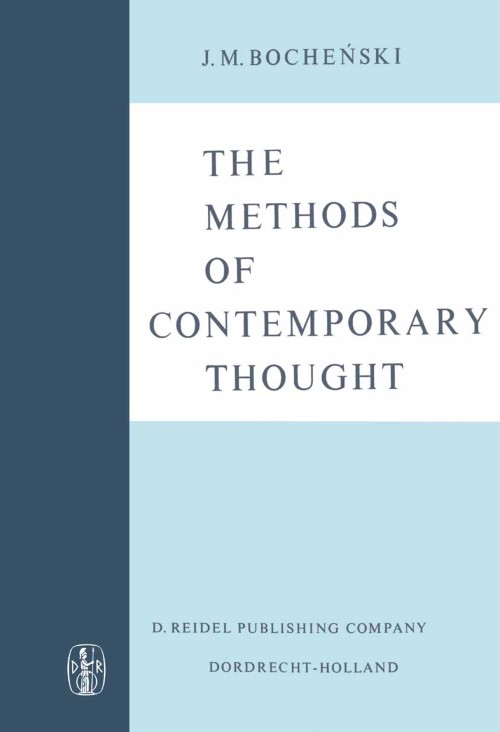
The Methods of Contemporary Thought [electronic resource] : Translated from the German by Peter Caws / by J.M. Bochenski.
Erişim Adresi
ISBN
9789401035781
Dil Kodu
İngilizce
Yer Numarası
DK/13227
Yazar
Basım Bildirimi
1st ed. 1965.
Yayın Bilgisi
Dordrecht : Springer Netherlands : Imprint: Springer, 1965.
Fiziksel Niteleme
145 p. online resource.
İçindekiler Notu
I Introduction -- 1. Terminology -- 2. Logic, Methodology and Science -- II The Phenomenological Method -- 3. General Remarks -- 4. “Back to the Things Themselves” -- 5. The Object of Phenomenological Investigation -- III Semiotic Methods -- 6. General Remarks -- 7. Formalism -- 8. Rules of Syntactic Meaning -- 9. Semantic Functions and Types -- 10. Semantic Meaning and Verifiability -- 11. Example of Semantic Methods in Practice -- IV The Axiomatic Method -- 12. General Remarks -- 13. The Axiomatic System -- 14. Mathematical Logic -- 15. Definition and Concept Formation -- 16. Example of the Axiomatic Method in Practice -- V Reductive Methods -- 17. General Remarks -- 18. The Structure of the Natural Sciences -- 19. Types of Explanatory Statements -- 20. Induction -- 21. Probability and Statistics -- 22. Historical Method -- Epilogue Guide to Further Reading -- Index of Persons -- Index of Subjects.
Özet, vb.
Professor Bochenski, as he himself points out in the prologue, is a logician; he is best known in England and the United States for his work in the history of logic, and more recently in Soviet and East European philosophy. But he has taught philosophy for many years - in Rome, in Switzerland, and on a number of visits to the United States - and in this book provides an elementary introduction to contemporary work in the field. As a means to this end he has chosen to deal with four alternative methods employed by philosophers in the twentieth century. Philosophical methodology has not attracted much attention, in English speaking circles, as a distinct branch of the discipline of philosophy; the term "methodologist", if used at all, would ordinarily be taken to refer to somebody concerned with scientific rather than philosophical method. When, therefore, Professor Bochenski refers, as he frequently does, to "contemporary methodologists", meaning people who debate the re spective merits of phenomenology and mathematical logic as ways of approaching the world, the phrase has an odd ring. But philosophical methodology really makes a great deal more sense than scientific method ology. In science methodology is almost superfluous; given all the avail able information and a reasonably clear idea of what is wanted, there is usually not much ambiguity as to the means of getting it, or not much that could be resolved by mere argument.
Konu
Philosophy, Modern.
Philosophy.
Early Modern Philosophy.
Philosophy.
Philosophy.
Early Modern Philosophy.
Philosophy.
Kurum Adı
Eseri Alıntıla
Referansları kullanmadan önce gözden geçirmeniz ve varsa gerekli düzeltmeleri yapmanız önerilir.
Dijital Kaynak
MARC Görünümü
LEADER 04777nam a22005295i 4500
001 811969
003 TR_AnAIT
005 20260131004007
007 cr nn 008mamaa
008 121227s1965 ne | s |||| 0|eng d
020 |a9789401035781|9978-94-010-3578-1
024 7 |a10.1007/978-94-010-3578-1|2doi
041 |aeng
049 |aTürk Tarih Kurumu Kütüphanesi
050 4|aB800.2-804
072 7|aHPCD|2bicssc
072 7|aPHI016000|2bisacsh
072 7|aQDH|2thema
082 04|a190.903|223
090 |aDK/13227
100 1 |aBochenski, J.M.|eauthor.|4aut|4http://id.loc.gov/vocabulary/relators/aut
245 14|aThe Methods of Contemporary Thought|h[electronic resource] :|bTranslated from the German by Peter Caws /|cby J.M. Bochenski.
250 |a1st ed. 1965.
264 1|aDordrecht :|bSpringer Netherlands :|bImprint: Springer,|c1965.
300 |a145 p.|bonline resource.
336 |atext|btxt|2rdacontent
337 |acomputer|bc|2rdamedia
338 |aonline resource|bcr|2rdacarrier
347 |atext file|bPDF|2rda
505 0 |aI Introduction -- 1. Terminology -- 2. Logic, Methodology and Science -- II The Phenomenological Method -- 3. General Remarks -- 4. “Back to the Things Themselves” -- 5. The Object of Phenomenological Investigation -- III Semiotic Methods -- 6. General Remarks -- 7. Formalism -- 8. Rules of Syntactic Meaning -- 9. Semantic Functions and Types -- 10. Semantic Meaning and Verifiability -- 11. Example of Semantic Methods in Practice -- IV The Axiomatic Method -- 12. General Remarks -- 13. The Axiomatic System -- 14. Mathematical Logic -- 15. Definition and Concept Formation -- 16. Example of the Axiomatic Method in Practice -- V Reductive Methods -- 17. General Remarks -- 18. The Structure of the Natural Sciences -- 19. Types of Explanatory Statements -- 20. Induction -- 21. Probability and Statistics -- 22. Historical Method -- Epilogue Guide to Further Reading -- Index of Persons -- Index of Subjects.
520 |aProfessor Bochenski, as he himself points out in the prologue, is a logician; he is best known in England and the United States for his work in the history of logic, and more recently in Soviet and East European philosophy. But he has taught philosophy for many years - in Rome, in Switzerland, and on a number of visits to the United States - and in this book provides an elementary introduction to contemporary work in the field. As a means to this end he has chosen to deal with four alternative methods employed by philosophers in the twentieth century. Philosophical methodology has not attracted much attention, in English speaking circles, as a distinct branch of the discipline of philosophy; the term "methodologist", if used at all, would ordinarily be taken to refer to somebody concerned with scientific rather than philosophical method. When, therefore, Professor Bochenski refers, as he frequently does, to "contemporary methodologists", meaning people who debate the re spective merits of phenomenology and mathematical logic as ways of approaching the world, the phrase has an odd ring. But philosophical methodology really makes a great deal more sense than scientific method ology. In science methodology is almost superfluous; given all the avail able information and a reasonably clear idea of what is wanted, there is usually not much ambiguity as to the means of getting it, or not much that could be resolved by mere argument.
532 8 |aAccessibility summary: This PDF is not accessible. It is based on scanned pages and does not support features such as screen reader compatibility or described non-text content (images, graphs etc). However, it likely supports searchable and selectable text based on OCR (Optical Character Recognition). Users with accessibility needs may not be able to use this content effectively. Please contact us at accessibilitysupport@springernature.com if you require assistance or an alternative format.
532 8 |aInaccessible, or known limited accessibility
532 8 |aNo reading system accessibility options actively disabled
532 8 |aPublisher contact for further accessibility information: accessibilitysupport@springernature.com
650 0|aPhilosophy, Modern.
650 0|aPhilosophy.
650 14|aEarly Modern Philosophy.
650 24|aPhilosophy.
710 2 |aSpringerLink (Online service)
773 0 |tSpringer Nature eBook
776 08|iPrinted edition:|z9789027700049
776 08|iPrinted edition:|z9789401035798
776 08|iPrinted edition:|z9789401035804
856 40|uhttps://doi.org/10.1007/978-94-010-3578-1
912 |aZDB-2-SHU
912 |aZDB-2-SXPR
912 |aZDB-2-BAE
950 |aHumanities, Social Sciences and Law (SpringerNature-11648)
950 |aPhilosophy and Religion (R0) (SpringerNature-43725)
001 811969
003 TR_AnAIT
005 20260131004007
007 cr nn 008mamaa
008 121227s1965 ne | s |||| 0|eng d
020 |a9789401035781|9978-94-010-3578-1
024 7 |a10.1007/978-94-010-3578-1|2doi
041 |aeng
049 |aTürk Tarih Kurumu Kütüphanesi
050 4|aB800.2-804
072 7|aHPCD|2bicssc
072 7|aPHI016000|2bisacsh
072 7|aQDH|2thema
082 04|a190.903|223
090 |aDK/13227
100 1 |aBochenski, J.M.|eauthor.|4aut|4http://id.loc.gov/vocabulary/relators/aut
245 14|aThe Methods of Contemporary Thought|h[electronic resource] :|bTranslated from the German by Peter Caws /|cby J.M. Bochenski.
250 |a1st ed. 1965.
264 1|aDordrecht :|bSpringer Netherlands :|bImprint: Springer,|c1965.
300 |a145 p.|bonline resource.
336 |atext|btxt|2rdacontent
337 |acomputer|bc|2rdamedia
338 |aonline resource|bcr|2rdacarrier
347 |atext file|bPDF|2rda
505 0 |aI Introduction -- 1. Terminology -- 2. Logic, Methodology and Science -- II The Phenomenological Method -- 3. General Remarks -- 4. “Back to the Things Themselves” -- 5. The Object of Phenomenological Investigation -- III Semiotic Methods -- 6. General Remarks -- 7. Formalism -- 8. Rules of Syntactic Meaning -- 9. Semantic Functions and Types -- 10. Semantic Meaning and Verifiability -- 11. Example of Semantic Methods in Practice -- IV The Axiomatic Method -- 12. General Remarks -- 13. The Axiomatic System -- 14. Mathematical Logic -- 15. Definition and Concept Formation -- 16. Example of the Axiomatic Method in Practice -- V Reductive Methods -- 17. General Remarks -- 18. The Structure of the Natural Sciences -- 19. Types of Explanatory Statements -- 20. Induction -- 21. Probability and Statistics -- 22. Historical Method -- Epilogue Guide to Further Reading -- Index of Persons -- Index of Subjects.
520 |aProfessor Bochenski, as he himself points out in the prologue, is a logician; he is best known in England and the United States for his work in the history of logic, and more recently in Soviet and East European philosophy. But he has taught philosophy for many years - in Rome, in Switzerland, and on a number of visits to the United States - and in this book provides an elementary introduction to contemporary work in the field. As a means to this end he has chosen to deal with four alternative methods employed by philosophers in the twentieth century. Philosophical methodology has not attracted much attention, in English speaking circles, as a distinct branch of the discipline of philosophy; the term "methodologist", if used at all, would ordinarily be taken to refer to somebody concerned with scientific rather than philosophical method. When, therefore, Professor Bochenski refers, as he frequently does, to "contemporary methodologists", meaning people who debate the re spective merits of phenomenology and mathematical logic as ways of approaching the world, the phrase has an odd ring. But philosophical methodology really makes a great deal more sense than scientific method ology. In science methodology is almost superfluous; given all the avail able information and a reasonably clear idea of what is wanted, there is usually not much ambiguity as to the means of getting it, or not much that could be resolved by mere argument.
532 8 |aAccessibility summary: This PDF is not accessible. It is based on scanned pages and does not support features such as screen reader compatibility or described non-text content (images, graphs etc). However, it likely supports searchable and selectable text based on OCR (Optical Character Recognition). Users with accessibility needs may not be able to use this content effectively. Please contact us at accessibilitysupport@springernature.com if you require assistance or an alternative format.
532 8 |aInaccessible, or known limited accessibility
532 8 |aNo reading system accessibility options actively disabled
532 8 |aPublisher contact for further accessibility information: accessibilitysupport@springernature.com
650 0|aPhilosophy, Modern.
650 0|aPhilosophy.
650 14|aEarly Modern Philosophy.
650 24|aPhilosophy.
710 2 |aSpringerLink (Online service)
773 0 |tSpringer Nature eBook
776 08|iPrinted edition:|z9789027700049
776 08|iPrinted edition:|z9789401035798
776 08|iPrinted edition:|z9789401035804
856 40|uhttps://doi.org/10.1007/978-94-010-3578-1
912 |aZDB-2-SHU
912 |aZDB-2-SXPR
912 |aZDB-2-BAE
950 |aHumanities, Social Sciences and Law (SpringerNature-11648)
950 |aPhilosophy and Religion (R0) (SpringerNature-43725)
Materyaller
Depodan talep edilen materyal sadece kütüphane içerisinde kullanılmaktadır.
Materyal dışarıya ödünç verilmemektedir.
Materyal dışarıya ödünç verilmemektedir.
