

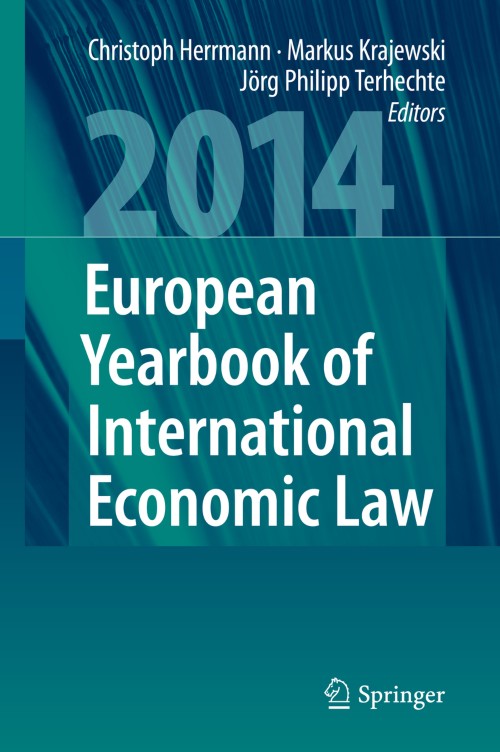
European Yearbook of International Economic Law 2014 [electronic resource] / edited by Christoph Herrmann, Markus Krajewski, Jörg Philipp Terhechte.
Erişim Adresi
ISBN
9783642409134
Dil Kodu
İngilizce
Yer Numarası
DK/13256
Basım Bildirimi
1st ed. 2013.
Yayın Bilgisi
Berlin, Heidelberg : Springer Berlin Heidelberg : Imprint: Springer, 2013.
Fiziksel Niteleme
XIX, 534 p. 4 illus. online resource.
Dizi
European Yearbook of International Economic Law, 2364-8406
İçindekiler Notu
Part I Topics -- Special Focus I: The Global Monetary and Financial System 70 Years After Bretton Woods -- Special Focus II: The Global Trading Order 20 Years After Marrakesh -- Part II Regional Integration -- Part III International Economic Institutions -- Part IV Book Reviews -- Annex – ELSA Moot Court Competition (EMC2) 2012-2013.
Özet, vb.
In 2014, the global economic system celebrates two anniversaries: Seventy years ago, on 22 July 1944 at Bretton Woods, New Hampshire, the Articles of Agreement of the International Monetary Fund (IMF) and the Articles of Agreement of the International Bank for Reconstruction and Development (Worldbank) were adopted. Since then the global financial and monetary system underwent significant policy changes, but the institutional framework remained the same. More recently, twenty years ago, on 15 April 1994, the Final Act of the Uruguay Round of Multilateral Trade Negotiations was signed and its key component, the Agreement establishing the World Trade Organization, entered into force on 1 January 1995. Even though the beginning of the multilateral trading system dates back to the late 1940s, the founding of the WTO constitutes a significant institutional reform which marks the beginning of a new era. Anniversaries are usually moments of celebration. However, even a superficial observer will notice that neither the current international financial and monetary regime nor the international trade regime is in a stage which invites celebration. Instead, both are facing difficult and fundamental challenges to their very existence from the outside but also from within. So while there may be no time to celebrate, anniversaries are also often used for reflection about the past and the future. Hence, EYIEL 5 (2014) considers these two anniversaries ample moments to reflect on the legacy and the current status of the main two pillars of International Economic Law in its Part one. Part two of EYIEL 5 (2014) brings together contributions on the EU’s Deep Trade Agenda, on Current Approaches to the International Investment Regime in South America, on the Multilayered System of Regional Economic Integration in West Africa and on the Tripartite Free Trade Area, as well as on India and her Trade Agreements. Part three contains treatises of developments in the World CustomsOrganization, the World Intellectual Property Organization and in International Investment Law. After the book reviews in Part four, EYIEL 5 (2014) is complemented with an Annex containing the Case (on exchange-rate manipulation and crisis-caused guarantees to financial institutions) and the Best Submissions of the 11th EMC2 ELSA WTO Moot Court Competition (of the Harvard team for the complainant and the Leuven team for the respondent). The case not only addresses issues of current interest but also links the subjects of our two special focusses nicely together.
Konu
International law.
Trade regulation.
International economic relations.
International Economic Law, Trade Law.
International Economics.
Trade regulation.
International economic relations.
International Economic Law, Trade Law.
International Economics.
Kurum Adı
Eseri Alıntıla
Referansları kullanmadan önce gözden geçirmeniz ve varsa gerekli düzeltmeleri yapmanız önerilir.
Dijital Kaynak
MARC Görünümü
LEADER 04992nam a22005295i 4500
001 811998
003 TR_AnAIT
005 20260131003914
007 cr nn 008mamaa
008 140210s2013 gw | s |||| 0|eng d
020 |a9783642409134|9978-3-642-40913-4
024 7 |a10.1007/978-3-642-40913-4|2doi
041 |aeng
049 |aTürk Tarih Kurumu Kütüphanesi
050 4|aK3820-3836
072 7|aLBBM|2bicssc
072 7|aLAW051000|2bisacsh
072 7|aLBBM|2thema
082 04|a343.07|223
090 |aDK/13256
245 10|aEuropean Yearbook of International Economic Law 2014|h[electronic resource] /|cedited by Christoph Herrmann, Markus Krajewski, Jörg Philipp Terhechte.
250 |a1st ed. 2013.
264 1|aBerlin, Heidelberg :|bSpringer Berlin Heidelberg :|bImprint: Springer,|c2013.
300 |aXIX, 534 p. 4 illus.|bonline resource.
336 |atext|btxt|2rdacontent
337 |acomputer|bc|2rdamedia
338 |aonline resource|bcr|2rdacarrier
347 |atext file|bPDF|2rda
490 1 |aEuropean Yearbook of International Economic Law,|x2364-8406
505 0 |aPart I Topics -- Special Focus I: The Global Monetary and Financial System 70 Years After Bretton Woods -- Special Focus II: The Global Trading Order 20 Years After Marrakesh -- Part II Regional Integration -- Part III International Economic Institutions -- Part IV Book Reviews -- Annex – ELSA Moot Court Competition (EMC2) 2012-2013.
520 |aIn 2014, the global economic system celebrates two anniversaries: Seventy years ago, on 22 July 1944 at Bretton Woods, New Hampshire, the Articles of Agreement of the International Monetary Fund (IMF) and the Articles of Agreement of the International Bank for Reconstruction and Development (Worldbank) were adopted. Since then the global financial and monetary system underwent significant policy changes, but the institutional framework remained the same. More recently, twenty years ago, on 15 April 1994, the Final Act of the Uruguay Round of Multilateral Trade Negotiations was signed and its key component, the Agreement establishing the World Trade Organization, entered into force on 1 January 1995. Even though the beginning of the multilateral trading system dates back to the late 1940s, the founding of the WTO constitutes a significant institutional reform which marks the beginning of a new era. Anniversaries are usually moments of celebration. However, even a superficial observer will notice that neither the current international financial and monetary regime nor the international trade regime is in a stage which invites celebration. Instead, both are facing difficult and fundamental challenges to their very existence from the outside but also from within. So while there may be no time to celebrate, anniversaries are also often used for reflection about the past and the future. Hence, EYIEL 5 (2014) considers these two anniversaries ample moments to reflect on the legacy and the current status of the main two pillars of International Economic Law in its Part one. Part two of EYIEL 5 (2014) brings together contributions on the EU’s Deep Trade Agenda, on Current Approaches to the International Investment Regime in South America, on the Multilayered System of Regional Economic Integration in West Africa and on the Tripartite Free Trade Area, as well as on India and her Trade Agreements. Part three contains treatises of developments in the World CustomsOrganization, the World Intellectual Property Organization and in International Investment Law. After the book reviews in Part four, EYIEL 5 (2014) is complemented with an Annex containing the Case (on exchange-rate manipulation and crisis-caused guarantees to financial institutions) and the Best Submissions of the 11th EMC2 ELSA WTO Moot Court Competition (of the Harvard team for the complainant and the Leuven team for the respondent). The case not only addresses issues of current interest but also links the subjects of our two special focusses nicely together.
650 0|aInternational law.
650 0|aTrade regulation.
650 0|aInternational economic relations.
650 14|aInternational Economic Law, Trade Law.
650 24|aInternational Economics.
700 1 |aHerrmann, Christoph.|eeditor.|4edt|4http://id.loc.gov/vocabulary/relators/edt
700 1 |aKrajewski, Markus.|eeditor.|4edt|4http://id.loc.gov/vocabulary/relators/edt
700 1 |aTerhechte, Jörg Philipp.|eeditor.|4edt|4http://id.loc.gov/vocabulary/relators/edt
710 2 |aSpringerLink (Online service)
773 0 |tSpringer Nature eBook
776 08|iPrinted edition:|z9783642409127
776 08|iPrinted edition:|z9783642409141
776 08|iPrinted edition:|z9783662514412
830 0|aEuropean Yearbook of International Economic Law,|x2364-8406
856 40|uhttps://doi.org/10.1007/978-3-642-40913-4
912 |aZDB-2-SHU
912 |aZDB-2-SXLC
950 |aHumanities, Social Sciences and Law (SpringerNature-11648)
950 |aLaw and Criminology (R0) (SpringerNature-43727)
001 811998
003 TR_AnAIT
005 20260131003914
007 cr nn 008mamaa
008 140210s2013 gw | s |||| 0|eng d
020 |a9783642409134|9978-3-642-40913-4
024 7 |a10.1007/978-3-642-40913-4|2doi
041 |aeng
049 |aTürk Tarih Kurumu Kütüphanesi
050 4|aK3820-3836
072 7|aLBBM|2bicssc
072 7|aLAW051000|2bisacsh
072 7|aLBBM|2thema
082 04|a343.07|223
090 |aDK/13256
245 10|aEuropean Yearbook of International Economic Law 2014|h[electronic resource] /|cedited by Christoph Herrmann, Markus Krajewski, Jörg Philipp Terhechte.
250 |a1st ed. 2013.
264 1|aBerlin, Heidelberg :|bSpringer Berlin Heidelberg :|bImprint: Springer,|c2013.
300 |aXIX, 534 p. 4 illus.|bonline resource.
336 |atext|btxt|2rdacontent
337 |acomputer|bc|2rdamedia
338 |aonline resource|bcr|2rdacarrier
347 |atext file|bPDF|2rda
490 1 |aEuropean Yearbook of International Economic Law,|x2364-8406
505 0 |aPart I Topics -- Special Focus I: The Global Monetary and Financial System 70 Years After Bretton Woods -- Special Focus II: The Global Trading Order 20 Years After Marrakesh -- Part II Regional Integration -- Part III International Economic Institutions -- Part IV Book Reviews -- Annex – ELSA Moot Court Competition (EMC2) 2012-2013.
520 |aIn 2014, the global economic system celebrates two anniversaries: Seventy years ago, on 22 July 1944 at Bretton Woods, New Hampshire, the Articles of Agreement of the International Monetary Fund (IMF) and the Articles of Agreement of the International Bank for Reconstruction and Development (Worldbank) were adopted. Since then the global financial and monetary system underwent significant policy changes, but the institutional framework remained the same. More recently, twenty years ago, on 15 April 1994, the Final Act of the Uruguay Round of Multilateral Trade Negotiations was signed and its key component, the Agreement establishing the World Trade Organization, entered into force on 1 January 1995. Even though the beginning of the multilateral trading system dates back to the late 1940s, the founding of the WTO constitutes a significant institutional reform which marks the beginning of a new era. Anniversaries are usually moments of celebration. However, even a superficial observer will notice that neither the current international financial and monetary regime nor the international trade regime is in a stage which invites celebration. Instead, both are facing difficult and fundamental challenges to their very existence from the outside but also from within. So while there may be no time to celebrate, anniversaries are also often used for reflection about the past and the future. Hence, EYIEL 5 (2014) considers these two anniversaries ample moments to reflect on the legacy and the current status of the main two pillars of International Economic Law in its Part one. Part two of EYIEL 5 (2014) brings together contributions on the EU’s Deep Trade Agenda, on Current Approaches to the International Investment Regime in South America, on the Multilayered System of Regional Economic Integration in West Africa and on the Tripartite Free Trade Area, as well as on India and her Trade Agreements. Part three contains treatises of developments in the World CustomsOrganization, the World Intellectual Property Organization and in International Investment Law. After the book reviews in Part four, EYIEL 5 (2014) is complemented with an Annex containing the Case (on exchange-rate manipulation and crisis-caused guarantees to financial institutions) and the Best Submissions of the 11th EMC2 ELSA WTO Moot Court Competition (of the Harvard team for the complainant and the Leuven team for the respondent). The case not only addresses issues of current interest but also links the subjects of our two special focusses nicely together.
650 0|aInternational law.
650 0|aTrade regulation.
650 0|aInternational economic relations.
650 14|aInternational Economic Law, Trade Law.
650 24|aInternational Economics.
700 1 |aHerrmann, Christoph.|eeditor.|4edt|4http://id.loc.gov/vocabulary/relators/edt
700 1 |aKrajewski, Markus.|eeditor.|4edt|4http://id.loc.gov/vocabulary/relators/edt
700 1 |aTerhechte, Jörg Philipp.|eeditor.|4edt|4http://id.loc.gov/vocabulary/relators/edt
710 2 |aSpringerLink (Online service)
773 0 |tSpringer Nature eBook
776 08|iPrinted edition:|z9783642409127
776 08|iPrinted edition:|z9783642409141
776 08|iPrinted edition:|z9783662514412
830 0|aEuropean Yearbook of International Economic Law,|x2364-8406
856 40|uhttps://doi.org/10.1007/978-3-642-40913-4
912 |aZDB-2-SHU
912 |aZDB-2-SXLC
950 |aHumanities, Social Sciences and Law (SpringerNature-11648)
950 |aLaw and Criminology (R0) (SpringerNature-43727)
Materyaller
Depodan talep edilen materyal sadece kütüphane içerisinde kullanılmaktadır.
Materyal dışarıya ödünç verilmemektedir.
Materyal dışarıya ödünç verilmemektedir.
