

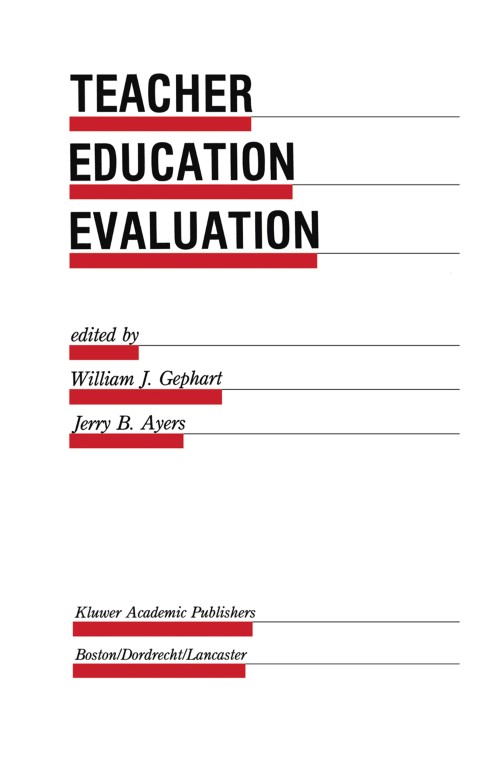
Teacher Education Evaluation [electronic resource] / edited by William J. Gephart, Jerry B. Ayers.
Erişim Adresi
ISBN
9789400926752
Dil Kodu
İngilizce
Yer Numarası
DK/13278
Basım Bildirimi
1st ed. 1988.
Yayın Bilgisi
Dordrecht : Springer Netherlands : Imprint: Springer, 1988.
Fiziksel Niteleme
XVIII, 174 p. online resource.
Dizi
Evaluation in Education and Human Services
İçindekiler Notu
1 Teacher Selection: A Problem of Admission Criteria, Certification Criteria, or Prediction of Job Performance? -- 2 Evaluation of Teacher Education Programs -- 3 The Professional Education Unit -- 4 An Outcomes-Based Teacher Preparation Program -- 5 Teacher Education Follow-up Evaluation: How To Do It -- 6 Pupil Achievement: The Weakest Link in the Evaluation Chain -- 7 Reflections on Conference Proceedings for the Center for Teacher Education Evaluation -- 8 Some Missing Links.
Özet, vb.
In an age that dictates accountability and verifiability of educational programs, institutions of higher education are called on to justify their programs. To meet these demands, there is a need for improved methods for the evaluation of teacher education programs. More importantly, there is a need for the development of methods and procedures to conduct continuous and on-going evaluation that can aid the process of program improvement. Many institutions have had difficulties in developing and implementing satisfactory systems for conducting needed evaluation. In recent years the standards for the approval of teacher education programs in all of the states were strengthened as were the standards for approval by the National Council for the Accreditation of Teacher Education (NCATE). These revised standards put even more emphasis on accountability and the need for both summative and formative evaluation in a teacher education program. Tennessee Technological University has long been recognized as an institution with an exemplary project in program evaluation. As a result, in 1986, the state of Tennessee established at Tennessee Technological University, a Center for Teacher Education Evaluation. The Center began work in July 1986, on the development of models and systems for conducting teacher education program evaluation. To most, teacher education program evaluation is simple and straightforward. Evaluation includes a set of options, a set of criteria, data collection and interpretation, x and then use in meeting accountability needs.
Konu
Educational tests and measurements.
Assessment and Testing.
Assessment and Testing.
Diğer Yazarlar
Kurum Adı
Eseri Alıntıla
Referansları kullanmadan önce gözden geçirmeniz ve varsa gerekli düzeltmeleri yapmanız önerilir.
Dijital Kaynak
MARC Görünümü
LEADER 04591nam a22005415i 4500
001 812021
003 TR_AnAIT
005 20260131003818
007 cr nn 008mamaa
008 121227s1988 ne | s |||| 0|eng d
020 |a9789400926752|9978-94-009-2675-2
024 7 |a10.1007/978-94-009-2675-2|2doi
041 |aeng
049 |aTürk Tarih Kurumu Kütüphanesi
050 4|aLB3050-3060.87
072 7|aJNKD|2bicssc
072 7|aEDU030000|2bisacsh
072 7|aJNDH|2thema
082 04|a371.26|223
090 |aDK/13278
245 10|aTeacher Education Evaluation|h[electronic resource] /|cedited by William J. Gephart, Jerry B. Ayers.
250 |a1st ed. 1988.
264 1|aDordrecht :|bSpringer Netherlands :|bImprint: Springer,|c1988.
300 |aXVIII, 174 p.|bonline resource.
336 |atext|btxt|2rdacontent
337 |acomputer|bc|2rdamedia
338 |aonline resource|bcr|2rdacarrier
347 |atext file|bPDF|2rda
490 1 |aEvaluation in Education and Human Services
505 0 |a1 Teacher Selection: A Problem of Admission Criteria, Certification Criteria, or Prediction of Job Performance? -- 2 Evaluation of Teacher Education Programs -- 3 The Professional Education Unit -- 4 An Outcomes-Based Teacher Preparation Program -- 5 Teacher Education Follow-up Evaluation: How To Do It -- 6 Pupil Achievement: The Weakest Link in the Evaluation Chain -- 7 Reflections on Conference Proceedings for the Center for Teacher Education Evaluation -- 8 Some Missing Links.
520 |aIn an age that dictates accountability and verifiability of educational programs, institutions of higher education are called on to justify their programs. To meet these demands, there is a need for improved methods for the evaluation of teacher education programs. More importantly, there is a need for the development of methods and procedures to conduct continuous and on-going evaluation that can aid the process of program improvement. Many institutions have had difficulties in developing and implementing satisfactory systems for conducting needed evaluation. In recent years the standards for the approval of teacher education programs in all of the states were strengthened as were the standards for approval by the National Council for the Accreditation of Teacher Education (NCATE). These revised standards put even more emphasis on accountability and the need for both summative and formative evaluation in a teacher education program. Tennessee Technological University has long been recognized as an institution with an exemplary project in program evaluation. As a result, in 1986, the state of Tennessee established at Tennessee Technological University, a Center for Teacher Education Evaluation. The Center began work in July 1986, on the development of models and systems for conducting teacher education program evaluation. To most, teacher education program evaluation is simple and straightforward. Evaluation includes a set of options, a set of criteria, data collection and interpretation, x and then use in meeting accountability needs.
532 8 |aAccessibility summary: This PDF is not accessible. It is based on scanned pages and does not support features such as screen reader compatibility or described non-text content (images, graphs etc). However, it likely supports searchable and selectable text based on OCR (Optical Character Recognition). Users with accessibility needs may not be able to use this content effectively. Please contact us at accessibilitysupport@springernature.com if you require assistance or an alternative format.
532 8 |aInaccessible, or known limited accessibility
532 8 |aNo reading system accessibility options actively disabled
532 8 |aPublisher contact for further accessibility information: accessibilitysupport@springernature.com
650 0|aEducational tests and measurements.
650 14|aAssessment and Testing.
700 1 |aGephart, William J.|eeditor.|4edt|4http://id.loc.gov/vocabulary/relators/edt
700 1 |aAyers, Jerry B.|eeditor.|4edt|4http://id.loc.gov/vocabulary/relators/edt
710 2 |aSpringerLink (Online service)
773 0 |tSpringer Nature eBook
776 08|iPrinted edition:|z9780898382709
776 08|iPrinted edition:|z9789400926769
776 08|iPrinted edition:|z9789401077064
830 0|aEvaluation in Education and Human Services
856 40|uhttps://doi.org/10.1007/978-94-009-2675-2
912 |aZDB-2-SHU
912 |aZDB-2-SXED
912 |aZDB-2-BAE
950 |aHumanities, Social Sciences and Law (SpringerNature-11648)
950 |aEducation (R0) (SpringerNature-43721)
001 812021
003 TR_AnAIT
005 20260131003818
007 cr nn 008mamaa
008 121227s1988 ne | s |||| 0|eng d
020 |a9789400926752|9978-94-009-2675-2
024 7 |a10.1007/978-94-009-2675-2|2doi
041 |aeng
049 |aTürk Tarih Kurumu Kütüphanesi
050 4|aLB3050-3060.87
072 7|aJNKD|2bicssc
072 7|aEDU030000|2bisacsh
072 7|aJNDH|2thema
082 04|a371.26|223
090 |aDK/13278
245 10|aTeacher Education Evaluation|h[electronic resource] /|cedited by William J. Gephart, Jerry B. Ayers.
250 |a1st ed. 1988.
264 1|aDordrecht :|bSpringer Netherlands :|bImprint: Springer,|c1988.
300 |aXVIII, 174 p.|bonline resource.
336 |atext|btxt|2rdacontent
337 |acomputer|bc|2rdamedia
338 |aonline resource|bcr|2rdacarrier
347 |atext file|bPDF|2rda
490 1 |aEvaluation in Education and Human Services
505 0 |a1 Teacher Selection: A Problem of Admission Criteria, Certification Criteria, or Prediction of Job Performance? -- 2 Evaluation of Teacher Education Programs -- 3 The Professional Education Unit -- 4 An Outcomes-Based Teacher Preparation Program -- 5 Teacher Education Follow-up Evaluation: How To Do It -- 6 Pupil Achievement: The Weakest Link in the Evaluation Chain -- 7 Reflections on Conference Proceedings for the Center for Teacher Education Evaluation -- 8 Some Missing Links.
520 |aIn an age that dictates accountability and verifiability of educational programs, institutions of higher education are called on to justify their programs. To meet these demands, there is a need for improved methods for the evaluation of teacher education programs. More importantly, there is a need for the development of methods and procedures to conduct continuous and on-going evaluation that can aid the process of program improvement. Many institutions have had difficulties in developing and implementing satisfactory systems for conducting needed evaluation. In recent years the standards for the approval of teacher education programs in all of the states were strengthened as were the standards for approval by the National Council for the Accreditation of Teacher Education (NCATE). These revised standards put even more emphasis on accountability and the need for both summative and formative evaluation in a teacher education program. Tennessee Technological University has long been recognized as an institution with an exemplary project in program evaluation. As a result, in 1986, the state of Tennessee established at Tennessee Technological University, a Center for Teacher Education Evaluation. The Center began work in July 1986, on the development of models and systems for conducting teacher education program evaluation. To most, teacher education program evaluation is simple and straightforward. Evaluation includes a set of options, a set of criteria, data collection and interpretation, x and then use in meeting accountability needs.
532 8 |aAccessibility summary: This PDF is not accessible. It is based on scanned pages and does not support features such as screen reader compatibility or described non-text content (images, graphs etc). However, it likely supports searchable and selectable text based on OCR (Optical Character Recognition). Users with accessibility needs may not be able to use this content effectively. Please contact us at accessibilitysupport@springernature.com if you require assistance or an alternative format.
532 8 |aInaccessible, or known limited accessibility
532 8 |aNo reading system accessibility options actively disabled
532 8 |aPublisher contact for further accessibility information: accessibilitysupport@springernature.com
650 0|aEducational tests and measurements.
650 14|aAssessment and Testing.
700 1 |aGephart, William J.|eeditor.|4edt|4http://id.loc.gov/vocabulary/relators/edt
700 1 |aAyers, Jerry B.|eeditor.|4edt|4http://id.loc.gov/vocabulary/relators/edt
710 2 |aSpringerLink (Online service)
773 0 |tSpringer Nature eBook
776 08|iPrinted edition:|z9780898382709
776 08|iPrinted edition:|z9789400926769
776 08|iPrinted edition:|z9789401077064
830 0|aEvaluation in Education and Human Services
856 40|uhttps://doi.org/10.1007/978-94-009-2675-2
912 |aZDB-2-SHU
912 |aZDB-2-SXED
912 |aZDB-2-BAE
950 |aHumanities, Social Sciences and Law (SpringerNature-11648)
950 |aEducation (R0) (SpringerNature-43721)
Materyaller
Depodan talep edilen materyal sadece kütüphane içerisinde kullanılmaktadır.
Materyal dışarıya ödünç verilmemektedir.
Materyal dışarıya ödünç verilmemektedir.
