

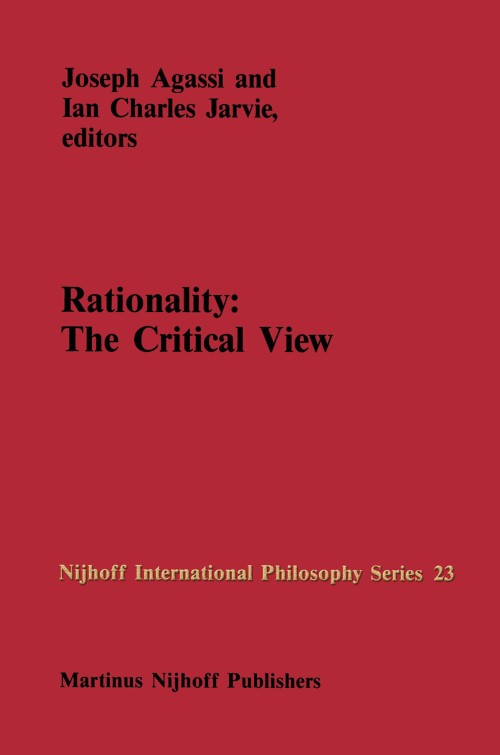
Rationality: The Critical View [electronic resource] / edited by J. Agassi, I.C. Jarvie.
Erişim Adresi
ISBN
9789400934917
Dil Kodu
İngilizce
Yer Numarası
DK/13297
Basım Bildirimi
1st ed. 1987.
Yayın Bilgisi
Dordrecht : Springer Netherlands : Imprint: Springer, 1987.
Fiziksel Niteleme
XII, 480 p. online resource.
Dizi
Nijhoff International Philosophy Series ; 23
İçindekiler Notu
I: Rationality in General -- 1. Seven Desiderata for Rationality -- 2. Arguments for Skepticism -- 3. Skeptical Rationalism -- 4. The Sceptic at Bay -- 5. Esotericism -- 6. Science and the Search for Truth -- 7. Rationality and the Problem of Scientific Traditions -- 8. An Ethic of Cognition -- 9. Methodological Individualism and Institutional Individualism -- 10. Epistemology and Politics -- 11. The Concept of Decision -- 12. Galileo’s Knife -- 13. The Objectivity of Criticism of the Arts -- 14. What is Literature? -- 15. Utopia and the Architect -- II: Rationality and Criticism -- 16. Theories of Rationality -- 17. Rationality and Problem-Solving -- 18. The Choice of Problems and the Limits of Reason -- 19. Rationality and Criticism -- 20. On Explaining Beliefs -- 21. Historicist Relativism and Bootstrap Rationality -- 22. On Two Non-Justificationist Theories -- 23. A Critique of Good Reasons -- III: Rationality and Irrationality -- 24. The Problem of the Rationality of Magic -- 25. Magic and Rationality Again -- 26. A Study in Westernization -- 27. Is Face the Same as Li? -- 28. The Rationality of Dogmatism -- 29. The Rationality of Irrationalism -- For Further Reading -- Sources -- Biographical Sketches -- Name Index.
Özet, vb.
In our papers on the rationality of magic, we distinghuished, for purposes of analysis, three levels of rationality. First and lowest (rationalitYl) the goal directed action of an agent with given aims and circumstances, where among his circumstances we included his knowledge and opinions. On this level the magician's treatment of illness by incantation is as rational as any traditional doctor's blood-letting or any modern one's use of anti-biotics. At the second level (rationalitY2) we add the element of rational thinking or thinking which obeys some set of explicit rules, a level which is not found in magic in general, though it is sometimes given to specific details of magical thinking within the magical thought-system. It was the late Sir Edward E. Evans-Pritchard who observed that when considering magic in detail the magician may be as consistent or critical as anyone else; but when considering magic in general, or any system of thought in general, the magician could not be critical or even comprehend the criticism. Evans-Pritchard went even further: he was sceptical as to whether it could be done in a truly consistent manner: one cannot be critical of one's own system, he thought. On this level (rationalitY2) of discussion we have explained (earlier) why we prefer to wed Evans Pritchard's view of the magician's capacity for piece-meal rationality to Sir James Frazer's view that magic in general is pseudo-rational because it lacks standards of rational thinking.
Konu
Science __ Philosophy.
Technology __ Philosophy.
Philosophy of Science.
Philosophy of Technology.
Technology __ Philosophy.
Philosophy of Science.
Philosophy of Technology.
Diğer Yazarlar
Kurum Adı
Eseri Alıntıla
Referansları kullanmadan önce gözden geçirmeniz ve varsa gerekli düzeltmeleri yapmanız önerilir.
Dijital Kaynak
MARC Görünümü
LEADER 05357nam a22005775i 4500
001 812040
003 TR_AnAIT
005 20260131003710
007 cr nn 008mamaa
008 121227s1987 ne | s |||| 0|eng d
020 |a9789400934917|9978-94-009-3491-7
024 7 |a10.1007/978-94-009-3491-7|2doi
041 |aeng
049 |aTürk Tarih Kurumu Kütüphanesi
050 4|aQ174-175.3
050 4|aB67
072 7|aPDA|2bicssc
072 7|aSCI075000|2bisacsh
072 7|aPDA|2thema
082 04|a501|223
090 |aDK/13297
245 10|aRationality: The Critical View|h[electronic resource] /|cedited by J. Agassi, I.C. Jarvie.
250 |a1st ed. 1987.
264 1|aDordrecht :|bSpringer Netherlands :|bImprint: Springer,|c1987.
300 |aXII, 480 p.|bonline resource.
336 |atext|btxt|2rdacontent
337 |acomputer|bc|2rdamedia
338 |aonline resource|bcr|2rdacarrier
347 |atext file|bPDF|2rda
490 1 |aNijhoff International Philosophy Series ;|v23
505 0 |aI: Rationality in General -- 1. Seven Desiderata for Rationality -- 2. Arguments for Skepticism -- 3. Skeptical Rationalism -- 4. The Sceptic at Bay -- 5. Esotericism -- 6. Science and the Search for Truth -- 7. Rationality and the Problem of Scientific Traditions -- 8. An Ethic of Cognition -- 9. Methodological Individualism and Institutional Individualism -- 10. Epistemology and Politics -- 11. The Concept of Decision -- 12. Galileo’s Knife -- 13. The Objectivity of Criticism of the Arts -- 14. What is Literature? -- 15. Utopia and the Architect -- II: Rationality and Criticism -- 16. Theories of Rationality -- 17. Rationality and Problem-Solving -- 18. The Choice of Problems and the Limits of Reason -- 19. Rationality and Criticism -- 20. On Explaining Beliefs -- 21. Historicist Relativism and Bootstrap Rationality -- 22. On Two Non-Justificationist Theories -- 23. A Critique of Good Reasons -- III: Rationality and Irrationality -- 24. The Problem of the Rationality of Magic -- 25. Magic and Rationality Again -- 26. A Study in Westernization -- 27. Is Face the Same as Li? -- 28. The Rationality of Dogmatism -- 29. The Rationality of Irrationalism -- For Further Reading -- Sources -- Biographical Sketches -- Name Index.
520 |aIn our papers on the rationality of magic, we distinghuished, for purposes of analysis, three levels of rationality. First and lowest (rationalitYl) the goal directed action of an agent with given aims and circumstances, where among his circumstances we included his knowledge and opinions. On this level the magician's treatment of illness by incantation is as rational as any traditional doctor's blood-letting or any modern one's use of anti-biotics. At the second level (rationalitY2) we add the element of rational thinking or thinking which obeys some set of explicit rules, a level which is not found in magic in general, though it is sometimes given to specific details of magical thinking within the magical thought-system. It was the late Sir Edward E. Evans-Pritchard who observed that when considering magic in detail the magician may be as consistent or critical as anyone else; but when considering magic in general, or any system of thought in general, the magician could not be critical or even comprehend the criticism. Evans-Pritchard went even further: he was sceptical as to whether it could be done in a truly consistent manner: one cannot be critical of one's own system, he thought. On this level (rationalitY2) of discussion we have explained (earlier) why we prefer to wed Evans Pritchard's view of the magician's capacity for piece-meal rationality to Sir James Frazer's view that magic in general is pseudo-rational because it lacks standards of rational thinking.
532 8 |aAccessibility summary: This PDF is not accessible. It is based on scanned pages and does not support features such as screen reader compatibility or described non-text content (images, graphs etc). However, it likely supports searchable and selectable text based on OCR (Optical Character Recognition). Users with accessibility needs may not be able to use this content effectively. Please contact us at accessibilitysupport@springernature.com if you require assistance or an alternative format.
532 8 |aInaccessible, or known limited accessibility
532 8 |aNo reading system accessibility options actively disabled
532 8 |aPublisher contact for further accessibility information: accessibilitysupport@springernature.com
650 0|aScience|xPhilosophy.
650 0|aTechnology|xPhilosophy.
650 14|aPhilosophy of Science.
650 24|aPhilosophy of Technology.
700 1 |aAgassi, J.|eeditor.|4edt|4http://id.loc.gov/vocabulary/relators/edt
700 1 |aJarvie, I.C.|eeditor.|4edt|4http://id.loc.gov/vocabulary/relators/edt
710 2 |aSpringerLink (Online service)
773 0 |tSpringer Nature eBook
776 08|iPrinted edition:|z9789024732753
776 08|iPrinted edition:|z9789024734559
776 08|iPrinted edition:|z9789400934924
830 0|aNijhoff International Philosophy Series ;|v23
856 40|uhttps://doi.org/10.1007/978-94-009-3491-7
912 |aZDB-2-SHU
912 |aZDB-2-SXPR
912 |aZDB-2-BAE
950 |aHumanities, Social Sciences and Law (SpringerNature-11648)
950 |aPhilosophy and Religion (R0) (SpringerNature-43725)
001 812040
003 TR_AnAIT
005 20260131003710
007 cr nn 008mamaa
008 121227s1987 ne | s |||| 0|eng d
020 |a9789400934917|9978-94-009-3491-7
024 7 |a10.1007/978-94-009-3491-7|2doi
041 |aeng
049 |aTürk Tarih Kurumu Kütüphanesi
050 4|aQ174-175.3
050 4|aB67
072 7|aPDA|2bicssc
072 7|aSCI075000|2bisacsh
072 7|aPDA|2thema
082 04|a501|223
090 |aDK/13297
245 10|aRationality: The Critical View|h[electronic resource] /|cedited by J. Agassi, I.C. Jarvie.
250 |a1st ed. 1987.
264 1|aDordrecht :|bSpringer Netherlands :|bImprint: Springer,|c1987.
300 |aXII, 480 p.|bonline resource.
336 |atext|btxt|2rdacontent
337 |acomputer|bc|2rdamedia
338 |aonline resource|bcr|2rdacarrier
347 |atext file|bPDF|2rda
490 1 |aNijhoff International Philosophy Series ;|v23
505 0 |aI: Rationality in General -- 1. Seven Desiderata for Rationality -- 2. Arguments for Skepticism -- 3. Skeptical Rationalism -- 4. The Sceptic at Bay -- 5. Esotericism -- 6. Science and the Search for Truth -- 7. Rationality and the Problem of Scientific Traditions -- 8. An Ethic of Cognition -- 9. Methodological Individualism and Institutional Individualism -- 10. Epistemology and Politics -- 11. The Concept of Decision -- 12. Galileo’s Knife -- 13. The Objectivity of Criticism of the Arts -- 14. What is Literature? -- 15. Utopia and the Architect -- II: Rationality and Criticism -- 16. Theories of Rationality -- 17. Rationality and Problem-Solving -- 18. The Choice of Problems and the Limits of Reason -- 19. Rationality and Criticism -- 20. On Explaining Beliefs -- 21. Historicist Relativism and Bootstrap Rationality -- 22. On Two Non-Justificationist Theories -- 23. A Critique of Good Reasons -- III: Rationality and Irrationality -- 24. The Problem of the Rationality of Magic -- 25. Magic and Rationality Again -- 26. A Study in Westernization -- 27. Is Face the Same as Li? -- 28. The Rationality of Dogmatism -- 29. The Rationality of Irrationalism -- For Further Reading -- Sources -- Biographical Sketches -- Name Index.
520 |aIn our papers on the rationality of magic, we distinghuished, for purposes of analysis, three levels of rationality. First and lowest (rationalitYl) the goal directed action of an agent with given aims and circumstances, where among his circumstances we included his knowledge and opinions. On this level the magician's treatment of illness by incantation is as rational as any traditional doctor's blood-letting or any modern one's use of anti-biotics. At the second level (rationalitY2) we add the element of rational thinking or thinking which obeys some set of explicit rules, a level which is not found in magic in general, though it is sometimes given to specific details of magical thinking within the magical thought-system. It was the late Sir Edward E. Evans-Pritchard who observed that when considering magic in detail the magician may be as consistent or critical as anyone else; but when considering magic in general, or any system of thought in general, the magician could not be critical or even comprehend the criticism. Evans-Pritchard went even further: he was sceptical as to whether it could be done in a truly consistent manner: one cannot be critical of one's own system, he thought. On this level (rationalitY2) of discussion we have explained (earlier) why we prefer to wed Evans Pritchard's view of the magician's capacity for piece-meal rationality to Sir James Frazer's view that magic in general is pseudo-rational because it lacks standards of rational thinking.
532 8 |aAccessibility summary: This PDF is not accessible. It is based on scanned pages and does not support features such as screen reader compatibility or described non-text content (images, graphs etc). However, it likely supports searchable and selectable text based on OCR (Optical Character Recognition). Users with accessibility needs may not be able to use this content effectively. Please contact us at accessibilitysupport@springernature.com if you require assistance or an alternative format.
532 8 |aInaccessible, or known limited accessibility
532 8 |aNo reading system accessibility options actively disabled
532 8 |aPublisher contact for further accessibility information: accessibilitysupport@springernature.com
650 0|aScience|xPhilosophy.
650 0|aTechnology|xPhilosophy.
650 14|aPhilosophy of Science.
650 24|aPhilosophy of Technology.
700 1 |aAgassi, J.|eeditor.|4edt|4http://id.loc.gov/vocabulary/relators/edt
700 1 |aJarvie, I.C.|eeditor.|4edt|4http://id.loc.gov/vocabulary/relators/edt
710 2 |aSpringerLink (Online service)
773 0 |tSpringer Nature eBook
776 08|iPrinted edition:|z9789024732753
776 08|iPrinted edition:|z9789024734559
776 08|iPrinted edition:|z9789400934924
830 0|aNijhoff International Philosophy Series ;|v23
856 40|uhttps://doi.org/10.1007/978-94-009-3491-7
912 |aZDB-2-SHU
912 |aZDB-2-SXPR
912 |aZDB-2-BAE
950 |aHumanities, Social Sciences and Law (SpringerNature-11648)
950 |aPhilosophy and Religion (R0) (SpringerNature-43725)
Materyaller
Depodan talep edilen materyal sadece kütüphane içerisinde kullanılmaktadır.
Materyal dışarıya ödünç verilmemektedir.
Materyal dışarıya ödünç verilmemektedir.
