

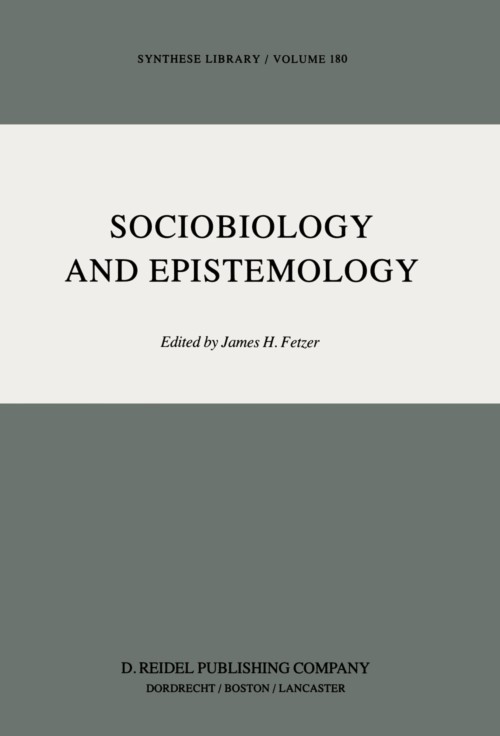
Sociobiology and Epistemology [electronic resource] / edited by J.H. Fetzer.
Erişim Adresi
ISBN
9789400953703
Dil Kodu
İngilizce
Yer Numarası
DK/13384
Basım Bildirimi
1st ed. 1985.
Yayın Bilgisi
Dordrecht : Springer Netherlands : Imprint: Springer, 1985.
Fiziksel Niteleme
X, 281 p. online resource.
Dizi
Synthese Library, Studies in Epistemology, Logic, Methodology, and Philosophy of Science, 2542-8292 ; 180
İçindekiler Notu
Prologue -- Gene-Culture Coevolution: Humankind in the Making -- I. Sociobiological Conceptions -- Sociobiology and the Information Metaphor -- Phenotypic Plasticity, Cultural Transmission, and Human Sociobiology -- Sociobiology and Human Culture -- Evolutionary Biology, Human Nature, and Knowledge -- Love and Morality: The Possibility of Altruism -- II. Epistemological Reflections -- Biological Reductionism and Genic Selectionism -- Adaptationalist Imperatives and Panglossian Paradigms -- Methodological Behaviorism, Evolution, and Game Theory -- Sociobiological Explanation and the Testability of Sociobiological Theory -- Science and Sociobiology -- Epilogue -- Evolutionary Epistemology: Can Sociobiology Help? -- Index of Names -- Index of Subjects.
Özet, vb.
The papers presented in this special collection focus upon conceptual, the oretical and epistemological aspects of sociobiology, an emerging discipline that deals with the extent to which genetic factors influence or control patterns of behavior as well as the extent to which patterns of behavior, in turn, influence or control genetic evolution. The Prologue advances a compre hensive acco/unt of the field of gene-culture co-evolution, where Lumsden and Gushurst differentiate between "classical" sociobiology (represented especially by Wilson's early work) and current research on human socio biology (represented by Lumsden and Wilson's later work), which emphasizes interplay between genes, minds, and culture. The specter of genetic deter minism, no doubt, has created considerable controversy, some of which may be laid to rest by Hanna's analysis of the (ambiguous) notion of a "genetic program", which indicates the necessity for distinguishing between descriptive and prescriptive dimensions of this complex concept. Brandon offers a framework for assessing the respective contributions of nature and of nurture by advancing a means for measuring genetic and cultural influences upon "inheritance", which supports the conclusion that evolving patterns of behavior do not always maximize inclusive fitness, contrary to what socio biologists have claimed. The influence of culture upon genetic evolution, of course, can be adequately appraised only when a suitable account of culture itself has been found, a desideratum Smillie attempts to satisfy by utilizing the notion of "cinfo" as culturally transmitted ecological informa tion, a resource other species tend not to exploit.
Konu
Science __ Philosophy.
Biology __ Philosophy.
Philosophy of Science.
Philosophy of Biology.
Biology __ Philosophy.
Philosophy of Science.
Philosophy of Biology.
Diğer Yazarlar
Kurum Adı
Eseri Alıntıla
Referansları kullanmadan önce gözden geçirmeniz ve varsa gerekli düzeltmeleri yapmanız önerilir.
Dijital Kaynak
MARC Görünümü
LEADER 05099nam a22005655i 4500
001 812127
003 TR_AnAIT
005 20260131002203
007 cr nn 008mamaa
008 121227s1985 ne | s |||| 0|eng d
020 |a9789400953703|9978-94-009-5370-3
024 7 |a10.1007/978-94-009-5370-3|2doi
041 |aeng
049 |aTürk Tarih Kurumu Kütüphanesi
050 4|aQ174-175.3
050 4|aB67
072 7|aPDA|2bicssc
072 7|aSCI075000|2bisacsh
072 7|aPDA|2thema
082 04|a501|223
090 |aDK/13384
245 10|aSociobiology and Epistemology|h[electronic resource] /|cedited by J.H. Fetzer.
250 |a1st ed. 1985.
264 1|aDordrecht :|bSpringer Netherlands :|bImprint: Springer,|c1985.
300 |aX, 281 p.|bonline resource.
336 |atext|btxt|2rdacontent
337 |acomputer|bc|2rdamedia
338 |aonline resource|bcr|2rdacarrier
347 |atext file|bPDF|2rda
490 1 |aSynthese Library, Studies in Epistemology, Logic, Methodology, and Philosophy of Science,|x2542-8292 ;|v180
505 0 |aPrologue -- Gene-Culture Coevolution: Humankind in the Making -- I. Sociobiological Conceptions -- Sociobiology and the Information Metaphor -- Phenotypic Plasticity, Cultural Transmission, and Human Sociobiology -- Sociobiology and Human Culture -- Evolutionary Biology, Human Nature, and Knowledge -- Love and Morality: The Possibility of Altruism -- II. Epistemological Reflections -- Biological Reductionism and Genic Selectionism -- Adaptationalist Imperatives and Panglossian Paradigms -- Methodological Behaviorism, Evolution, and Game Theory -- Sociobiological Explanation and the Testability of Sociobiological Theory -- Science and Sociobiology -- Epilogue -- Evolutionary Epistemology: Can Sociobiology Help? -- Index of Names -- Index of Subjects.
520 |aThe papers presented in this special collection focus upon conceptual, the oretical and epistemological aspects of sociobiology, an emerging discipline that deals with the extent to which genetic factors influence or control patterns of behavior as well as the extent to which patterns of behavior, in turn, influence or control genetic evolution. The Prologue advances a compre hensive acco/unt of the field of gene-culture co-evolution, where Lumsden and Gushurst differentiate between "classical" sociobiology (represented especially by Wilson's early work) and current research on human socio biology (represented by Lumsden and Wilson's later work), which emphasizes interplay between genes, minds, and culture. The specter of genetic deter minism, no doubt, has created considerable controversy, some of which may be laid to rest by Hanna's analysis of the (ambiguous) notion of a "genetic program", which indicates the necessity for distinguishing between descriptive and prescriptive dimensions of this complex concept. Brandon offers a framework for assessing the respective contributions of nature and of nurture by advancing a means for measuring genetic and cultural influences upon "inheritance", which supports the conclusion that evolving patterns of behavior do not always maximize inclusive fitness, contrary to what socio biologists have claimed. The influence of culture upon genetic evolution, of course, can be adequately appraised only when a suitable account of culture itself has been found, a desideratum Smillie attempts to satisfy by utilizing the notion of "cinfo" as culturally transmitted ecological informa tion, a resource other species tend not to exploit.
532 8 |aAccessibility summary: This PDF is not accessible. It is based on scanned pages and does not support features such as screen reader compatibility or described non-text content (images, graphs etc). However, it likely supports searchable and selectable text based on OCR (Optical Character Recognition). Users with accessibility needs may not be able to use this content effectively. Please contact us at accessibilitysupport@springernature.com if you require assistance or an alternative format.
532 8 |aInaccessible, or known limited accessibility
532 8 |aNo reading system accessibility options actively disabled
532 8 |aPublisher contact for further accessibility information: accessibilitysupport@springernature.com
650 0|aScience|xPhilosophy.
650 0|aBiology|xPhilosophy.
650 14|aPhilosophy of Science.
650 24|aPhilosophy of Biology.
700 1 |aFetzer, J.H.|eeditor.|4edt|4http://id.loc.gov/vocabulary/relators/edt
710 2 |aSpringerLink (Online service)
773 0 |tSpringer Nature eBook
776 08|iPrinted edition:|z9789027720054
776 08|iPrinted edition:|z9789027720061
776 08|iPrinted edition:|z9789400953710
830 0|aSynthese Library, Studies in Epistemology, Logic, Methodology, and Philosophy of Science,|x2542-8292 ;|v180
856 40|uhttps://doi.org/10.1007/978-94-009-5370-3
912 |aZDB-2-SHU
912 |aZDB-2-SXPR
912 |aZDB-2-BAE
950 |aHumanities, Social Sciences and Law (SpringerNature-11648)
950 |aPhilosophy and Religion (R0) (SpringerNature-43725)
001 812127
003 TR_AnAIT
005 20260131002203
007 cr nn 008mamaa
008 121227s1985 ne | s |||| 0|eng d
020 |a9789400953703|9978-94-009-5370-3
024 7 |a10.1007/978-94-009-5370-3|2doi
041 |aeng
049 |aTürk Tarih Kurumu Kütüphanesi
050 4|aQ174-175.3
050 4|aB67
072 7|aPDA|2bicssc
072 7|aSCI075000|2bisacsh
072 7|aPDA|2thema
082 04|a501|223
090 |aDK/13384
245 10|aSociobiology and Epistemology|h[electronic resource] /|cedited by J.H. Fetzer.
250 |a1st ed. 1985.
264 1|aDordrecht :|bSpringer Netherlands :|bImprint: Springer,|c1985.
300 |aX, 281 p.|bonline resource.
336 |atext|btxt|2rdacontent
337 |acomputer|bc|2rdamedia
338 |aonline resource|bcr|2rdacarrier
347 |atext file|bPDF|2rda
490 1 |aSynthese Library, Studies in Epistemology, Logic, Methodology, and Philosophy of Science,|x2542-8292 ;|v180
505 0 |aPrologue -- Gene-Culture Coevolution: Humankind in the Making -- I. Sociobiological Conceptions -- Sociobiology and the Information Metaphor -- Phenotypic Plasticity, Cultural Transmission, and Human Sociobiology -- Sociobiology and Human Culture -- Evolutionary Biology, Human Nature, and Knowledge -- Love and Morality: The Possibility of Altruism -- II. Epistemological Reflections -- Biological Reductionism and Genic Selectionism -- Adaptationalist Imperatives and Panglossian Paradigms -- Methodological Behaviorism, Evolution, and Game Theory -- Sociobiological Explanation and the Testability of Sociobiological Theory -- Science and Sociobiology -- Epilogue -- Evolutionary Epistemology: Can Sociobiology Help? -- Index of Names -- Index of Subjects.
520 |aThe papers presented in this special collection focus upon conceptual, the oretical and epistemological aspects of sociobiology, an emerging discipline that deals with the extent to which genetic factors influence or control patterns of behavior as well as the extent to which patterns of behavior, in turn, influence or control genetic evolution. The Prologue advances a compre hensive acco/unt of the field of gene-culture co-evolution, where Lumsden and Gushurst differentiate between "classical" sociobiology (represented especially by Wilson's early work) and current research on human socio biology (represented by Lumsden and Wilson's later work), which emphasizes interplay between genes, minds, and culture. The specter of genetic deter minism, no doubt, has created considerable controversy, some of which may be laid to rest by Hanna's analysis of the (ambiguous) notion of a "genetic program", which indicates the necessity for distinguishing between descriptive and prescriptive dimensions of this complex concept. Brandon offers a framework for assessing the respective contributions of nature and of nurture by advancing a means for measuring genetic and cultural influences upon "inheritance", which supports the conclusion that evolving patterns of behavior do not always maximize inclusive fitness, contrary to what socio biologists have claimed. The influence of culture upon genetic evolution, of course, can be adequately appraised only when a suitable account of culture itself has been found, a desideratum Smillie attempts to satisfy by utilizing the notion of "cinfo" as culturally transmitted ecological informa tion, a resource other species tend not to exploit.
532 8 |aAccessibility summary: This PDF is not accessible. It is based on scanned pages and does not support features such as screen reader compatibility or described non-text content (images, graphs etc). However, it likely supports searchable and selectable text based on OCR (Optical Character Recognition). Users with accessibility needs may not be able to use this content effectively. Please contact us at accessibilitysupport@springernature.com if you require assistance or an alternative format.
532 8 |aInaccessible, or known limited accessibility
532 8 |aNo reading system accessibility options actively disabled
532 8 |aPublisher contact for further accessibility information: accessibilitysupport@springernature.com
650 0|aScience|xPhilosophy.
650 0|aBiology|xPhilosophy.
650 14|aPhilosophy of Science.
650 24|aPhilosophy of Biology.
700 1 |aFetzer, J.H.|eeditor.|4edt|4http://id.loc.gov/vocabulary/relators/edt
710 2 |aSpringerLink (Online service)
773 0 |tSpringer Nature eBook
776 08|iPrinted edition:|z9789027720054
776 08|iPrinted edition:|z9789027720061
776 08|iPrinted edition:|z9789400953710
830 0|aSynthese Library, Studies in Epistemology, Logic, Methodology, and Philosophy of Science,|x2542-8292 ;|v180
856 40|uhttps://doi.org/10.1007/978-94-009-5370-3
912 |aZDB-2-SHU
912 |aZDB-2-SXPR
912 |aZDB-2-BAE
950 |aHumanities, Social Sciences and Law (SpringerNature-11648)
950 |aPhilosophy and Religion (R0) (SpringerNature-43725)
Materyaller
Depodan talep edilen materyal sadece kütüphane içerisinde kullanılmaktadır.
Materyal dışarıya ödünç verilmemektedir.
Materyal dışarıya ödünç verilmemektedir.
