

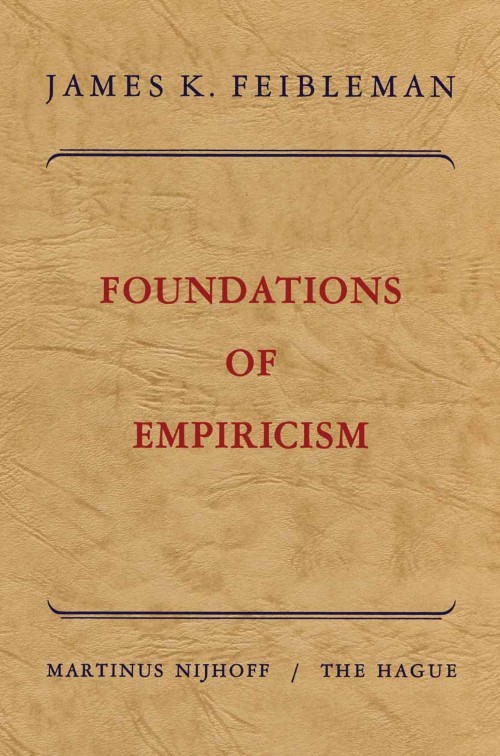
Foundations of empiricism [electronic resource] / by James K. Feibleman.
Erişim Adresi
ISBN
9789401190886
Dil Kodu
İngilizce
Yer Numarası
DK/13421
Yazar
Basım Bildirimi
1st ed. 1962.
Yayın Bilgisi
Dordrecht : Springer Netherlands : Imprint: Springer, 1962.
Fiziksel Niteleme
389 p. online resource.
İçindekiler Notu
I. An Introduction to Metaphysics for Empiricists -- One. Categorematics -- II. On the Topics and Definitions of the Categories -- III. Some Typically Selected Categories -- Two. Axiomatics -- IV. On the Theory of Induction -- V. On the Connections Between the Two Worlds -- VI. A Logically Primitive and Empirically Verifiable Ontology -- VII. Propositions and Facts -- Three. Systemics -- VIII. The Domain of Finite Ontology -- IX. The Range of Dyadic Ontology -- Four. Ethics -- X. An Objective, Empirical Ethics -- XI. Ethical Variations on a Theme by Rosmini-Serbati -- XII. The Ethics of Action -- Five. Practics -- XIII. The Rational Unconscious -- XIV. Culture as Applied Ontology -- XV. Toward an Analysis of the Basic Value System -- XVI. The Natural Society -- XVII. Language and Metaphysics -- SIX. Historics -- XVIII. History of Dyadic Ontology -- XIX. Aristotle as Finite Ontologist -- XX. Kant and Metaphysics -- Seven. Epistemics -- XXI. The Range of Sensational Epistemology -- XXII. Knowing About Semipalatinsk -- XXIII. An Ontology of Knowledge.
Özet, vb.
For some centuries now the western world has endeavored to choose between rationalism and empiricism; or, when a choice was found impossible, somehow to reconcile them. But the particular brands of both which were taken for granted in confronting the problem were sUbjective: individual human reasoning stood for rationalism and private sense experience for empiricism. Since Plato it has been known that reasoning and feeling are often in conflict. No wonder that a standard for deciding between them or for harmonizing the two was found difficult to come by. Fortunately, due to the revival of realism, a way out presented itself, and we could now consider rationalism and empiricism on some kind of objective basis. In other words, rationalism is a theory about something outside us, and reasoning involves the utilization of a logic which in no wise depends upon our knowledge of it. Similarly; sense experience reveals the existence of data which can be reached through the senses but which in no way relies upon experience for its existence. Thus both reasoning and sensing bring us fragmentary news about an external world which contains not only logic and value but also the prospects for their reconciliation. The implicit philosophy of nominalism is self-liquidating. Where is the proposition which asserts or takes for granted the sole reality of actual physical particulars to get its reality? The meaning of it as a proposition has no place among the particulars.
Konu
Metaphysics.
Science __ Philosophy.
Social sciences.
Humanities.
Metaphysics.
Philosophy of Science.
Humanities and Social Sciences.
Science __ Philosophy.
Social sciences.
Humanities.
Metaphysics.
Philosophy of Science.
Humanities and Social Sciences.
Kurum Adı
Eseri Alıntıla
Referansları kullanmadan önce gözden geçirmeniz ve varsa gerekli düzeltmeleri yapmanız önerilir.
Dijital Kaynak
MARC Görünümü
LEADER 04953nam a22005535i 4500
001 812164
003 TR_AnAIT
005 20260131001553
007 cr nn 008mamaa
008 121227s1962 ne | s |||| 0|eng d
020 |a9789401190886|9978-94-011-9088-6
024 7 |a10.1007/978-94-011-9088-6|2doi
041 |aeng
049 |aTürk Tarih Kurumu Kütüphanesi
050 4|aBD95-131
072 7|aHPJ|2bicssc
072 7|aPHI013000|2bisacsh
072 7|aQDTJ|2thema
082 04|a110|223
090 |aDK/13421
100 1 |aFeibleman, James K.|eauthor.|4aut|4http://id.loc.gov/vocabulary/relators/aut
245 10|aFoundations of empiricism|h[electronic resource] /|cby James K. Feibleman.
250 |a1st ed. 1962.
264 1|aDordrecht :|bSpringer Netherlands :|bImprint: Springer,|c1962.
300 |a389 p.|bonline resource.
336 |atext|btxt|2rdacontent
337 |acomputer|bc|2rdamedia
338 |aonline resource|bcr|2rdacarrier
347 |atext file|bPDF|2rda
505 0 |aI. An Introduction to Metaphysics for Empiricists -- One. Categorematics -- II. On the Topics and Definitions of the Categories -- III. Some Typically Selected Categories -- Two. Axiomatics -- IV. On the Theory of Induction -- V. On the Connections Between the Two Worlds -- VI. A Logically Primitive and Empirically Verifiable Ontology -- VII. Propositions and Facts -- Three. Systemics -- VIII. The Domain of Finite Ontology -- IX. The Range of Dyadic Ontology -- Four. Ethics -- X. An Objective, Empirical Ethics -- XI. Ethical Variations on a Theme by Rosmini-Serbati -- XII. The Ethics of Action -- Five. Practics -- XIII. The Rational Unconscious -- XIV. Culture as Applied Ontology -- XV. Toward an Analysis of the Basic Value System -- XVI. The Natural Society -- XVII. Language and Metaphysics -- SIX. Historics -- XVIII. History of Dyadic Ontology -- XIX. Aristotle as Finite Ontologist -- XX. Kant and Metaphysics -- Seven. Epistemics -- XXI. The Range of Sensational Epistemology -- XXII. Knowing About Semipalatinsk -- XXIII. An Ontology of Knowledge.
520 |aFor some centuries now the western world has endeavored to choose between rationalism and empiricism; or, when a choice was found impossible, somehow to reconcile them. But the particular brands of both which were taken for granted in confronting the problem were sUbjective: individual human reasoning stood for rationalism and private sense experience for empiricism. Since Plato it has been known that reasoning and feeling are often in conflict. No wonder that a standard for deciding between them or for harmonizing the two was found difficult to come by. Fortunately, due to the revival of realism, a way out presented itself, and we could now consider rationalism and empiricism on some kind of objective basis. In other words, rationalism is a theory about something outside us, and reasoning involves the utilization of a logic which in no wise depends upon our knowledge of it. Similarly; sense experience reveals the existence of data which can be reached through the senses but which in no way relies upon experience for its existence. Thus both reasoning and sensing bring us fragmentary news about an external world which contains not only logic and value but also the prospects for their reconciliation. The implicit philosophy of nominalism is self-liquidating. Where is the proposition which asserts or takes for granted the sole reality of actual physical particulars to get its reality? The meaning of it as a proposition has no place among the particulars.
532 8 |aAccessibility summary: This PDF is not accessible. It is based on scanned pages and does not support features such as screen reader compatibility or described non-text content (images, graphs etc). However, it likely supports searchable and selectable text based on OCR (Optical Character Recognition). Users with accessibility needs may not be able to use this content effectively. Please contact us at accessibilitysupport@springernature.com if you require assistance or an alternative format.
532 8 |aInaccessible, or known limited accessibility
532 8 |aNo reading system accessibility options actively disabled
532 8 |aPublisher contact for further accessibility information: accessibilitysupport@springernature.com
650 0|aMetaphysics.
650 0|aScience|xPhilosophy.
650 0|aSocial sciences.
650 0|aHumanities.
650 14|aMetaphysics.
650 24|aPhilosophy of Science.
650 24|aHumanities and Social Sciences.
710 2 |aSpringerLink (Online service)
773 0 |tSpringer Nature eBook
776 08|iPrinted edition:|z9789401183901
776 08|iPrinted edition:|z9789401190893
856 40|uhttps://doi.org/10.1007/978-94-011-9088-6
912 |aZDB-2-SHU
912 |aZDB-2-SXPR
912 |aZDB-2-BAE
950 |aHumanities, Social Sciences and Law (SpringerNature-11648)
950 |aPhilosophy and Religion (R0) (SpringerNature-43725)
001 812164
003 TR_AnAIT
005 20260131001553
007 cr nn 008mamaa
008 121227s1962 ne | s |||| 0|eng d
020 |a9789401190886|9978-94-011-9088-6
024 7 |a10.1007/978-94-011-9088-6|2doi
041 |aeng
049 |aTürk Tarih Kurumu Kütüphanesi
050 4|aBD95-131
072 7|aHPJ|2bicssc
072 7|aPHI013000|2bisacsh
072 7|aQDTJ|2thema
082 04|a110|223
090 |aDK/13421
100 1 |aFeibleman, James K.|eauthor.|4aut|4http://id.loc.gov/vocabulary/relators/aut
245 10|aFoundations of empiricism|h[electronic resource] /|cby James K. Feibleman.
250 |a1st ed. 1962.
264 1|aDordrecht :|bSpringer Netherlands :|bImprint: Springer,|c1962.
300 |a389 p.|bonline resource.
336 |atext|btxt|2rdacontent
337 |acomputer|bc|2rdamedia
338 |aonline resource|bcr|2rdacarrier
347 |atext file|bPDF|2rda
505 0 |aI. An Introduction to Metaphysics for Empiricists -- One. Categorematics -- II. On the Topics and Definitions of the Categories -- III. Some Typically Selected Categories -- Two. Axiomatics -- IV. On the Theory of Induction -- V. On the Connections Between the Two Worlds -- VI. A Logically Primitive and Empirically Verifiable Ontology -- VII. Propositions and Facts -- Three. Systemics -- VIII. The Domain of Finite Ontology -- IX. The Range of Dyadic Ontology -- Four. Ethics -- X. An Objective, Empirical Ethics -- XI. Ethical Variations on a Theme by Rosmini-Serbati -- XII. The Ethics of Action -- Five. Practics -- XIII. The Rational Unconscious -- XIV. Culture as Applied Ontology -- XV. Toward an Analysis of the Basic Value System -- XVI. The Natural Society -- XVII. Language and Metaphysics -- SIX. Historics -- XVIII. History of Dyadic Ontology -- XIX. Aristotle as Finite Ontologist -- XX. Kant and Metaphysics -- Seven. Epistemics -- XXI. The Range of Sensational Epistemology -- XXII. Knowing About Semipalatinsk -- XXIII. An Ontology of Knowledge.
520 |aFor some centuries now the western world has endeavored to choose between rationalism and empiricism; or, when a choice was found impossible, somehow to reconcile them. But the particular brands of both which were taken for granted in confronting the problem were sUbjective: individual human reasoning stood for rationalism and private sense experience for empiricism. Since Plato it has been known that reasoning and feeling are often in conflict. No wonder that a standard for deciding between them or for harmonizing the two was found difficult to come by. Fortunately, due to the revival of realism, a way out presented itself, and we could now consider rationalism and empiricism on some kind of objective basis. In other words, rationalism is a theory about something outside us, and reasoning involves the utilization of a logic which in no wise depends upon our knowledge of it. Similarly; sense experience reveals the existence of data which can be reached through the senses but which in no way relies upon experience for its existence. Thus both reasoning and sensing bring us fragmentary news about an external world which contains not only logic and value but also the prospects for their reconciliation. The implicit philosophy of nominalism is self-liquidating. Where is the proposition which asserts or takes for granted the sole reality of actual physical particulars to get its reality? The meaning of it as a proposition has no place among the particulars.
532 8 |aAccessibility summary: This PDF is not accessible. It is based on scanned pages and does not support features such as screen reader compatibility or described non-text content (images, graphs etc). However, it likely supports searchable and selectable text based on OCR (Optical Character Recognition). Users with accessibility needs may not be able to use this content effectively. Please contact us at accessibilitysupport@springernature.com if you require assistance or an alternative format.
532 8 |aInaccessible, or known limited accessibility
532 8 |aNo reading system accessibility options actively disabled
532 8 |aPublisher contact for further accessibility information: accessibilitysupport@springernature.com
650 0|aMetaphysics.
650 0|aScience|xPhilosophy.
650 0|aSocial sciences.
650 0|aHumanities.
650 14|aMetaphysics.
650 24|aPhilosophy of Science.
650 24|aHumanities and Social Sciences.
710 2 |aSpringerLink (Online service)
773 0 |tSpringer Nature eBook
776 08|iPrinted edition:|z9789401183901
776 08|iPrinted edition:|z9789401190893
856 40|uhttps://doi.org/10.1007/978-94-011-9088-6
912 |aZDB-2-SHU
912 |aZDB-2-SXPR
912 |aZDB-2-BAE
950 |aHumanities, Social Sciences and Law (SpringerNature-11648)
950 |aPhilosophy and Religion (R0) (SpringerNature-43725)
Materyaller
Depodan talep edilen materyal sadece kütüphane içerisinde kullanılmaktadır.
Materyal dışarıya ödünç verilmemektedir.
Materyal dışarıya ödünç verilmemektedir.
