

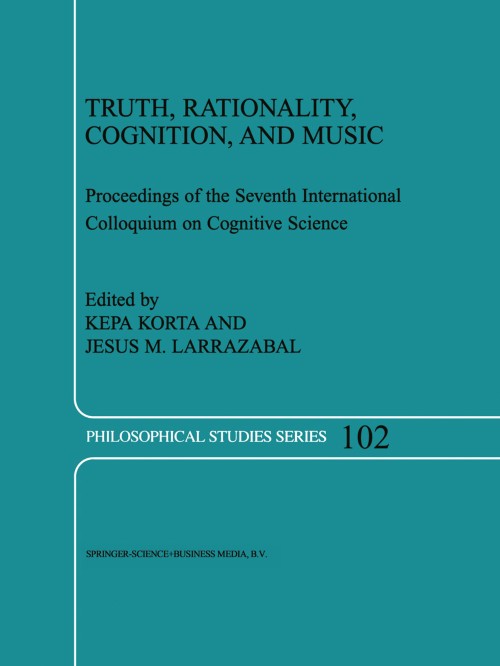
Truth, Rationality, Cognition, and Music [electronic resource] / edited by K. Korta, Jesús M. Larrazabal.
Erişim Adresi
ISBN
9789401705486
Dil Kodu
İngilizce
Yer Numarası
DK/13443
Basım Bildirimi
1st ed. 2004.
Yayın Bilgisi
Dordrecht : Springer Netherlands : Imprint: Springer, 2004.
Fiziksel Niteleme
XII, 254 p. online resource.
Dizi
Philosophical Studies Series, 2542-8349 ; 102
İçindekiler Notu
1. Cognitive Science and David Hume’s Science of the Mind -- 2. Truth and Meaning -- 3. Truth and Borderline Cases -- 4. Meaning Finitism and Truth -- 5. Subjective Experience and External World -- 6. The Explanatory Relevance of Psychological Properties -- 7. Epistemology and Cognitive Theorizing -- 8. Music, Language and Cognition: Which doesn’t belong? -- 9. Music and Knowledge -- 10. Event Coreference and Discourse Relations -- 11. Rationality in Context -- 12. Individual and Collective Rationality in a Social Framework -- Acknowledgments.
Özet, vb.
A speech for the defence in a Paris murder trial, a road-safety slogan, Hobbes' political theory; each appeals to reason of a kind, but it remains an oblique and rhetoricalldnd. Each relies on comparisons rather than on direct statements, and none can override or supersede the conclusions of ethical reasoning proper. Nevertheless, just as slogans may do more for road safety than the mere recital of accident statistics, or of the evidence given at coroners' inquests, so the arguments of a Hobbes or a Bentham may be of greater practical effect than the assertion of genuinely ethical or political statements, however true and relevant these may be. Stephen Toulmin, Reason in Ethics, 1950. The International Colloquium on Cognitive Science (ICCS), held in Donostia - San Sebastian every two years since 1989, has become one of the most important plazas for cognitive scientists in Europe to present the results of their research and to exchange ideas. The seventh edition, co-organized as usual by the Institute for Logic, Cognition, Language, and Information (ILCLI) and the Department of Logic and Philosophy of Science, both from the University of the Basque Country, took place from May 9 to 12, 200 1, addressing the following main topics: 1. Truth: Epistemology and Logic. 2. Rationality in a Social Setting. 3. Music, Language, and Cognition. Vlll TRUTH, RATIONALITY, COGNITION, AND MUSIC 4. The Order of Discourse: Logic, Pragmatics, and Rhetoric.
Konu
Philosophy.
Artificial intelligence.
Semiotics.
Philosophy.
Artificial Intelligence.
Semiotics.
Artificial intelligence.
Semiotics.
Philosophy.
Artificial Intelligence.
Semiotics.
Diğer Yazarlar
Kurum Adı
Eseri Alıntıla
Referansları kullanmadan önce gözden geçirmeniz ve varsa gerekli düzeltmeleri yapmanız önerilir.
Dijital Kaynak
MARC Görünümü
LEADER 04670nam a22005895i 4500
001 812188
003 TR_AnAIT
005 20260131001442
007 cr nn 008mamaa
008 130125s2004 ne | s |||| 0|eng d
020 |a9789401705486|9978-94-017-0548-6
024 7 |a10.1007/978-94-017-0548-6|2doi
041 |aeng
049 |aTürk Tarih Kurumu Kütüphanesi
050 4|aB1-5802
072 7|aHP|2bicssc
072 7|aPHI000000|2bisacsh
072 7|aQD|2thema
082 04|a100|223
090 |aDK/13443
245 10|aTruth, Rationality, Cognition, and Music|h[electronic resource] /|cedited by K. Korta, Jesús M. Larrazabal.
250 |a1st ed. 2004.
264 1|aDordrecht :|bSpringer Netherlands :|bImprint: Springer,|c2004.
300 |aXII, 254 p.|bonline resource.
336 |atext|btxt|2rdacontent
337 |acomputer|bc|2rdamedia
338 |aonline resource|bcr|2rdacarrier
347 |atext file|bPDF|2rda
490 1 |aPhilosophical Studies Series,|x2542-8349 ;|v102
505 0 |a1. Cognitive Science and David Hume’s Science of the Mind -- 2. Truth and Meaning -- 3. Truth and Borderline Cases -- 4. Meaning Finitism and Truth -- 5. Subjective Experience and External World -- 6. The Explanatory Relevance of Psychological Properties -- 7. Epistemology and Cognitive Theorizing -- 8. Music, Language and Cognition: Which doesn’t belong? -- 9. Music and Knowledge -- 10. Event Coreference and Discourse Relations -- 11. Rationality in Context -- 12. Individual and Collective Rationality in a Social Framework -- Acknowledgments.
520 |aA speech for the defence in a Paris murder trial, a road-safety slogan, Hobbes' political theory; each appeals to reason of a kind, but it remains an oblique and rhetoricalldnd. Each relies on comparisons rather than on direct statements, and none can override or supersede the conclusions of ethical reasoning proper. Nevertheless, just as slogans may do more for road safety than the mere recital of accident statistics, or of the evidence given at coroners' inquests, so the arguments of a Hobbes or a Bentham may be of greater practical effect than the assertion of genuinely ethical or political statements, however true and relevant these may be. Stephen Toulmin, Reason in Ethics, 1950. The International Colloquium on Cognitive Science (ICCS), held in Donostia - San Sebastian every two years since 1989, has become one of the most important plazas for cognitive scientists in Europe to present the results of their research and to exchange ideas. The seventh edition, co-organized as usual by the Institute for Logic, Cognition, Language, and Information (ILCLI) and the Department of Logic and Philosophy of Science, both from the University of the Basque Country, took place from May 9 to 12, 200 1, addressing the following main topics: 1. Truth: Epistemology and Logic. 2. Rationality in a Social Setting. 3. Music, Language, and Cognition. Vlll TRUTH, RATIONALITY, COGNITION, AND MUSIC 4. The Order of Discourse: Logic, Pragmatics, and Rhetoric.
532 8 |aAccessibility summary: This PDF is not accessible. It is based on scanned pages and does not support features such as screen reader compatibility or described non-text content (images, graphs etc). However, it likely supports searchable and selectable text based on OCR (Optical Character Recognition). Users with accessibility needs may not be able to use this content effectively. Please contact us at accessibilitysupport@springernature.com if you require assistance or an alternative format.
532 8 |aInaccessible, or known limited accessibility
532 8 |aNo reading system accessibility options actively disabled
532 8 |aPublisher contact for further accessibility information: accessibilitysupport@springernature.com
650 0|aPhilosophy.
650 0|aArtificial intelligence.
650 0|aSemiotics.
650 14|aPhilosophy.
650 24|aArtificial Intelligence.
650 24|aSemiotics.
700 1 |aKorta, K.|eeditor.|4edt|4http://id.loc.gov/vocabulary/relators/edt
700 1 |aLarrazabal, Jesús M.|eeditor.|4edt|4http://id.loc.gov/vocabulary/relators/edt
710 2 |aSpringerLink (Online service)
773 0 |tSpringer Nature eBook
776 08|iPrinted edition:|z9781402019128
776 08|iPrinted edition:|z9789048165438
776 08|iPrinted edition:|z9789401705493
830 0|aPhilosophical Studies Series,|x2542-8349 ;|v102
856 40|uhttps://doi.org/10.1007/978-94-017-0548-6
912 |aZDB-2-SHU
912 |aZDB-2-SXPR
912 |aZDB-2-BAE
950 |aHumanities, Social Sciences and Law (SpringerNature-11648)
950 |aPhilosophy and Religion (R0) (SpringerNature-43725)
001 812188
003 TR_AnAIT
005 20260131001442
007 cr nn 008mamaa
008 130125s2004 ne | s |||| 0|eng d
020 |a9789401705486|9978-94-017-0548-6
024 7 |a10.1007/978-94-017-0548-6|2doi
041 |aeng
049 |aTürk Tarih Kurumu Kütüphanesi
050 4|aB1-5802
072 7|aHP|2bicssc
072 7|aPHI000000|2bisacsh
072 7|aQD|2thema
082 04|a100|223
090 |aDK/13443
245 10|aTruth, Rationality, Cognition, and Music|h[electronic resource] /|cedited by K. Korta, Jesús M. Larrazabal.
250 |a1st ed. 2004.
264 1|aDordrecht :|bSpringer Netherlands :|bImprint: Springer,|c2004.
300 |aXII, 254 p.|bonline resource.
336 |atext|btxt|2rdacontent
337 |acomputer|bc|2rdamedia
338 |aonline resource|bcr|2rdacarrier
347 |atext file|bPDF|2rda
490 1 |aPhilosophical Studies Series,|x2542-8349 ;|v102
505 0 |a1. Cognitive Science and David Hume’s Science of the Mind -- 2. Truth and Meaning -- 3. Truth and Borderline Cases -- 4. Meaning Finitism and Truth -- 5. Subjective Experience and External World -- 6. The Explanatory Relevance of Psychological Properties -- 7. Epistemology and Cognitive Theorizing -- 8. Music, Language and Cognition: Which doesn’t belong? -- 9. Music and Knowledge -- 10. Event Coreference and Discourse Relations -- 11. Rationality in Context -- 12. Individual and Collective Rationality in a Social Framework -- Acknowledgments.
520 |aA speech for the defence in a Paris murder trial, a road-safety slogan, Hobbes' political theory; each appeals to reason of a kind, but it remains an oblique and rhetoricalldnd. Each relies on comparisons rather than on direct statements, and none can override or supersede the conclusions of ethical reasoning proper. Nevertheless, just as slogans may do more for road safety than the mere recital of accident statistics, or of the evidence given at coroners' inquests, so the arguments of a Hobbes or a Bentham may be of greater practical effect than the assertion of genuinely ethical or political statements, however true and relevant these may be. Stephen Toulmin, Reason in Ethics, 1950. The International Colloquium on Cognitive Science (ICCS), held in Donostia - San Sebastian every two years since 1989, has become one of the most important plazas for cognitive scientists in Europe to present the results of their research and to exchange ideas. The seventh edition, co-organized as usual by the Institute for Logic, Cognition, Language, and Information (ILCLI) and the Department of Logic and Philosophy of Science, both from the University of the Basque Country, took place from May 9 to 12, 200 1, addressing the following main topics: 1. Truth: Epistemology and Logic. 2. Rationality in a Social Setting. 3. Music, Language, and Cognition. Vlll TRUTH, RATIONALITY, COGNITION, AND MUSIC 4. The Order of Discourse: Logic, Pragmatics, and Rhetoric.
532 8 |aAccessibility summary: This PDF is not accessible. It is based on scanned pages and does not support features such as screen reader compatibility or described non-text content (images, graphs etc). However, it likely supports searchable and selectable text based on OCR (Optical Character Recognition). Users with accessibility needs may not be able to use this content effectively. Please contact us at accessibilitysupport@springernature.com if you require assistance or an alternative format.
532 8 |aInaccessible, or known limited accessibility
532 8 |aNo reading system accessibility options actively disabled
532 8 |aPublisher contact for further accessibility information: accessibilitysupport@springernature.com
650 0|aPhilosophy.
650 0|aArtificial intelligence.
650 0|aSemiotics.
650 14|aPhilosophy.
650 24|aArtificial Intelligence.
650 24|aSemiotics.
700 1 |aKorta, K.|eeditor.|4edt|4http://id.loc.gov/vocabulary/relators/edt
700 1 |aLarrazabal, Jesús M.|eeditor.|4edt|4http://id.loc.gov/vocabulary/relators/edt
710 2 |aSpringerLink (Online service)
773 0 |tSpringer Nature eBook
776 08|iPrinted edition:|z9781402019128
776 08|iPrinted edition:|z9789048165438
776 08|iPrinted edition:|z9789401705493
830 0|aPhilosophical Studies Series,|x2542-8349 ;|v102
856 40|uhttps://doi.org/10.1007/978-94-017-0548-6
912 |aZDB-2-SHU
912 |aZDB-2-SXPR
912 |aZDB-2-BAE
950 |aHumanities, Social Sciences and Law (SpringerNature-11648)
950 |aPhilosophy and Religion (R0) (SpringerNature-43725)
Materyaller
Depodan talep edilen materyal sadece kütüphane içerisinde kullanılmaktadır.
Materyal dışarıya ödünç verilmemektedir.
Materyal dışarıya ödünç verilmemektedir.
