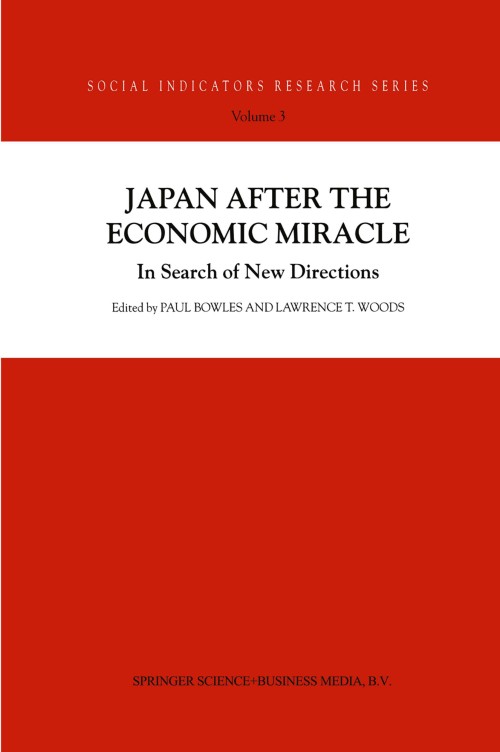
Japan after the Economic Miracle [electronic resource] : In Search of New Directions / edited by P. Bowles, L.T. Woods.
Erişim Adresi
ISBN
9789401142779
Dil Kodu
İngilizce
Yer Numarası
DK/13475
Basım Bildirimi
1st ed. 2000.
Yayın Bilgisi
Dordrecht : Springer Netherlands : Imprint: Springer, 2000.
Fiziksel Niteleme
IX, 327 p. online resource.
Dizi
Social Indicators Research Series, 2215-0099 ; 3
İçindekiler Notu
I. Searching for new directions: the Japanese challenges and responses -- 1. Japan’s postwar Fordism: an historical perspective on the economic crisis in Japan -- 2. Restoring the legitimacy of Japanese business in the post-bubble era: can good economics make good ethics easier? -- Changing behaviour of Japanese consumers -- 4. Back in the race: Japan and the Internet -- 5. New directions in Canada’s Japanese-owned automobile plants -- 6. Producing and managing hazardous waste in Japan -- 7. Sustainability of farm settlements in Japan after the economic miracle: a case study of Onoji hamlet and Yamanashi prefecture -- 8. New directions in Japanese urban planning: a case study of Nagoya -- 9. the aging of Japanese society: human resource management in transition -- 10. Contemporary party politics in Japan: an old wine in a new bottle? -- II. Searching for new directions: the Canadian challenges and responses -- 11. Breaking into the Japanese Market: Canadian companies and the challenge of doing business in Japan -- 12. Learning with a new media -- 13. History of Japanese language education at UBC, 1956–1998: challenges and future directions -- 114. Teaching Japanese to a multicultural student population -- 15. Beyond boundaries: Japanese migrant women in North America.
Özet, vb.
As Japan comes to grips with a decade of economic malaise after its spectacular post-war growth record, how will Japanese society react? Contributors to this volume examine the challenges ahead for Japan in the fields of politics, economics, sociology, environment and business. This multidisciplinary inquiry looks for areas of continuity and for new directions in government, business and social policy and practice. Also examined is how Western students should approach the study of Japan; what new directions should institutions take to ensure that students learn about the `real' Japan? Written by Canadian academics, the articles in this volume will be of interest to academics and policy-makers studying or teaching about contemporary Japan.
Konu
Sociology __ Methodology.
Quality of life.
Business.
Management science.
Social sciences.
Economics.
Asia __ Languages.
Sociological Methods.
Quality of Life Research.
Business and Management.
Society.
Political Economy and Economic Systems.
Asian Languages.
Quality of life.
Business.
Management science.
Social sciences.
Economics.
Asia __ Languages.
Sociological Methods.
Quality of Life Research.
Business and Management.
Society.
Political Economy and Economic Systems.
Asian Languages.
Diğer Yazarlar
Kurum Adı

Eseri Alıntıla
Referansları kullanmadan önce gözden geçirmeniz ve varsa gerekli düzeltmeleri yapmanız önerilir.
Dijital Kaynak
MARC Görünümü
LEADER 04979nam a22006735i 4500
001 812220
003 TR_AnAIT
005 20260131001149
007 cr nn 008mamaa
008 121227s2000 ne | s |||| 0|eng d
020 |a9789401142779|9978-94-011-4277-9
024 7 |a10.1007/978-94-011-4277-9|2doi
041 |aeng
049 |aTürk Tarih Kurumu Kütüphanesi
050 4|aHM511-538
072 7|aJHB|2bicssc
072 7|aSOC026000|2bisacsh
072 7|aJHB|2thema
082 04|a301.01|223
090 |aDK/13475
245 10|aJapan after the Economic Miracle|h[electronic resource] :|bIn Search of New Directions /|cedited by P. Bowles, L.T. Woods.
250 |a1st ed. 2000.
264 1|aDordrecht :|bSpringer Netherlands :|bImprint: Springer,|c2000.
300 |aIX, 327 p.|bonline resource.
336 |atext|btxt|2rdacontent
337 |acomputer|bc|2rdamedia
338 |aonline resource|bcr|2rdacarrier
347 |atext file|bPDF|2rda
490 1 |aSocial Indicators Research Series,|x2215-0099 ;|v3
505 0 |aI. Searching for new directions: the Japanese challenges and responses -- 1. Japan’s postwar Fordism: an historical perspective on the economic crisis in Japan -- 2. Restoring the legitimacy of Japanese business in the post-bubble era: can good economics make good ethics easier? -- Changing behaviour of Japanese consumers -- 4. Back in the race: Japan and the Internet -- 5. New directions in Canada’s Japanese-owned automobile plants -- 6. Producing and managing hazardous waste in Japan -- 7. Sustainability of farm settlements in Japan after the economic miracle: a case study of Onoji hamlet and Yamanashi prefecture -- 8. New directions in Japanese urban planning: a case study of Nagoya -- 9. the aging of Japanese society: human resource management in transition -- 10. Contemporary party politics in Japan: an old wine in a new bottle? -- II. Searching for new directions: the Canadian challenges and responses -- 11. Breaking into the Japanese Market: Canadian companies and the challenge of doing business in Japan -- 12. Learning with a new media -- 13. History of Japanese language education at UBC, 1956–1998: challenges and future directions -- 114. Teaching Japanese to a multicultural student population -- 15. Beyond boundaries: Japanese migrant women in North America.
520 |aAs Japan comes to grips with a decade of economic malaise after its spectacular post-war growth record, how will Japanese society react? Contributors to this volume examine the challenges ahead for Japan in the fields of politics, economics, sociology, environment and business. This multidisciplinary inquiry looks for areas of continuity and for new directions in government, business and social policy and practice. Also examined is how Western students should approach the study of Japan; what new directions should institutions take to ensure that students learn about the `real' Japan? Written by Canadian academics, the articles in this volume will be of interest to academics and policy-makers studying or teaching about contemporary Japan.
532 8 |aAccessibility summary: This PDF is not accessible. It is based on scanned pages and does not support features such as screen reader compatibility or described non-text content (images, graphs etc). However, it likely supports searchable and selectable text based on OCR (Optical Character Recognition). Users with accessibility needs may not be able to use this content effectively. Please contact us at accessibilitysupport@springernature.com if you require assistance or an alternative format.
532 8 |aInaccessible, or known limited accessibility
532 8 |aNo reading system accessibility options actively disabled
532 8 |aPublisher contact for further accessibility information: accessibilitysupport@springernature.com
650 0|aSociology|xMethodology.
650 0|aQuality of life.
650 0|aBusiness.
650 0|aManagement science.
650 0|aSocial sciences.
650 0|aEconomics.
650 0|aAsia|xLanguages.
650 14|aSociological Methods.
650 24|aQuality of Life Research.
650 24|aBusiness and Management.
650 24|aSociety.
650 24|aPolitical Economy and Economic Systems.
650 24|aAsian Languages.
700 1 |aBowles, P.|eeditor.|4edt|4http://id.loc.gov/vocabulary/relators/edt
700 1 |aWoods, L.T.|eeditor.|4edt|4http://id.loc.gov/vocabulary/relators/edt
710 2 |aSpringerLink (Online service)
773 0 |tSpringer Nature eBook
776 08|iPrinted edition:|z9780792360315
776 08|iPrinted edition:|z9789401142786
776 08|iPrinted edition:|z9789401058544
830 0|aSocial Indicators Research Series,|x2215-0099 ;|v3
856 40|uhttps://doi.org/10.1007/978-94-011-4277-9
912 |aZDB-2-SHU
912 |aZDB-2-SXS
912 |aZDB-2-BAE
950 |aHumanities, Social Sciences and Law (SpringerNature-11648)
950 |aSocial Sciences (R0) (SpringerNature-43726)
001 812220
003 TR_AnAIT
005 20260131001149
007 cr nn 008mamaa
008 121227s2000 ne | s |||| 0|eng d
020 |a9789401142779|9978-94-011-4277-9
024 7 |a10.1007/978-94-011-4277-9|2doi
041 |aeng
049 |aTürk Tarih Kurumu Kütüphanesi
050 4|aHM511-538
072 7|aJHB|2bicssc
072 7|aSOC026000|2bisacsh
072 7|aJHB|2thema
082 04|a301.01|223
090 |aDK/13475
245 10|aJapan after the Economic Miracle|h[electronic resource] :|bIn Search of New Directions /|cedited by P. Bowles, L.T. Woods.
250 |a1st ed. 2000.
264 1|aDordrecht :|bSpringer Netherlands :|bImprint: Springer,|c2000.
300 |aIX, 327 p.|bonline resource.
336 |atext|btxt|2rdacontent
337 |acomputer|bc|2rdamedia
338 |aonline resource|bcr|2rdacarrier
347 |atext file|bPDF|2rda
490 1 |aSocial Indicators Research Series,|x2215-0099 ;|v3
505 0 |aI. Searching for new directions: the Japanese challenges and responses -- 1. Japan’s postwar Fordism: an historical perspective on the economic crisis in Japan -- 2. Restoring the legitimacy of Japanese business in the post-bubble era: can good economics make good ethics easier? -- Changing behaviour of Japanese consumers -- 4. Back in the race: Japan and the Internet -- 5. New directions in Canada’s Japanese-owned automobile plants -- 6. Producing and managing hazardous waste in Japan -- 7. Sustainability of farm settlements in Japan after the economic miracle: a case study of Onoji hamlet and Yamanashi prefecture -- 8. New directions in Japanese urban planning: a case study of Nagoya -- 9. the aging of Japanese society: human resource management in transition -- 10. Contemporary party politics in Japan: an old wine in a new bottle? -- II. Searching for new directions: the Canadian challenges and responses -- 11. Breaking into the Japanese Market: Canadian companies and the challenge of doing business in Japan -- 12. Learning with a new media -- 13. History of Japanese language education at UBC, 1956–1998: challenges and future directions -- 114. Teaching Japanese to a multicultural student population -- 15. Beyond boundaries: Japanese migrant women in North America.
520 |aAs Japan comes to grips with a decade of economic malaise after its spectacular post-war growth record, how will Japanese society react? Contributors to this volume examine the challenges ahead for Japan in the fields of politics, economics, sociology, environment and business. This multidisciplinary inquiry looks for areas of continuity and for new directions in government, business and social policy and practice. Also examined is how Western students should approach the study of Japan; what new directions should institutions take to ensure that students learn about the `real' Japan? Written by Canadian academics, the articles in this volume will be of interest to academics and policy-makers studying or teaching about contemporary Japan.
532 8 |aAccessibility summary: This PDF is not accessible. It is based on scanned pages and does not support features such as screen reader compatibility or described non-text content (images, graphs etc). However, it likely supports searchable and selectable text based on OCR (Optical Character Recognition). Users with accessibility needs may not be able to use this content effectively. Please contact us at accessibilitysupport@springernature.com if you require assistance or an alternative format.
532 8 |aInaccessible, or known limited accessibility
532 8 |aNo reading system accessibility options actively disabled
532 8 |aPublisher contact for further accessibility information: accessibilitysupport@springernature.com
650 0|aSociology|xMethodology.
650 0|aQuality of life.
650 0|aBusiness.
650 0|aManagement science.
650 0|aSocial sciences.
650 0|aEconomics.
650 0|aAsia|xLanguages.
650 14|aSociological Methods.
650 24|aQuality of Life Research.
650 24|aBusiness and Management.
650 24|aSociety.
650 24|aPolitical Economy and Economic Systems.
650 24|aAsian Languages.
700 1 |aBowles, P.|eeditor.|4edt|4http://id.loc.gov/vocabulary/relators/edt
700 1 |aWoods, L.T.|eeditor.|4edt|4http://id.loc.gov/vocabulary/relators/edt
710 2 |aSpringerLink (Online service)
773 0 |tSpringer Nature eBook
776 08|iPrinted edition:|z9780792360315
776 08|iPrinted edition:|z9789401142786
776 08|iPrinted edition:|z9789401058544
830 0|aSocial Indicators Research Series,|x2215-0099 ;|v3
856 40|uhttps://doi.org/10.1007/978-94-011-4277-9
912 |aZDB-2-SHU
912 |aZDB-2-SXS
912 |aZDB-2-BAE
950 |aHumanities, Social Sciences and Law (SpringerNature-11648)
950 |aSocial Sciences (R0) (SpringerNature-43726)
Materyaller
Depodan talep edilen materyal sadece kütüphane içerisinde kullanılmaktadır.
Materyal dışarıya ödünç verilmemektedir.
