

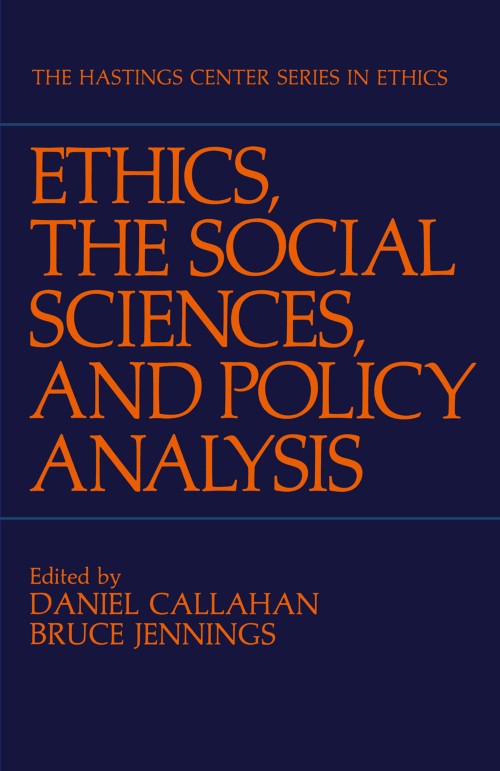
Ethics, The Social Sciences, and Policy Analysis [electronic resource] / edited by Daniel Callahan, Bruce Jennings.
Erişim Adresi
ISBN
9781468470154
Dil Kodu
İngilizce
Yer Numarası
DK/13484
Basım Bildirimi
1st ed. 1983.
Yayın Bilgisi
New York, NY : Springer US : Imprint: Springer, 1983.
Fiziksel Niteleme
XXVI, 381 p. online resource.
Dizi
The Hastings Center Series in Ethics
İçindekiler Notu
I. Policy Analysis in a New Key: Exploring Alternatives to Positivism -- 1. Interpretive Social Science and Policy Analysis -- 2 Social Science as Practical Reason -- 3 Comment on Robert N. Bellah, “Social Science as Practical Reason” -- 4 Imperfect Democracy and the Moral Responsibilities of Policy Advisers -- 5 Value-Critical Policy Analysis -- 6 Emancipatory Social Science and Social Critique -- II. Social Science and Political Advocacy -- 7 The British Tradition of Social Administration: Moral Concerns at the Expense of Scientific Rigor -- 8 Social Research and Political Advocacy: New Stages and Old Problems in Integrating Science and Values -- 9 Ideology, Interests, and Information: The Basis of Policy Positions -- III. Disciplinary Standards and Policy Analysis -- 10 Use of Social Science Data for Policy Analysis and Policymaking -- 11 Social Science and Policy Analysis: Some Fundamental Differences -- 12 Subverting Policy Premises -- 13 Partial Knowledge -- IV. Toward Ethical Guidelines -- 14 Toward Ethical Guidelines for Social Science Research in Public Policy.
Özet, vb.
The social sciences playa variety of multifaceted roles in the policymaking process. So varied are these roles, indeed, that it is futile to talk in the singular about the use of social science in policymaking, as if there were one constant relationship between two fixed and stable entities. Instead, to address this issue sensibly one must talk in the plural about uses of dif ferent modes of social scientific inquiry for different kinds of policies under various circumstances. In some cases, the influence of social scientific research is direct and tangible, and the connection between the find ings and the policy is easy to see. In other cases, perhaps most, its influence is indirect-one small piece in a larger mosaic of politics, bargaining, and compromise. Occasionally the findings of social scientific studies are explicitly drawn upon by policymakers in the formation, implementation, or evaluation of particular policies. More often, the categories and theoretical models of social science provide a general background orientation within which policymakers concep tualize problems and frame policy options. At times, the in fluence of social scientific work is cognitive and informational in nature; in other instances, policymakers use social science primarily for symbolic and political purposes in order to le gitimate preestablished goals and strategies. Nonetheless, amid this diversity and variety, troubling general questions persistently arise.
Konu
Ethics.
Social sciences.
Moral Philosophy and Applied Ethics.
Society.
Social sciences.
Moral Philosophy and Applied Ethics.
Society.
Diğer Yazarlar
Kurum Adı
Eseri Alıntıla
Referansları kullanmadan önce gözden geçirmeniz ve varsa gerekli düzeltmeleri yapmanız önerilir.
Dijital Kaynak
MARC Görünümü
LEADER 05158nam a22005655i 4500
001 812229
003 TR_AnAIT
005 20260131001058
007 cr nn 008mamaa
008 121227s1983 xxu| s |||| 0|eng d
020 |a9781468470154|9978-1-4684-7015-4
024 7 |a10.1007/978-1-4684-7015-4|2doi
041 |aeng
049 |aTürk Tarih Kurumu Kütüphanesi
050 4|aBJ1-1725
072 7|aHPQ|2bicssc
072 7|aPHI005000|2bisacsh
072 7|aQDTQ|2thema
082 04|a170|223
090 |aDK/13484
245 10|aEthics, The Social Sciences, and Policy Analysis|h[electronic resource] /|cedited by Daniel Callahan, Bruce Jennings.
250 |a1st ed. 1983.
264 1|aNew York, NY :|bSpringer US :|bImprint: Springer,|c1983.
300 |aXXVI, 381 p.|bonline resource.
336 |atext|btxt|2rdacontent
337 |acomputer|bc|2rdamedia
338 |aonline resource|bcr|2rdacarrier
347 |atext file|bPDF|2rda
490 1 |aThe Hastings Center Series in Ethics
505 0 |aI. Policy Analysis in a New Key: Exploring Alternatives to Positivism -- 1. Interpretive Social Science and Policy Analysis -- 2 Social Science as Practical Reason -- 3 Comment on Robert N. Bellah, “Social Science as Practical Reason” -- 4 Imperfect Democracy and the Moral Responsibilities of Policy Advisers -- 5 Value-Critical Policy Analysis -- 6 Emancipatory Social Science and Social Critique -- II. Social Science and Political Advocacy -- 7 The British Tradition of Social Administration: Moral Concerns at the Expense of Scientific Rigor -- 8 Social Research and Political Advocacy: New Stages and Old Problems in Integrating Science and Values -- 9 Ideology, Interests, and Information: The Basis of Policy Positions -- III. Disciplinary Standards and Policy Analysis -- 10 Use of Social Science Data for Policy Analysis and Policymaking -- 11 Social Science and Policy Analysis: Some Fundamental Differences -- 12 Subverting Policy Premises -- 13 Partial Knowledge -- IV. Toward Ethical Guidelines -- 14 Toward Ethical Guidelines for Social Science Research in Public Policy.
520 |aThe social sciences playa variety of multifaceted roles in the policymaking process. So varied are these roles, indeed, that it is futile to talk in the singular about the use of social science in policymaking, as if there were one constant relationship between two fixed and stable entities. Instead, to address this issue sensibly one must talk in the plural about uses of dif ferent modes of social scientific inquiry for different kinds of policies under various circumstances. In some cases, the influence of social scientific research is direct and tangible, and the connection between the find ings and the policy is easy to see. In other cases, perhaps most, its influence is indirect-one small piece in a larger mosaic of politics, bargaining, and compromise. Occasionally the findings of social scientific studies are explicitly drawn upon by policymakers in the formation, implementation, or evaluation of particular policies. More often, the categories and theoretical models of social science provide a general background orientation within which policymakers concep tualize problems and frame policy options. At times, the in fluence of social scientific work is cognitive and informational in nature; in other instances, policymakers use social science primarily for symbolic and political purposes in order to le gitimate preestablished goals and strategies. Nonetheless, amid this diversity and variety, troubling general questions persistently arise.
532 8 |aAccessibility summary: This PDF is not accessible. It is based on scanned pages and does not support features such as screen reader compatibility or described non-text content (images, graphs etc). However, it likely supports searchable and selectable text based on OCR (Optical Character Recognition). Users with accessibility needs may not be able to use this content effectively. Please contact us at accessibilitysupport@springernature.com if you require assistance or an alternative format.
532 8 |aInaccessible, or known limited accessibility
532 8 |aNo reading system accessibility options actively disabled
532 8 |aPublisher contact for further accessibility information: accessibilitysupport@springernature.com
650 0|aEthics.
650 0|aSocial sciences.
650 14|aMoral Philosophy and Applied Ethics.
650 24|aSociety.
700 1 |aCallahan, Daniel.|eeditor.|4edt|4http://id.loc.gov/vocabulary/relators/edt
700 1 |aJennings, Bruce.|eeditor.|4edt|4http://id.loc.gov/vocabulary/relators/edt
710 2 |aSpringerLink (Online service)
773 0 |tSpringer Nature eBook
776 08|iPrinted edition:|z9780306411434
776 08|iPrinted edition:|z9781468470161
776 08|iPrinted edition:|z9781468470178
830 0|aThe Hastings Center Series in Ethics
856 40|uhttps://doi.org/10.1007/978-1-4684-7015-4
912 |aZDB-2-SHU
912 |aZDB-2-SXPR
912 |aZDB-2-BAE
950 |aHumanities, Social Sciences and Law (SpringerNature-11648)
950 |aPhilosophy and Religion (R0) (SpringerNature-43725)
001 812229
003 TR_AnAIT
005 20260131001058
007 cr nn 008mamaa
008 121227s1983 xxu| s |||| 0|eng d
020 |a9781468470154|9978-1-4684-7015-4
024 7 |a10.1007/978-1-4684-7015-4|2doi
041 |aeng
049 |aTürk Tarih Kurumu Kütüphanesi
050 4|aBJ1-1725
072 7|aHPQ|2bicssc
072 7|aPHI005000|2bisacsh
072 7|aQDTQ|2thema
082 04|a170|223
090 |aDK/13484
245 10|aEthics, The Social Sciences, and Policy Analysis|h[electronic resource] /|cedited by Daniel Callahan, Bruce Jennings.
250 |a1st ed. 1983.
264 1|aNew York, NY :|bSpringer US :|bImprint: Springer,|c1983.
300 |aXXVI, 381 p.|bonline resource.
336 |atext|btxt|2rdacontent
337 |acomputer|bc|2rdamedia
338 |aonline resource|bcr|2rdacarrier
347 |atext file|bPDF|2rda
490 1 |aThe Hastings Center Series in Ethics
505 0 |aI. Policy Analysis in a New Key: Exploring Alternatives to Positivism -- 1. Interpretive Social Science and Policy Analysis -- 2 Social Science as Practical Reason -- 3 Comment on Robert N. Bellah, “Social Science as Practical Reason” -- 4 Imperfect Democracy and the Moral Responsibilities of Policy Advisers -- 5 Value-Critical Policy Analysis -- 6 Emancipatory Social Science and Social Critique -- II. Social Science and Political Advocacy -- 7 The British Tradition of Social Administration: Moral Concerns at the Expense of Scientific Rigor -- 8 Social Research and Political Advocacy: New Stages and Old Problems in Integrating Science and Values -- 9 Ideology, Interests, and Information: The Basis of Policy Positions -- III. Disciplinary Standards and Policy Analysis -- 10 Use of Social Science Data for Policy Analysis and Policymaking -- 11 Social Science and Policy Analysis: Some Fundamental Differences -- 12 Subverting Policy Premises -- 13 Partial Knowledge -- IV. Toward Ethical Guidelines -- 14 Toward Ethical Guidelines for Social Science Research in Public Policy.
520 |aThe social sciences playa variety of multifaceted roles in the policymaking process. So varied are these roles, indeed, that it is futile to talk in the singular about the use of social science in policymaking, as if there were one constant relationship between two fixed and stable entities. Instead, to address this issue sensibly one must talk in the plural about uses of dif ferent modes of social scientific inquiry for different kinds of policies under various circumstances. In some cases, the influence of social scientific research is direct and tangible, and the connection between the find ings and the policy is easy to see. In other cases, perhaps most, its influence is indirect-one small piece in a larger mosaic of politics, bargaining, and compromise. Occasionally the findings of social scientific studies are explicitly drawn upon by policymakers in the formation, implementation, or evaluation of particular policies. More often, the categories and theoretical models of social science provide a general background orientation within which policymakers concep tualize problems and frame policy options. At times, the in fluence of social scientific work is cognitive and informational in nature; in other instances, policymakers use social science primarily for symbolic and political purposes in order to le gitimate preestablished goals and strategies. Nonetheless, amid this diversity and variety, troubling general questions persistently arise.
532 8 |aAccessibility summary: This PDF is not accessible. It is based on scanned pages and does not support features such as screen reader compatibility or described non-text content (images, graphs etc). However, it likely supports searchable and selectable text based on OCR (Optical Character Recognition). Users with accessibility needs may not be able to use this content effectively. Please contact us at accessibilitysupport@springernature.com if you require assistance or an alternative format.
532 8 |aInaccessible, or known limited accessibility
532 8 |aNo reading system accessibility options actively disabled
532 8 |aPublisher contact for further accessibility information: accessibilitysupport@springernature.com
650 0|aEthics.
650 0|aSocial sciences.
650 14|aMoral Philosophy and Applied Ethics.
650 24|aSociety.
700 1 |aCallahan, Daniel.|eeditor.|4edt|4http://id.loc.gov/vocabulary/relators/edt
700 1 |aJennings, Bruce.|eeditor.|4edt|4http://id.loc.gov/vocabulary/relators/edt
710 2 |aSpringerLink (Online service)
773 0 |tSpringer Nature eBook
776 08|iPrinted edition:|z9780306411434
776 08|iPrinted edition:|z9781468470161
776 08|iPrinted edition:|z9781468470178
830 0|aThe Hastings Center Series in Ethics
856 40|uhttps://doi.org/10.1007/978-1-4684-7015-4
912 |aZDB-2-SHU
912 |aZDB-2-SXPR
912 |aZDB-2-BAE
950 |aHumanities, Social Sciences and Law (SpringerNature-11648)
950 |aPhilosophy and Religion (R0) (SpringerNature-43725)
Materyaller
Depodan talep edilen materyal sadece kütüphane içerisinde kullanılmaktadır.
Materyal dışarıya ödünç verilmemektedir.
Materyal dışarıya ödünç verilmemektedir.
