LEADER 04356nam a22005655i 4500
001 812262
003 TR_AnAIT
005 20260131000846
007 cr nn 008mamaa
008 121227s2001 xxu| s |||| 0|eng d
020 |a9781461513957|9978-1-4615-1395-7
024 7 |a10.1007/978-1-4615-1395-7|2doi
041 |aeng
049 |aTürk Tarih Kurumu Kütüphanesi
050 4|aJA1-92
072 7|aJPA|2bicssc
072 7|aPOL000000|2bisacsh
072 7|aJPA|2thema
082 04|a320|223
090 |aDK/13517
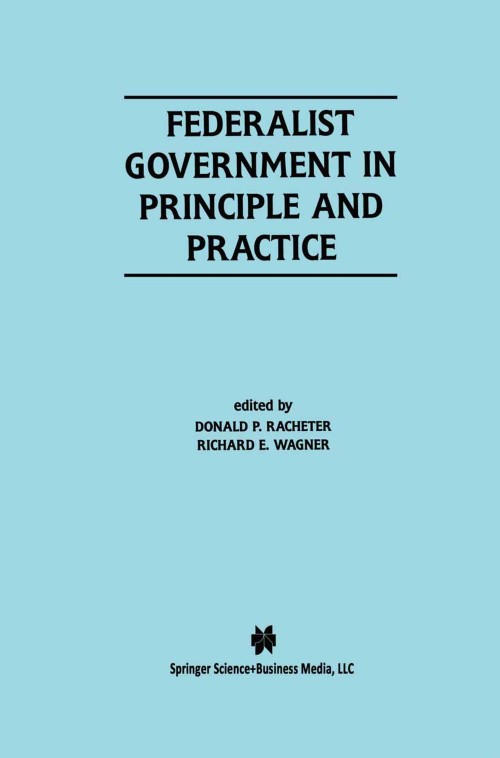
245 10|aFederalist Government in Principle and Practice|h[electronic resource] /|cedited by Donald P. Racheter, Richard E. Wagner.
250 |a1st ed. 2001.
264 1|aNew York, NY :|bSpringer US :|bImprint: Springer,|c2001.
300 |aXVII, 297 p.|bonline resource.
336 |atext|btxt|2rdacontent
337 |acomputer|bc|2rdamedia
338 |aonline resource|bcr|2rdacarrier
347 |atext file|bPDF|2rda
505 0 |a1. Liberty, Markets, and Federalism -- 2. Competitive Federalism in Institutional Perspective -- 3. Taxes, Grants, and Porkbarrel Politics: The Case for Decentralizing the Power to Tax -- 4. Fiscal Competition in a Federal System -- 5. Immobile Taxation in a World of Mobility -- 6. Fiscal Vacations and Federalism in Western Europe: A Search for Sovereignty -- 7. Federalism and Commercial Regulation -- 8. Redistribution in a Federal System: Lessons from Welfare Reform -- 9. Education: The Path from Centralization to Privatization -- 10. Federalism and Agricultural and Resource Policy -- 11. Federalism and the Protection of Property -- 12. Legislation and Adjudication in a Federal Republic.
520 |aFederalism has generally been characterized as a system of government that is friendly to liberty. It is not obvious, though, why this should be so. Federalism is a form of government where citizens simultaneously reside in at least two governments, each of which has independent authority to tax and to regulate. By contrast, in a unitary form of government citizens face only one government with independent authority to tax and regulate. At first glance, it would seem a bit strange to claim that liberty is more secure when citizens are members of two governments with independent authority than when they are members of only one such government. The relationship between federalism and liberty turns out to be a complex one, and one that is capable of working in either direction. Whether federalism supports or erodes liberty depends on importantly on the institutional framework within which federalist governance takes place. The essays in Federalist Government in Principle and Practice examine this institutionalist theme from both theoretical and practical perspectives.
532 8 |aAccessibility summary: This PDF is not accessible. It is based on scanned pages and does not support features such as screen reader compatibility or described non-text content (images, graphs etc). However, it likely supports searchable and selectable text based on OCR (Optical Character Recognition). Users with accessibility needs may not be able to use this content effectively. Please contact us at accessibilitysupport@springernature.com if you require assistance or an alternative format.
532 8 |aInaccessible, or known limited accessibility
532 8 |aNo reading system accessibility options actively disabled
532 8 |aPublisher contact for further accessibility information: accessibilitysupport@springernature.com
650 0|aPolitical science.
650 0|aEconomic policy.
650 0|aFinance, Public.
650 14|aPolitical Science.
650 24|aEconomic Policy.
650 24|aPublic Economics.
700 1 |aRacheter, Donald P.|eeditor.|4edt|4http://id.loc.gov/vocabulary/relators/edt
700 1 |aWagner, Richard E.|eeditor.|4edt|4http://id.loc.gov/vocabulary/relators/edt
710 2 |aSpringerLink (Online service)
773 0 |tSpringer Nature eBook
776 08|iPrinted edition:|z9780792379935
776 08|iPrinted edition:|z9781461513964
776 08|iPrinted edition:|z9781461355328
856 40|uhttps://doi.org/10.1007/978-1-4615-1395-7
912 |aZDB-2-SHU
912 |aZDB-2-SXPI
912 |aZDB-2-BAE
950 |aHumanities, Social Sciences and Law (SpringerNature-11648)
950 |aPolitical Science and International Studies (R0) (SpringerNature-43724)