

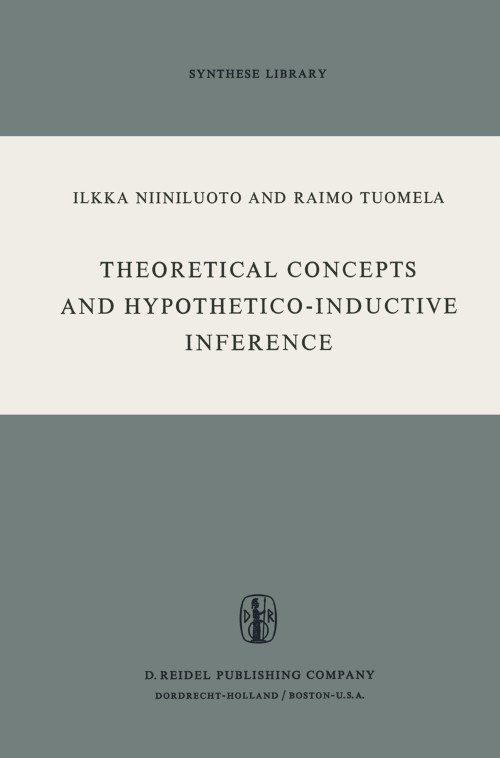
Theoretical Concepts and Hypothetico-Inductive Inference [electronic resource] / by I. Niiniluoto, R. Tuomela.
Erişim Adresi
ISBN
9789401025966
Dil Kodu
İngilizce
Yer Numarası
DK/13549
Yazar
Basım Bildirimi
1st ed. 1973.
Yayın Bilgisi
Dordrecht : Springer Netherlands : Imprint: Springer, 1973.
Fiziksel Niteleme
269 p. online resource.
Dizi
Synthese Library, Studies in Epistemology, Logic, Methodology, and Philosophy of Science, 2542-8292 ; 53
İçindekiler Notu
1. Theoretical concepts and inductive Inference -- 1. Problems of Inductive Systematization: the Transitivity Dilemma -- 2. Inductive Systematization Established by Theories -- 3. A Logical Framework for the Dynamics of Conceptual Change and Induction -- 2. Hintikka’s Two-Dimensional Continuum of Inductive Logic -- 1. Summary of Hintikka’s Two-dimensional Continuum -- 2. The Treatment of Incomplete Evidence -- 3. Inductive Probabilities of Weak Generalizations -- 1. Probabilities in the Observational Language -- 2. Evidential Theoretical Concepts -- 3. Non-Evidential Theoretical Concepts -- 4. Inductive Probabilities of Strong Generalizations -- 5. Piecewise Definable Theoretical Concepts -- 6. Epistemic Utilities and Inductive Systematization -- 1. Measures of Information and Systematic Power -- 2. Expected Epistemic Utilities of Generalizations -- 3. Competing Generalizations -- 7. Theoretical Concepts and Inductive Explanation -- 1. Explanatory Power of Theories -- 2. Inductive Explanation Illustrated -- 3. Positive Inductive Relevance, Supersessance, and Screening Off -- 4. Inductive Explanation within Hintikka’s System -- 8. Corroboration and Theoretical Concepts -- 1. Theoretical and Observational Support -- 2. Measures of Corroboration Based on Positive Inductive Relevance -- 3. Hintikka’s Measure of Corroboration -- 9. The Logical Indispensability of Theoretical Concepts within Inductive Systematization -- 1. The Theoretician’s Dilemma: Methodological Instrumentalism Refuted -- 2. Logical Indispensability and Positive Inductive Relevance -- 3. Logical Indispensability and Rules of Acceptance -- 10. Linguistic Variance in Inductive Logic -- 1. Linguistic Invariance and Linguistic Variance -- 2. Probability Kinematics -- 3. Goodman’s New Riddle of Induction -- 11. Towards aNon-Inductivist Logic of Induction -- 1. Deductivism and Inductivism -- 2. Hypothetico-Deductive and Hypothetico-Inductive Inference -- 3. The Atheoretical Thesis -- 4. Converse Deduction and Indirect Support -- 5. Conjectures.
Özet, vb.
Conceptual change and its connection to the development of new seien tific theories has reeently beeome an intensively discussed topic in philo sophieal literature. Even if the inductive aspects related to conceptual change have already been discussed to some extent, there has so far existed no systematic treatment of inductive change due to conceptual enrichment. This is what we attempt to accomplish in this work, al though most of our technical results are restricted to the framework of monadic languages. We extend Hintikka's system of inductive logic to apply to situations in which new concepts are introduced to the original language. By interpreting them as theoretica1 concepts, it is possible to discuss a number of currently debated philosophical and methodological problems which have previously escaped systematic and exact treatment. For instance, the role which seientific theories employing theoretical con cepts may play within inductive inference can be studied within this framework. From the viewpoint of seientific realism, sueh a study gives outlines for a theory of what we call hypothetico-induetive inference. Some parts of this work which are based on Hintikka's system of in ductive logic are fairly technical. However, no previous knowledge of this system is required, but, in general, acquaintance with the basic ideas of elementary logic and probability theory is suffieient. This work is part of a project, originated by Professors Jaakko Hintikka and Raimo Tuomela, concerning the role of theoretical concepts in science.
Konu
Science __ Philosophy.
Philosophy of Science.
Philosophy of Science.
Diğer Yazarlar
Kurum Adı
Eseri Alıntıla
Referansları kullanmadan önce gözden geçirmeniz ve varsa gerekli düzeltmeleri yapmanız önerilir.
Dijital Kaynak
MARC Görünümü
LEADER 06295nam a22005535i 4500
001 812295
003 TR_AnAIT
005 20260131000454
007 cr nn 008mamaa
008 121227s1973 ne | s |||| 0|eng d
020 |a9789401025966|9978-94-010-2596-6
024 7 |a10.1007/978-94-010-2596-6|2doi
041 |aeng
049 |aTürk Tarih Kurumu Kütüphanesi
050 4|aQ174-175.3
050 4|aB67
072 7|aPDA|2bicssc
072 7|aSCI075000|2bisacsh
072 7|aPDA|2thema
082 04|a501|223
090 |aDK/13549
100 1 |aNiiniluoto, I.|eauthor.|4aut|4http://id.loc.gov/vocabulary/relators/aut
245 10|aTheoretical Concepts and Hypothetico-Inductive Inference|h[electronic resource] /|cby I. Niiniluoto, R. Tuomela.
250 |a1st ed. 1973.
264 1|aDordrecht :|bSpringer Netherlands :|bImprint: Springer,|c1973.
300 |a269 p.|bonline resource.
336 |atext|btxt|2rdacontent
337 |acomputer|bc|2rdamedia
338 |aonline resource|bcr|2rdacarrier
347 |atext file|bPDF|2rda
490 1 |aSynthese Library, Studies in Epistemology, Logic, Methodology, and Philosophy of Science,|x2542-8292 ;|v53
505 0 |a1. Theoretical concepts and inductive Inference -- 1. Problems of Inductive Systematization: the Transitivity Dilemma -- 2. Inductive Systematization Established by Theories -- 3. A Logical Framework for the Dynamics of Conceptual Change and Induction -- 2. Hintikka’s Two-Dimensional Continuum of Inductive Logic -- 1. Summary of Hintikka’s Two-dimensional Continuum -- 2. The Treatment of Incomplete Evidence -- 3. Inductive Probabilities of Weak Generalizations -- 1. Probabilities in the Observational Language -- 2. Evidential Theoretical Concepts -- 3. Non-Evidential Theoretical Concepts -- 4. Inductive Probabilities of Strong Generalizations -- 5. Piecewise Definable Theoretical Concepts -- 6. Epistemic Utilities and Inductive Systematization -- 1. Measures of Information and Systematic Power -- 2. Expected Epistemic Utilities of Generalizations -- 3. Competing Generalizations -- 7. Theoretical Concepts and Inductive Explanation -- 1. Explanatory Power of Theories -- 2. Inductive Explanation Illustrated -- 3. Positive Inductive Relevance, Supersessance, and Screening Off -- 4. Inductive Explanation within Hintikka’s System -- 8. Corroboration and Theoretical Concepts -- 1. Theoretical and Observational Support -- 2. Measures of Corroboration Based on Positive Inductive Relevance -- 3. Hintikka’s Measure of Corroboration -- 9. The Logical Indispensability of Theoretical Concepts within Inductive Systematization -- 1. The Theoretician’s Dilemma: Methodological Instrumentalism Refuted -- 2. Logical Indispensability and Positive Inductive Relevance -- 3. Logical Indispensability and Rules of Acceptance -- 10. Linguistic Variance in Inductive Logic -- 1. Linguistic Invariance and Linguistic Variance -- 2. Probability Kinematics -- 3. Goodman’s New Riddle of Induction -- 11. Towards aNon-Inductivist Logic of Induction -- 1. Deductivism and Inductivism -- 2. Hypothetico-Deductive and Hypothetico-Inductive Inference -- 3. The Atheoretical Thesis -- 4. Converse Deduction and Indirect Support -- 5. Conjectures.
520 |aConceptual change and its connection to the development of new seien tific theories has reeently beeome an intensively discussed topic in philo sophieal literature. Even if the inductive aspects related to conceptual change have already been discussed to some extent, there has so far existed no systematic treatment of inductive change due to conceptual enrichment. This is what we attempt to accomplish in this work, al though most of our technical results are restricted to the framework of monadic languages. We extend Hintikka's system of inductive logic to apply to situations in which new concepts are introduced to the original language. By interpreting them as theoretica1 concepts, it is possible to discuss a number of currently debated philosophical and methodological problems which have previously escaped systematic and exact treatment. For instance, the role which seientific theories employing theoretical con cepts may play within inductive inference can be studied within this framework. From the viewpoint of seientific realism, sueh a study gives outlines for a theory of what we call hypothetico-induetive inference. Some parts of this work which are based on Hintikka's system of in ductive logic are fairly technical. However, no previous knowledge of this system is required, but, in general, acquaintance with the basic ideas of elementary logic and probability theory is suffieient. This work is part of a project, originated by Professors Jaakko Hintikka and Raimo Tuomela, concerning the role of theoretical concepts in science.
532 8 |aAccessibility summary: This PDF is not accessible. It is based on scanned pages and does not support features such as screen reader compatibility or described non-text content (images, graphs etc). However, it likely supports searchable and selectable text based on OCR (Optical Character Recognition). Users with accessibility needs may not be able to use this content effectively. Please contact us at accessibilitysupport@springernature.com if you require assistance or an alternative format.
532 8 |aInaccessible, or known limited accessibility
532 8 |aNo reading system accessibility options actively disabled
532 8 |aPublisher contact for further accessibility information: accessibilitysupport@springernature.com
650 0|aScience|xPhilosophy.
650 14|aPhilosophy of Science.
700 1 |aTuomela, R.|eauthor.|4aut|4http://id.loc.gov/vocabulary/relators/aut
710 2 |aSpringerLink (Online service)
773 0 |tSpringer Nature eBook
776 08|iPrinted edition:|z9789027703439
776 08|iPrinted edition:|z9789401025973
776 08|iPrinted edition:|z9789401025980
830 0|aSynthese Library, Studies in Epistemology, Logic, Methodology, and Philosophy of Science,|x2542-8292 ;|v53
856 40|uhttps://doi.org/10.1007/978-94-010-2596-6
912 |aZDB-2-SHU
912 |aZDB-2-SXPR
912 |aZDB-2-BAE
950 |aHumanities, Social Sciences and Law (SpringerNature-11648)
950 |aPhilosophy and Religion (R0) (SpringerNature-43725)
001 812295
003 TR_AnAIT
005 20260131000454
007 cr nn 008mamaa
008 121227s1973 ne | s |||| 0|eng d
020 |a9789401025966|9978-94-010-2596-6
024 7 |a10.1007/978-94-010-2596-6|2doi
041 |aeng
049 |aTürk Tarih Kurumu Kütüphanesi
050 4|aQ174-175.3
050 4|aB67
072 7|aPDA|2bicssc
072 7|aSCI075000|2bisacsh
072 7|aPDA|2thema
082 04|a501|223
090 |aDK/13549
100 1 |aNiiniluoto, I.|eauthor.|4aut|4http://id.loc.gov/vocabulary/relators/aut
245 10|aTheoretical Concepts and Hypothetico-Inductive Inference|h[electronic resource] /|cby I. Niiniluoto, R. Tuomela.
250 |a1st ed. 1973.
264 1|aDordrecht :|bSpringer Netherlands :|bImprint: Springer,|c1973.
300 |a269 p.|bonline resource.
336 |atext|btxt|2rdacontent
337 |acomputer|bc|2rdamedia
338 |aonline resource|bcr|2rdacarrier
347 |atext file|bPDF|2rda
490 1 |aSynthese Library, Studies in Epistemology, Logic, Methodology, and Philosophy of Science,|x2542-8292 ;|v53
505 0 |a1. Theoretical concepts and inductive Inference -- 1. Problems of Inductive Systematization: the Transitivity Dilemma -- 2. Inductive Systematization Established by Theories -- 3. A Logical Framework for the Dynamics of Conceptual Change and Induction -- 2. Hintikka’s Two-Dimensional Continuum of Inductive Logic -- 1. Summary of Hintikka’s Two-dimensional Continuum -- 2. The Treatment of Incomplete Evidence -- 3. Inductive Probabilities of Weak Generalizations -- 1. Probabilities in the Observational Language -- 2. Evidential Theoretical Concepts -- 3. Non-Evidential Theoretical Concepts -- 4. Inductive Probabilities of Strong Generalizations -- 5. Piecewise Definable Theoretical Concepts -- 6. Epistemic Utilities and Inductive Systematization -- 1. Measures of Information and Systematic Power -- 2. Expected Epistemic Utilities of Generalizations -- 3. Competing Generalizations -- 7. Theoretical Concepts and Inductive Explanation -- 1. Explanatory Power of Theories -- 2. Inductive Explanation Illustrated -- 3. Positive Inductive Relevance, Supersessance, and Screening Off -- 4. Inductive Explanation within Hintikka’s System -- 8. Corroboration and Theoretical Concepts -- 1. Theoretical and Observational Support -- 2. Measures of Corroboration Based on Positive Inductive Relevance -- 3. Hintikka’s Measure of Corroboration -- 9. The Logical Indispensability of Theoretical Concepts within Inductive Systematization -- 1. The Theoretician’s Dilemma: Methodological Instrumentalism Refuted -- 2. Logical Indispensability and Positive Inductive Relevance -- 3. Logical Indispensability and Rules of Acceptance -- 10. Linguistic Variance in Inductive Logic -- 1. Linguistic Invariance and Linguistic Variance -- 2. Probability Kinematics -- 3. Goodman’s New Riddle of Induction -- 11. Towards aNon-Inductivist Logic of Induction -- 1. Deductivism and Inductivism -- 2. Hypothetico-Deductive and Hypothetico-Inductive Inference -- 3. The Atheoretical Thesis -- 4. Converse Deduction and Indirect Support -- 5. Conjectures.
520 |aConceptual change and its connection to the development of new seien tific theories has reeently beeome an intensively discussed topic in philo sophieal literature. Even if the inductive aspects related to conceptual change have already been discussed to some extent, there has so far existed no systematic treatment of inductive change due to conceptual enrichment. This is what we attempt to accomplish in this work, al though most of our technical results are restricted to the framework of monadic languages. We extend Hintikka's system of inductive logic to apply to situations in which new concepts are introduced to the original language. By interpreting them as theoretica1 concepts, it is possible to discuss a number of currently debated philosophical and methodological problems which have previously escaped systematic and exact treatment. For instance, the role which seientific theories employing theoretical con cepts may play within inductive inference can be studied within this framework. From the viewpoint of seientific realism, sueh a study gives outlines for a theory of what we call hypothetico-induetive inference. Some parts of this work which are based on Hintikka's system of in ductive logic are fairly technical. However, no previous knowledge of this system is required, but, in general, acquaintance with the basic ideas of elementary logic and probability theory is suffieient. This work is part of a project, originated by Professors Jaakko Hintikka and Raimo Tuomela, concerning the role of theoretical concepts in science.
532 8 |aAccessibility summary: This PDF is not accessible. It is based on scanned pages and does not support features such as screen reader compatibility or described non-text content (images, graphs etc). However, it likely supports searchable and selectable text based on OCR (Optical Character Recognition). Users with accessibility needs may not be able to use this content effectively. Please contact us at accessibilitysupport@springernature.com if you require assistance or an alternative format.
532 8 |aInaccessible, or known limited accessibility
532 8 |aNo reading system accessibility options actively disabled
532 8 |aPublisher contact for further accessibility information: accessibilitysupport@springernature.com
650 0|aScience|xPhilosophy.
650 14|aPhilosophy of Science.
700 1 |aTuomela, R.|eauthor.|4aut|4http://id.loc.gov/vocabulary/relators/aut
710 2 |aSpringerLink (Online service)
773 0 |tSpringer Nature eBook
776 08|iPrinted edition:|z9789027703439
776 08|iPrinted edition:|z9789401025973
776 08|iPrinted edition:|z9789401025980
830 0|aSynthese Library, Studies in Epistemology, Logic, Methodology, and Philosophy of Science,|x2542-8292 ;|v53
856 40|uhttps://doi.org/10.1007/978-94-010-2596-6
912 |aZDB-2-SHU
912 |aZDB-2-SXPR
912 |aZDB-2-BAE
950 |aHumanities, Social Sciences and Law (SpringerNature-11648)
950 |aPhilosophy and Religion (R0) (SpringerNature-43725)
Materyaller
Depodan talep edilen materyal sadece kütüphane içerisinde kullanılmaktadır.
Materyal dışarıya ödünç verilmemektedir.
Materyal dışarıya ödünç verilmemektedir.
