

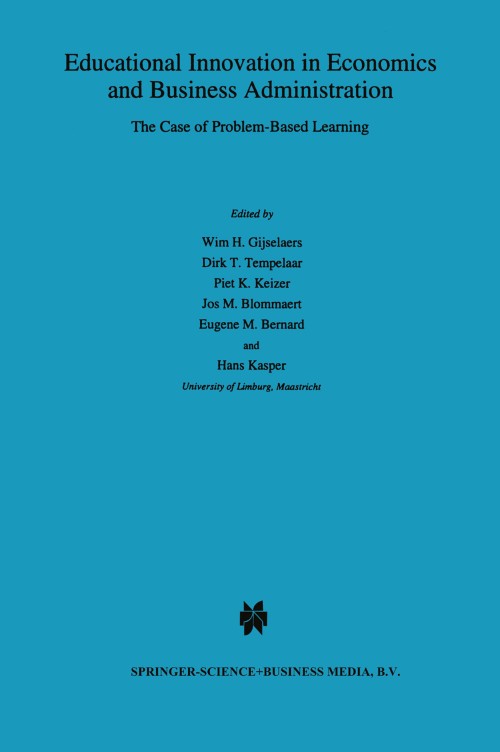
Educational Innovation in Economics and Business Administration: [electronic resource] : The Case of Problem-Based Learning / edited by Wim H. Gijselaers, Dirk T. Tempelaar, Piet K. Keizer, Jos M. Blommaert, Eugene M. Bernard, Hans Kasper.
Erişim Adresi
ISBN
9789401585453
Dil Kodu
İngilizce
Yer Numarası
DK/13575
Basım Bildirimi
1st ed. 1995.
Yayın Bilgisi
Dordrecht : Springer Netherlands : Imprint: Springer, 1995.
Fiziksel Niteleme
X, 486 p. online resource.
Dizi
Educational Innovation in Economics and Business ; 1
İçindekiler Notu
Acknowledgements -- 1. Introduction -- 2. Rhetorical Obstacles In The Teaching Of Economics -- 3. A Total Quality Improvement Approach to Student Learning -- 4. Educating Leaders For The New Competitive Environment -- 5. Perspectives On Problem-based Learning -- 6. PBL, Ideology Or Practical Solution? -- 7. Differences In The Organisation And Application Of Knowledge Between Novice, Intermediate And Experienced Auditors -- 8. Problem Solving Strategies -- 9. The Reading, Interpretation And Usage Of Scientific Articles In Undergraduate Accounting Education -- 10. The Development Of Expertise In Management Accounting -- 11. Teaching For Expertise -- 12. Choosing the Right Platform for Computer-Based Materials Used in Teaching and Learning Economics -- 13. A New Software Architecture For Simulation -- 14. Using Online Databases In Applied Economics -- 15. Running The British Economy. A High Quality Learning Environment -- 16. An Economic Game As An Interactive Learning Environment -- 17. Using A Computer Based Management Simulation Exercise For Developing Business Specific And General Transferable Skills In Hospitality Management Students -- 18. Integrating Multidimensional Business Knowledge Using A Non-Computerised Business Game -- 19. Teaching Problem-Solving And Analytical Thinking Skills With A Special Reference To Modelling In Management Science -- 20. Economics And Electronic Spreadsheets. Interdisciplinary Economics In Education -- 21. Bridging The Gap Between Informatics And Business Disciplines -- 22. Modelling And Learning. Using Systems Methodology And Algorithms In Teaching Strategic Management And Planning -- 23. Quantitative Methods In A Problem-Based Curriculum -- 24. Problem-Based Learning And Teaching Mathematical Subject An Attempt At Bridging The Gap In Maastricht -- 25. Discovery Of The Reality. Experiences With Integrated Project Studies -- 26. Teaching PIMS Principles In A Problem-based Learning Environment -- 27. Educational Innovation In Problem — Based Learning: Teaching Service Management Through Team Teaching And With Quality Techniques -- 28. Student Directed Learning. A Business Challenge For Freshmen -- 29. Problem-Based Learning In The Business Curriculum. An Alternative To Traditional Approaches -- 30. Students’ Assessment Of The Effectiveness Of The Various Activities In A Non-Traditional Course -- 31. The Use Of Students As Consultants In Live Case Study Tasks. Progress At Newcastle Business School -- 32. Looking For Benchmarks In Vocational Training -- 33. Distance Education And Problem-Based Learning -- 34. Case-Methodology To Teach Problem-Solving Skills -- 35. Variations To Problem-Based Learning Due To Course Requirements -- 36. The Development Of A Curriculum For Project Management And Real Estate Management -- 37. Peer Group Support In Economics. Innovations In Problem-Based Learning -- 38. Student Assessment In A Problem-Based Curriculum -- 39. Problem-Solving And Assessment. The Maastricht Experiences -- 40. What Do We Learn From Test Scores? A Case Study On The Use Of Test Scores For Evaluative Purposes -- 41. Discrepancies In The Labour Market For RL-Educated Economists -- 42. Do Staff Members Appreciate The Problem Based Learning Approach? -- 43. Restructuring The Maastricht Program In Economics And Business Administration. Some Lessons Learned From Managing This Project -- 44. Reflections On Innovation Methodology -- 45. Developing And Managing Faculty-Driven Innovation. A Continuous Improvement Model With Self-Directed Work Teams -- 46. Business Schools And Innovation. Receptive Contexts For Change? -- 47. Universal Learning. AScience And Methodology For Education And Training -- 48. Universal Learning As A Tool For Educational Tranformation And Process Control Systems In Problem-Based Programs -- 49. The Nature Of Education And The Short-Termism Threat The Special Case Of Accounting Education -- 50. Economics and Political Correctness in a European Setting -- 51. The Resistance Of The Established Educational System To Problem-Based Learning. The Turkish Case -- 52. Applicability Of The ‘Problem-Based Learning’ Approach To An International Student Body. Some Preliminary Results From Economics -- 53. Experiencing A Tutorial Group -- 54. Mathematics, Economics, And Electronic Spreadsheets Interdisciplinary Economies In Education -- 55. Organisation of Education In A Problem-based Programme -- 56. A Symposia. MBAs Working In A Problem-based Environment -- 57. Running The British Economy -- 58. Competence in Economics. To Test Or Not To Test, That’s The Question! -- 59. How To Design A Curriculum/Block -- 60. A Symposia. Managing The Evolution Of Problem-based Learning In The MBA Programme At Ohio University -- 61. An Interactive Simulation Game Focused On The Microeconomic Fundamentals Of Macroeconomics -- 62. Task Construction In Problem Based Learning -- 63. Bridging The Gap Between Informatics And Business Disciplines -- 64. Developing Computer Based Learning Materials For Economics Using ToolBook™ -- 65. A Workshop. The Role Of The Tutor In Problem-based Learning -- 66. Using On-Line Databases In Applied Economics. A Measure Of Efficiency Or Effectiveness -- 67. Choosing The Right Platform For Computer-Based Materials Used In Teaching And Learning Economics. First Session -- 68. Computer-based Problem-solving Environments Stella -- 69. Choosing The Right Platform For Computer-Based Materials Used InTeaching And Learning Economics.Second Session.
Özet, vb.
During the last few years economics and business education have emerged as one of the largest fields of study in higher education. At the same time, the pressing concern for improving the quality of higher education has led to a definite need for more knowledge about effective instruction and innovation in economics and business education. The book brings together many examples of reform in economics and business education. Special attention is paid to the problem-based learning approach, which over the past ten years, has developed as a very important innovation in higher education. The book contains contributions from a variety of institutions on the necessity of curriculum reform, the choice of instructional methods, assessment and testing, and management of change. It is of interest for teachers in higher education, educational psychologists, and any person interested in educational innovation in economics and business administration.
Konu
Educational technology.
Economics.
Business.
Management science.
Digital Education and Educational Technology.
Economics.
Business and Management.
Economics.
Business.
Management science.
Digital Education and Educational Technology.
Economics.
Business and Management.
Diğer Yazarlar
Kurum Adı
Eseri Alıntıla
Referansları kullanmadan önce gözden geçirmeniz ve varsa gerekli düzeltmeleri yapmanız önerilir.
Dijital Kaynak
MARC Görünümü
LEADER 09684nam a22006495i 4500
001 812322
003 TR_AnAIT
005 20260131000113
007 cr nn 008mamaa
008 130125s1995 ne | s |||| 0|eng d
020 |a9789401585453|9978-94-015-8545-3
024 7 |a10.1007/978-94-015-8545-3|2doi
041 |aeng
049 |aTürk Tarih Kurumu Kütüphanesi
050 4|aLB1028.3
072 7|aJNV|2bicssc
072 7|aEDU000000|2bisacsh
072 7|aJNV|2thema
082 04|a371.33|223
090 |aDK/13575
245 10|aEducational Innovation in Economics and Business Administration:|h[electronic resource] :|bThe Case of Problem-Based Learning /|cedited by Wim H. Gijselaers, Dirk T. Tempelaar, Piet K. Keizer, Jos M. Blommaert, Eugene M. Bernard, Hans Kasper.
250 |a1st ed. 1995.
264 1|aDordrecht :|bSpringer Netherlands :|bImprint: Springer,|c1995.
300 |aX, 486 p.|bonline resource.
336 |atext|btxt|2rdacontent
337 |acomputer|bc|2rdamedia
338 |aonline resource|bcr|2rdacarrier
347 |atext file|bPDF|2rda
490 1 |aEducational Innovation in Economics and Business ;|v1
505 0 |aAcknowledgements -- 1. Introduction -- 2. Rhetorical Obstacles In The Teaching Of Economics -- 3. A Total Quality Improvement Approach to Student Learning -- 4. Educating Leaders For The New Competitive Environment -- 5. Perspectives On Problem-based Learning -- 6. PBL, Ideology Or Practical Solution? -- 7. Differences In The Organisation And Application Of Knowledge Between Novice, Intermediate And Experienced Auditors -- 8. Problem Solving Strategies -- 9. The Reading, Interpretation And Usage Of Scientific Articles In Undergraduate Accounting Education -- 10. The Development Of Expertise In Management Accounting -- 11. Teaching For Expertise -- 12. Choosing the Right Platform for Computer-Based Materials Used in Teaching and Learning Economics -- 13. A New Software Architecture For Simulation -- 14. Using Online Databases In Applied Economics -- 15. Running The British Economy. A High Quality Learning Environment -- 16. An Economic Game As An Interactive Learning Environment -- 17. Using A Computer Based Management Simulation Exercise For Developing Business Specific And General Transferable Skills In Hospitality Management Students -- 18. Integrating Multidimensional Business Knowledge Using A Non-Computerised Business Game -- 19. Teaching Problem-Solving And Analytical Thinking Skills With A Special Reference To Modelling In Management Science -- 20. Economics And Electronic Spreadsheets. Interdisciplinary Economics In Education -- 21. Bridging The Gap Between Informatics And Business Disciplines -- 22. Modelling And Learning. Using Systems Methodology And Algorithms In Teaching Strategic Management And Planning -- 23. Quantitative Methods In A Problem-Based Curriculum -- 24. Problem-Based Learning And Teaching Mathematical Subject An Attempt At Bridging The Gap In Maastricht -- 25. Discovery Of The Reality. Experiences With Integrated Project Studies -- 26. Teaching PIMS Principles In A Problem-based Learning Environment -- 27. Educational Innovation In Problem — Based Learning: Teaching Service Management Through Team Teaching And With Quality Techniques -- 28. Student Directed Learning. A Business Challenge For Freshmen -- 29. Problem-Based Learning In The Business Curriculum. An Alternative To Traditional Approaches -- 30. Students’ Assessment Of The Effectiveness Of The Various Activities In A Non-Traditional Course -- 31. The Use Of Students As Consultants In Live Case Study Tasks. Progress At Newcastle Business School -- 32. Looking For Benchmarks In Vocational Training -- 33. Distance Education And Problem-Based Learning -- 34. Case-Methodology To Teach Problem-Solving Skills -- 35. Variations To Problem-Based Learning Due To Course Requirements -- 36. The Development Of A Curriculum For Project Management And Real Estate Management -- 37. Peer Group Support In Economics. Innovations In Problem-Based Learning -- 38. Student Assessment In A Problem-Based Curriculum -- 39. Problem-Solving And Assessment. The Maastricht Experiences -- 40. What Do We Learn From Test Scores? A Case Study On The Use Of Test Scores For Evaluative Purposes -- 41. Discrepancies In The Labour Market For RL-Educated Economists -- 42. Do Staff Members Appreciate The Problem Based Learning Approach? -- 43. Restructuring The Maastricht Program In Economics And Business Administration. Some Lessons Learned From Managing This Project -- 44. Reflections On Innovation Methodology -- 45. Developing And Managing Faculty-Driven Innovation. A Continuous Improvement Model With Self-Directed Work Teams -- 46. Business Schools And Innovation. Receptive Contexts For Change? -- 47. Universal Learning. AScience And Methodology For Education And Training -- 48. Universal Learning As A Tool For Educational Tranformation And Process Control Systems In Problem-Based Programs -- 49. The Nature Of Education And The Short-Termism Threat The Special Case Of Accounting Education -- 50. Economics and Political Correctness in a European Setting -- 51. The Resistance Of The Established Educational System To Problem-Based Learning. The Turkish Case -- 52. Applicability Of The ‘Problem-Based Learning’ Approach To An International Student Body. Some Preliminary Results From Economics -- 53. Experiencing A Tutorial Group -- 54. Mathematics, Economics, And Electronic Spreadsheets Interdisciplinary Economies In Education -- 55. Organisation of Education In A Problem-based Programme -- 56. A Symposia. MBAs Working In A Problem-based Environment -- 57. Running The British Economy -- 58. Competence in Economics. To Test Or Not To Test, That’s The Question! -- 59. How To Design A Curriculum/Block -- 60. A Symposia. Managing The Evolution Of Problem-based Learning In The MBA Programme At Ohio University -- 61. An Interactive Simulation Game Focused On The Microeconomic Fundamentals Of Macroeconomics -- 62. Task Construction In Problem Based Learning -- 63. Bridging The Gap Between Informatics And Business Disciplines -- 64. Developing Computer Based Learning Materials For Economics Using ToolBook™ -- 65. A Workshop. The Role Of The Tutor In Problem-based Learning -- 66. Using On-Line Databases In Applied Economics. A Measure Of Efficiency Or Effectiveness -- 67. Choosing The Right Platform For Computer-Based Materials Used In Teaching And Learning Economics. First Session -- 68. Computer-based Problem-solving Environments Stella -- 69. Choosing The Right Platform For Computer-Based Materials Used InTeaching And Learning Economics.Second Session.
520 |aDuring the last few years economics and business education have emerged as one of the largest fields of study in higher education. At the same time, the pressing concern for improving the quality of higher education has led to a definite need for more knowledge about effective instruction and innovation in economics and business education. The book brings together many examples of reform in economics and business education. Special attention is paid to the problem-based learning approach, which over the past ten years, has developed as a very important innovation in higher education. The book contains contributions from a variety of institutions on the necessity of curriculum reform, the choice of instructional methods, assessment and testing, and management of change. It is of interest for teachers in higher education, educational psychologists, and any person interested in educational innovation in economics and business administration.
532 8 |aAccessibility summary: This PDF is not accessible. It is based on scanned pages and does not support features such as screen reader compatibility or described non-text content (images, graphs etc). However, it likely supports searchable and selectable text based on OCR (Optical Character Recognition). Users with accessibility needs may not be able to use this content effectively. Please contact us at accessibilitysupport@springernature.com if you require assistance or an alternative format.
532 8 |aInaccessible, or known limited accessibility
532 8 |aNo reading system accessibility options actively disabled
532 8 |aPublisher contact for further accessibility information: accessibilitysupport@springernature.com
650 0|aEducational technology.
650 0|aEconomics.
650 0|aBusiness.
650 0|aManagement science.
650 14|aDigital Education and Educational Technology.
650 24|aEconomics.
650 24|aBusiness and Management.
700 1 |aGijselaers, Wim H.|eeditor.|4edt|4http://id.loc.gov/vocabulary/relators/edt
700 1 |aTempelaar, Dirk T.|eeditor.|4edt|4http://id.loc.gov/vocabulary/relators/edt
700 1 |aKeizer, Piet K.|eeditor.|4edt|4http://id.loc.gov/vocabulary/relators/edt
700 1 |aBlommaert, Jos M.|eeditor.|4edt|4http://id.loc.gov/vocabulary/relators/edt
700 1 |aBernard, Eugene M.|eeditor.|4edt|4http://id.loc.gov/vocabulary/relators/edt
700 1 |aKasper, Hans.|eeditor.|4edt|4http://id.loc.gov/vocabulary/relators/edt
710 2 |aSpringerLink (Online service)
773 0 |tSpringer Nature eBook
776 08|iPrinted edition:|z9780792332725
776 08|iPrinted edition:|z9789048145041
776 08|iPrinted edition:|z9789401585460
830 0|aEducational Innovation in Economics and Business ;|v1
856 40|uhttps://doi.org/10.1007/978-94-015-8545-3
912 |aZDB-2-SHU
912 |aZDB-2-SXED
912 |aZDB-2-BAE
950 |aHumanities, Social Sciences and Law (SpringerNature-11648)
950 |aEducation (R0) (SpringerNature-43721)
001 812322
003 TR_AnAIT
005 20260131000113
007 cr nn 008mamaa
008 130125s1995 ne | s |||| 0|eng d
020 |a9789401585453|9978-94-015-8545-3
024 7 |a10.1007/978-94-015-8545-3|2doi
041 |aeng
049 |aTürk Tarih Kurumu Kütüphanesi
050 4|aLB1028.3
072 7|aJNV|2bicssc
072 7|aEDU000000|2bisacsh
072 7|aJNV|2thema
082 04|a371.33|223
090 |aDK/13575
245 10|aEducational Innovation in Economics and Business Administration:|h[electronic resource] :|bThe Case of Problem-Based Learning /|cedited by Wim H. Gijselaers, Dirk T. Tempelaar, Piet K. Keizer, Jos M. Blommaert, Eugene M. Bernard, Hans Kasper.
250 |a1st ed. 1995.
264 1|aDordrecht :|bSpringer Netherlands :|bImprint: Springer,|c1995.
300 |aX, 486 p.|bonline resource.
336 |atext|btxt|2rdacontent
337 |acomputer|bc|2rdamedia
338 |aonline resource|bcr|2rdacarrier
347 |atext file|bPDF|2rda
490 1 |aEducational Innovation in Economics and Business ;|v1
505 0 |aAcknowledgements -- 1. Introduction -- 2. Rhetorical Obstacles In The Teaching Of Economics -- 3. A Total Quality Improvement Approach to Student Learning -- 4. Educating Leaders For The New Competitive Environment -- 5. Perspectives On Problem-based Learning -- 6. PBL, Ideology Or Practical Solution? -- 7. Differences In The Organisation And Application Of Knowledge Between Novice, Intermediate And Experienced Auditors -- 8. Problem Solving Strategies -- 9. The Reading, Interpretation And Usage Of Scientific Articles In Undergraduate Accounting Education -- 10. The Development Of Expertise In Management Accounting -- 11. Teaching For Expertise -- 12. Choosing the Right Platform for Computer-Based Materials Used in Teaching and Learning Economics -- 13. A New Software Architecture For Simulation -- 14. Using Online Databases In Applied Economics -- 15. Running The British Economy. A High Quality Learning Environment -- 16. An Economic Game As An Interactive Learning Environment -- 17. Using A Computer Based Management Simulation Exercise For Developing Business Specific And General Transferable Skills In Hospitality Management Students -- 18. Integrating Multidimensional Business Knowledge Using A Non-Computerised Business Game -- 19. Teaching Problem-Solving And Analytical Thinking Skills With A Special Reference To Modelling In Management Science -- 20. Economics And Electronic Spreadsheets. Interdisciplinary Economics In Education -- 21. Bridging The Gap Between Informatics And Business Disciplines -- 22. Modelling And Learning. Using Systems Methodology And Algorithms In Teaching Strategic Management And Planning -- 23. Quantitative Methods In A Problem-Based Curriculum -- 24. Problem-Based Learning And Teaching Mathematical Subject An Attempt At Bridging The Gap In Maastricht -- 25. Discovery Of The Reality. Experiences With Integrated Project Studies -- 26. Teaching PIMS Principles In A Problem-based Learning Environment -- 27. Educational Innovation In Problem — Based Learning: Teaching Service Management Through Team Teaching And With Quality Techniques -- 28. Student Directed Learning. A Business Challenge For Freshmen -- 29. Problem-Based Learning In The Business Curriculum. An Alternative To Traditional Approaches -- 30. Students’ Assessment Of The Effectiveness Of The Various Activities In A Non-Traditional Course -- 31. The Use Of Students As Consultants In Live Case Study Tasks. Progress At Newcastle Business School -- 32. Looking For Benchmarks In Vocational Training -- 33. Distance Education And Problem-Based Learning -- 34. Case-Methodology To Teach Problem-Solving Skills -- 35. Variations To Problem-Based Learning Due To Course Requirements -- 36. The Development Of A Curriculum For Project Management And Real Estate Management -- 37. Peer Group Support In Economics. Innovations In Problem-Based Learning -- 38. Student Assessment In A Problem-Based Curriculum -- 39. Problem-Solving And Assessment. The Maastricht Experiences -- 40. What Do We Learn From Test Scores? A Case Study On The Use Of Test Scores For Evaluative Purposes -- 41. Discrepancies In The Labour Market For RL-Educated Economists -- 42. Do Staff Members Appreciate The Problem Based Learning Approach? -- 43. Restructuring The Maastricht Program In Economics And Business Administration. Some Lessons Learned From Managing This Project -- 44. Reflections On Innovation Methodology -- 45. Developing And Managing Faculty-Driven Innovation. A Continuous Improvement Model With Self-Directed Work Teams -- 46. Business Schools And Innovation. Receptive Contexts For Change? -- 47. Universal Learning. AScience And Methodology For Education And Training -- 48. Universal Learning As A Tool For Educational Tranformation And Process Control Systems In Problem-Based Programs -- 49. The Nature Of Education And The Short-Termism Threat The Special Case Of Accounting Education -- 50. Economics and Political Correctness in a European Setting -- 51. The Resistance Of The Established Educational System To Problem-Based Learning. The Turkish Case -- 52. Applicability Of The ‘Problem-Based Learning’ Approach To An International Student Body. Some Preliminary Results From Economics -- 53. Experiencing A Tutorial Group -- 54. Mathematics, Economics, And Electronic Spreadsheets Interdisciplinary Economies In Education -- 55. Organisation of Education In A Problem-based Programme -- 56. A Symposia. MBAs Working In A Problem-based Environment -- 57. Running The British Economy -- 58. Competence in Economics. To Test Or Not To Test, That’s The Question! -- 59. How To Design A Curriculum/Block -- 60. A Symposia. Managing The Evolution Of Problem-based Learning In The MBA Programme At Ohio University -- 61. An Interactive Simulation Game Focused On The Microeconomic Fundamentals Of Macroeconomics -- 62. Task Construction In Problem Based Learning -- 63. Bridging The Gap Between Informatics And Business Disciplines -- 64. Developing Computer Based Learning Materials For Economics Using ToolBook™ -- 65. A Workshop. The Role Of The Tutor In Problem-based Learning -- 66. Using On-Line Databases In Applied Economics. A Measure Of Efficiency Or Effectiveness -- 67. Choosing The Right Platform For Computer-Based Materials Used In Teaching And Learning Economics. First Session -- 68. Computer-based Problem-solving Environments Stella -- 69. Choosing The Right Platform For Computer-Based Materials Used InTeaching And Learning Economics.Second Session.
520 |aDuring the last few years economics and business education have emerged as one of the largest fields of study in higher education. At the same time, the pressing concern for improving the quality of higher education has led to a definite need for more knowledge about effective instruction and innovation in economics and business education. The book brings together many examples of reform in economics and business education. Special attention is paid to the problem-based learning approach, which over the past ten years, has developed as a very important innovation in higher education. The book contains contributions from a variety of institutions on the necessity of curriculum reform, the choice of instructional methods, assessment and testing, and management of change. It is of interest for teachers in higher education, educational psychologists, and any person interested in educational innovation in economics and business administration.
532 8 |aAccessibility summary: This PDF is not accessible. It is based on scanned pages and does not support features such as screen reader compatibility or described non-text content (images, graphs etc). However, it likely supports searchable and selectable text based on OCR (Optical Character Recognition). Users with accessibility needs may not be able to use this content effectively. Please contact us at accessibilitysupport@springernature.com if you require assistance or an alternative format.
532 8 |aInaccessible, or known limited accessibility
532 8 |aNo reading system accessibility options actively disabled
532 8 |aPublisher contact for further accessibility information: accessibilitysupport@springernature.com
650 0|aEducational technology.
650 0|aEconomics.
650 0|aBusiness.
650 0|aManagement science.
650 14|aDigital Education and Educational Technology.
650 24|aEconomics.
650 24|aBusiness and Management.
700 1 |aGijselaers, Wim H.|eeditor.|4edt|4http://id.loc.gov/vocabulary/relators/edt
700 1 |aTempelaar, Dirk T.|eeditor.|4edt|4http://id.loc.gov/vocabulary/relators/edt
700 1 |aKeizer, Piet K.|eeditor.|4edt|4http://id.loc.gov/vocabulary/relators/edt
700 1 |aBlommaert, Jos M.|eeditor.|4edt|4http://id.loc.gov/vocabulary/relators/edt
700 1 |aBernard, Eugene M.|eeditor.|4edt|4http://id.loc.gov/vocabulary/relators/edt
700 1 |aKasper, Hans.|eeditor.|4edt|4http://id.loc.gov/vocabulary/relators/edt
710 2 |aSpringerLink (Online service)
773 0 |tSpringer Nature eBook
776 08|iPrinted edition:|z9780792332725
776 08|iPrinted edition:|z9789048145041
776 08|iPrinted edition:|z9789401585460
830 0|aEducational Innovation in Economics and Business ;|v1
856 40|uhttps://doi.org/10.1007/978-94-015-8545-3
912 |aZDB-2-SHU
912 |aZDB-2-SXED
912 |aZDB-2-BAE
950 |aHumanities, Social Sciences and Law (SpringerNature-11648)
950 |aEducation (R0) (SpringerNature-43721)
Materyaller
Depodan talep edilen materyal sadece kütüphane içerisinde kullanılmaktadır.
Materyal dışarıya ödünç verilmemektedir.
Materyal dışarıya ödünç verilmemektedir.
