

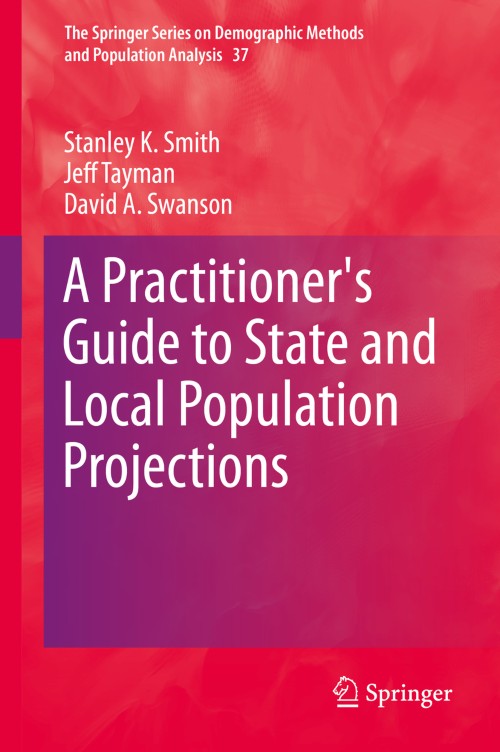
A Practitioner's Guide to State and Local Population Projections [electronic resource] / by Stanley K. Smith, Jeff Tayman, David A. Swanson.
Erişim Adresi
ISBN
9789400775510
Dil Kodu
İngilizce
Yer Numarası
DK/13589
Yazar
Basım Bildirimi
1st ed. 2013.
Yayın Bilgisi
Dordrecht : Springer Netherlands : Imprint: Springer, 2013.
Fiziksel Niteleme
XV, 411 p. 26 illus. online resource.
Dizi
The Springer Series on Demographic Methods and Population Analysis, 2215-1990 ; 37
İçindekiler Notu
Chapter 1: Rationale, Terminology, Scope -- Chapter 2: Fundamental of Population Analysis -- Chapter 3: Overview of the Cohort-Component Method -- Chapter 4: Mortality -- Chapter 5: fertility -- Chapter 6: Migration -- Chapter 7: Implementing the Cohort-Component Method -- Chapter 8: Extrapolation Methods -- Chapter 9: Structural and Microsimulation Models -- Chapter 10: Special Adjustments -- Chapter 11: Related Projections -- Chapter 12: Evaluating Projections -- Chapter 13 Forecast Accuracy and Bias -- Chapter 14: A Practical Guide to Small-Area Projections -- Epilogues: Some Final Thoughts -- Glossary -- Index.
Özet, vb.
This book focuses on the methodology and analysis of state and local population projections. It describes the most commonly used data sources and application techniques for four types of projection methods: cohort-component, trend extrapolation, structural models, and microsimulation. It covers the components of population growth, sources of data, the formation of assumptions, the development of evaluation criteria, and the determinants of forecast accuracy. It considers the strengths and weaknesses of various projection methods and pays special attention to the unique problems that characterize small-area projections. The authors provide practical guidance to demographers, planners, market analysts, and others called on to construct state and local population projections. They use many examples and illustrations and present suggestions for dealing with special populations, unique circumstances, and inadequate or unreliable data. They describe techniques for controlling one set of projections to another, for interpolating between time points, for sub-dividing age groups, and for constructing projections of population-related variables (e.g., school enrollment, households). They discuss the role of judgment and the importance of the political context in which projections are made. They emphasize the “utility” of projections, or their usefulness for decision making in a world of competing demands and limited resources. This comprehensive book will provide readers with an understanding not only of the mechanics of the most commonly used population projection methods, but also of the many complex issues affecting their construction, interpretation, evaluation, and use.
Konu
Demography.
Population.
Sociology __ Methodology.
Population and Demography.
Sociological Methods.
Population.
Sociology __ Methodology.
Population and Demography.
Sociological Methods.
Diğer Yazarlar
Kurum Adı
Eseri Alıntıla
Referansları kullanmadan önce gözden geçirmeniz ve varsa gerekli düzeltmeleri yapmanız önerilir.
Dijital Kaynak
MARC Görünümü
LEADER 04394nam a22005295i 4500
001 812336
003 TR_AnAIT
005 20260130235950
007 cr nn 008mamaa
008 131216s2013 ne | s |||| 0|eng d
020 |a9789400775510|9978-94-007-7551-0
024 7 |a10.1007/978-94-007-7551-0|2doi
041 |aeng
049 |aTürk Tarih Kurumu Kütüphanesi
050 4|aHB848-3697
072 7|aJHBD|2bicssc
072 7|aSOC006000|2bisacsh
072 7|aJHBD|2thema
082 04|a304.6|223
090 |aDK/13589
100 1 |aSmith, Stanley K.|eauthor.|4aut|4http://id.loc.gov/vocabulary/relators/aut
245 12|aA Practitioner's Guide to State and Local Population Projections|h[electronic resource] /|cby Stanley K. Smith, Jeff Tayman, David A. Swanson.
250 |a1st ed. 2013.
264 1|aDordrecht :|bSpringer Netherlands :|bImprint: Springer,|c2013.
300 |aXV, 411 p. 26 illus.|bonline resource.
336 |atext|btxt|2rdacontent
337 |acomputer|bc|2rdamedia
338 |aonline resource|bcr|2rdacarrier
347 |atext file|bPDF|2rda
490 1 |aThe Springer Series on Demographic Methods and Population Analysis,|x2215-1990 ;|v37
505 0 |aChapter 1: Rationale, Terminology, Scope -- Chapter 2: Fundamental of Population Analysis -- Chapter 3: Overview of the Cohort-Component Method -- Chapter 4: Mortality -- Chapter 5: fertility -- Chapter 6: Migration -- Chapter 7: Implementing the Cohort-Component Method -- Chapter 8: Extrapolation Methods -- Chapter 9: Structural and Microsimulation Models -- Chapter 10: Special Adjustments -- Chapter 11: Related Projections -- Chapter 12: Evaluating Projections -- Chapter 13 Forecast Accuracy and Bias -- Chapter 14: A Practical Guide to Small-Area Projections -- Epilogues: Some Final Thoughts -- Glossary -- Index.
520 |aThis book focuses on the methodology and analysis of state and local population projections. It describes the most commonly used data sources and application techniques for four types of projection methods: cohort-component, trend extrapolation, structural models, and microsimulation. It covers the components of population growth, sources of data, the formation of assumptions, the development of evaluation criteria, and the determinants of forecast accuracy. It considers the strengths and weaknesses of various projection methods and pays special attention to the unique problems that characterize small-area projections. The authors provide practical guidance to demographers, planners, market analysts, and others called on to construct state and local population projections. They use many examples and illustrations and present suggestions for dealing with special populations, unique circumstances, and inadequate or unreliable data. They describe techniques for controlling one set of projections to another, for interpolating between time points, for sub-dividing age groups, and for constructing projections of population-related variables (e.g., school enrollment, households). They discuss the role of judgment and the importance of the political context in which projections are made. They emphasize the “utility” of projections, or their usefulness for decision making in a world of competing demands and limited resources. This comprehensive book will provide readers with an understanding not only of the mechanics of the most commonly used population projection methods, but also of the many complex issues affecting their construction, interpretation, evaluation, and use.
650 0|aDemography.
650 0|aPopulation.
650 0|aSociology|xMethodology.
650 14|aPopulation and Demography.
650 24|aSociological Methods.
700 1 |aTayman, Jeff.|eauthor.|4aut|4http://id.loc.gov/vocabulary/relators/aut
700 1 |aSwanson, David A.|eauthor.|4aut|4http://id.loc.gov/vocabulary/relators/aut
710 2 |aSpringerLink (Online service)
773 0 |tSpringer Nature eBook
776 08|iPrinted edition:|z9789400775503
776 08|iPrinted edition:|z9789400775527
776 08|iPrinted edition:|z9789402402759
830 0|aThe Springer Series on Demographic Methods and Population Analysis,|x2215-1990 ;|v37
856 40|uhttps://doi.org/10.1007/978-94-007-7551-0
912 |aZDB-2-SHU
912 |aZDB-2-SXS
950 |aHumanities, Social Sciences and Law (SpringerNature-11648)
950 |aSocial Sciences (R0) (SpringerNature-43726)
001 812336
003 TR_AnAIT
005 20260130235950
007 cr nn 008mamaa
008 131216s2013 ne | s |||| 0|eng d
020 |a9789400775510|9978-94-007-7551-0
024 7 |a10.1007/978-94-007-7551-0|2doi
041 |aeng
049 |aTürk Tarih Kurumu Kütüphanesi
050 4|aHB848-3697
072 7|aJHBD|2bicssc
072 7|aSOC006000|2bisacsh
072 7|aJHBD|2thema
082 04|a304.6|223
090 |aDK/13589
100 1 |aSmith, Stanley K.|eauthor.|4aut|4http://id.loc.gov/vocabulary/relators/aut
245 12|aA Practitioner's Guide to State and Local Population Projections|h[electronic resource] /|cby Stanley K. Smith, Jeff Tayman, David A. Swanson.
250 |a1st ed. 2013.
264 1|aDordrecht :|bSpringer Netherlands :|bImprint: Springer,|c2013.
300 |aXV, 411 p. 26 illus.|bonline resource.
336 |atext|btxt|2rdacontent
337 |acomputer|bc|2rdamedia
338 |aonline resource|bcr|2rdacarrier
347 |atext file|bPDF|2rda
490 1 |aThe Springer Series on Demographic Methods and Population Analysis,|x2215-1990 ;|v37
505 0 |aChapter 1: Rationale, Terminology, Scope -- Chapter 2: Fundamental of Population Analysis -- Chapter 3: Overview of the Cohort-Component Method -- Chapter 4: Mortality -- Chapter 5: fertility -- Chapter 6: Migration -- Chapter 7: Implementing the Cohort-Component Method -- Chapter 8: Extrapolation Methods -- Chapter 9: Structural and Microsimulation Models -- Chapter 10: Special Adjustments -- Chapter 11: Related Projections -- Chapter 12: Evaluating Projections -- Chapter 13 Forecast Accuracy and Bias -- Chapter 14: A Practical Guide to Small-Area Projections -- Epilogues: Some Final Thoughts -- Glossary -- Index.
520 |aThis book focuses on the methodology and analysis of state and local population projections. It describes the most commonly used data sources and application techniques for four types of projection methods: cohort-component, trend extrapolation, structural models, and microsimulation. It covers the components of population growth, sources of data, the formation of assumptions, the development of evaluation criteria, and the determinants of forecast accuracy. It considers the strengths and weaknesses of various projection methods and pays special attention to the unique problems that characterize small-area projections. The authors provide practical guidance to demographers, planners, market analysts, and others called on to construct state and local population projections. They use many examples and illustrations and present suggestions for dealing with special populations, unique circumstances, and inadequate or unreliable data. They describe techniques for controlling one set of projections to another, for interpolating between time points, for sub-dividing age groups, and for constructing projections of population-related variables (e.g., school enrollment, households). They discuss the role of judgment and the importance of the political context in which projections are made. They emphasize the “utility” of projections, or their usefulness for decision making in a world of competing demands and limited resources. This comprehensive book will provide readers with an understanding not only of the mechanics of the most commonly used population projection methods, but also of the many complex issues affecting their construction, interpretation, evaluation, and use.
650 0|aDemography.
650 0|aPopulation.
650 0|aSociology|xMethodology.
650 14|aPopulation and Demography.
650 24|aSociological Methods.
700 1 |aTayman, Jeff.|eauthor.|4aut|4http://id.loc.gov/vocabulary/relators/aut
700 1 |aSwanson, David A.|eauthor.|4aut|4http://id.loc.gov/vocabulary/relators/aut
710 2 |aSpringerLink (Online service)
773 0 |tSpringer Nature eBook
776 08|iPrinted edition:|z9789400775503
776 08|iPrinted edition:|z9789400775527
776 08|iPrinted edition:|z9789402402759
830 0|aThe Springer Series on Demographic Methods and Population Analysis,|x2215-1990 ;|v37
856 40|uhttps://doi.org/10.1007/978-94-007-7551-0
912 |aZDB-2-SHU
912 |aZDB-2-SXS
950 |aHumanities, Social Sciences and Law (SpringerNature-11648)
950 |aSocial Sciences (R0) (SpringerNature-43726)
Materyaller
Depodan talep edilen materyal sadece kütüphane içerisinde kullanılmaktadır.
Materyal dışarıya ödünç verilmemektedir.
Materyal dışarıya ödünç verilmemektedir.
