

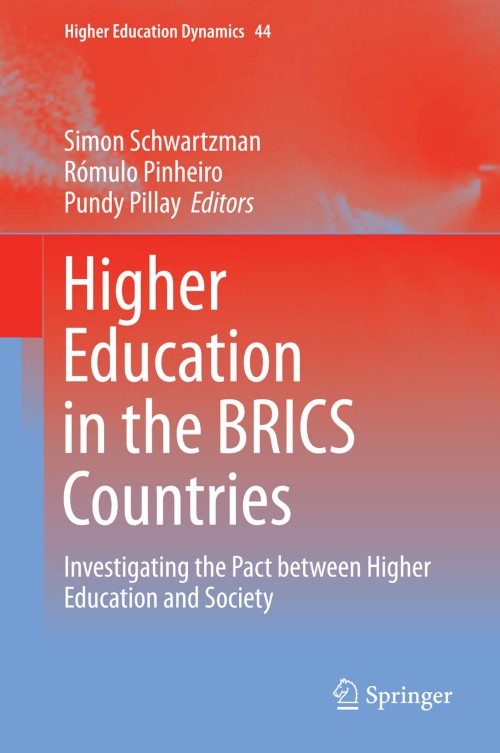
Higher Education in the BRICS Countries [electronic resource] : Investigating the Pact between Higher Education and Society / edited by Simon Schwartzman, Rómulo Pinheiro, Pundy Pillay.
Erişim Adresi
ISBN
9789401795708
Dil Kodu
İngilizce
Yer Numarası
DK/13604
Basım Bildirimi
1st ed. 2015.
Yayın Bilgisi
Dordrecht : Springer Netherlands : Imprint: Springer, 2015.
Fiziksel Niteleme
XVI, 493 p. 60 illus. online resource.
Dizi
Higher Education Dynamics, 2215-1923 ; 44
İçindekiler Notu
Introduction -- The Rise of the BRICS and Higher Education Dynamics. Simon Schwartzman, Rómulo Pinheiro and Pundy Pillay -- Part I: Thematic Summaries -- Demand and Policies for Higher Education. Simon Schwartzman -- The Role of Internal and External Stakeholders. Rómulo Pinheiro -- Linking University Research and Innovation in the BRICS. Creso M. Sá -- Part II: Supply and Demand -- Demand and Supply for Higher Education in Brazil. Clarissa E. B. Neves -- Supply and Demand Patterns in Russian Higher Education. Isak Froumin and Yarolslav Kuuzminov -- Higher Education, Social Demand and Social Equity in India. Kishore M. Joshi -- Demands and Responses in Chinese Higher Education. Yuzhuo Cai and Fengqiao Yan.-Supply and Demand in South Africa. Kirti Menon.-Part III: The Role of Stakeholders -- The Role of Internal and External Stakeholders in Brazilian Higher Education. Elizabeth Balbachevsky -- Russian System of Higher Education and its Stakeholders: Ten years on the way to congruence. Evgeny Kniazev and Drantusova Natalya -- Cost Sharing in China’s Higher Education: Analyses of Major Stakeholders. Rui Yang -- The Role of Stakeholders in the Transformation of the South African Higher Education System. Peliwe Lolwana -- Part IV: Government Policy -- Higher Education policies in Brazil: A Case of Failure in Market Regulation. Maria H. M. Castro -- The Federal State, Regional Interests and the Reinvention of Russian Higher Education. Mark S. Johnson -- The Complex Web of Policy Choices: Dilemmas Facing Indian Higher Education Reform. Roopa D. Trilokekar and Sheila Embleton -- The Chinese Model of Development and the Higher Education Policy. Qiang Zha and Ruth Hayhoe -- State Power, Transition and New Modes of Coordination in Higher Education in South Africa. Michael Cross -- Part V: Research and Innovation -- Research and the ‘Third mission” in Light of Global Events. Creso M. Sá, Andrew Kretz and Kristjan Sigurdson -- Globalization and the Research Mission of Universities in Russia. Anna Smolentseva -- Research and Innovation in Indian Higher Education. Radhika Gorur and Fazal Rizvi -- Promoting Entrepreneurship and Innovation in China: Transformations in University Curriculum and Research Capacity. Joshua K. H. Mok and Kan Yue -- Research and Innovation in South Africa. Pundy Pillay -- EPILOGUE: Higher Education in the BRICS: What Have We Learnt and Where Are We Heading? Rómulo Pinheiro, Simon Schwartzman and Pundy Pillay.
Özet, vb.
In spite of the increasing attention attributed to the rise in prominence of the BRICS (Brazil, Russia, India, China and South Africa) countries, few studies have looked at the ways in which broader social expectations with respect to the role of higher education across the BRICS have changed, or not, in recent years. Our point of departure is that, contrary to the conventional wisdom focusing on functionalistic perspectives, higher education systems are not just designed by governments to fulfill certain functions, but have a tendency for evolving in a rather unpredictable fashion as a result of the complex interplay between a number of internal and external factors. In reality, national higher education systems develop and change according to a complex process that encompasses the expectations of governmental agencies, markets, the aspirations of the population for the benefits of education, the specific institutional traditions and cultures of higher education institutions, and,increasingly so, the interests and strategies of the private firms entering and offering services in the higher education market. This basically means that it is of outmost importance to move away from conceiving of "universities" or "higher education" as single, monolithic actors or sector. One way of doing this is by investigating a selected number of distinct, but nonetheless interrelated factors or drivers, which, taken together, help determine the nature and scope of the social compact between higher education (its core actors and institutions) and society at large (government, industry, local communities, professional associations).
Konu
Education, Higher.
International education .
Comparative education.
Educational sociology.
Higher Education.
International and Comparative Education.
Sociology of Education.
International education .
Comparative education.
Educational sociology.
Higher Education.
International and Comparative Education.
Sociology of Education.
Diğer Yazarlar
Kurum Adı
Eseri Alıntıla
Referansları kullanmadan önce gözden geçirmeniz ve varsa gerekli düzeltmeleri yapmanız önerilir.
Dijital Kaynak
MARC Görünümü
LEADER 06258nam a22005535i 4500
001 812351
003 TR_AnAIT
005 20260130235803
007 cr nn 008mamaa
008 150324s2015 ne | s |||| 0|eng d
020 |a9789401795708|9978-94-017-9570-8
024 7 |a10.1007/978-94-017-9570-8|2doi
041 |aeng
049 |aTürk Tarih Kurumu Kütüphanesi
050 4|aLB2300-2799.3
072 7|aJNM|2bicssc
072 7|aEDU015000|2bisacsh
072 7|aJNM|2thema
082 04|a378|223
090 |aDK/13604
245 10|aHigher Education in the BRICS Countries|h[electronic resource] :|bInvestigating the Pact between Higher Education and Society /|cedited by Simon Schwartzman, Rómulo Pinheiro, Pundy Pillay.
250 |a1st ed. 2015.
264 1|aDordrecht :|bSpringer Netherlands :|bImprint: Springer,|c2015.
300 |aXVI, 493 p. 60 illus.|bonline resource.
336 |atext|btxt|2rdacontent
337 |acomputer|bc|2rdamedia
338 |aonline resource|bcr|2rdacarrier
347 |atext file|bPDF|2rda
490 1 |aHigher Education Dynamics,|x2215-1923 ;|v44
505 0 |aIntroduction -- The Rise of the BRICS and Higher Education Dynamics. Simon Schwartzman, Rómulo Pinheiro and Pundy Pillay -- Part I: Thematic Summaries -- Demand and Policies for Higher Education. Simon Schwartzman -- The Role of Internal and External Stakeholders. Rómulo Pinheiro -- Linking University Research and Innovation in the BRICS. Creso M. Sá -- Part II: Supply and Demand -- Demand and Supply for Higher Education in Brazil. Clarissa E. B. Neves -- Supply and Demand Patterns in Russian Higher Education. Isak Froumin and Yarolslav Kuuzminov -- Higher Education, Social Demand and Social Equity in India. Kishore M. Joshi -- Demands and Responses in Chinese Higher Education. Yuzhuo Cai and Fengqiao Yan.-Supply and Demand in South Africa. Kirti Menon.-Part III: The Role of Stakeholders -- The Role of Internal and External Stakeholders in Brazilian Higher Education. Elizabeth Balbachevsky -- Russian System of Higher Education and its Stakeholders: Ten years on the way to congruence. Evgeny Kniazev and Drantusova Natalya -- Cost Sharing in China’s Higher Education: Analyses of Major Stakeholders. Rui Yang -- The Role of Stakeholders in the Transformation of the South African Higher Education System. Peliwe Lolwana -- Part IV: Government Policy -- Higher Education policies in Brazil: A Case of Failure in Market Regulation. Maria H. M. Castro -- The Federal State, Regional Interests and the Reinvention of Russian Higher Education. Mark S. Johnson -- The Complex Web of Policy Choices: Dilemmas Facing Indian Higher Education Reform. Roopa D. Trilokekar and Sheila Embleton -- The Chinese Model of Development and the Higher Education Policy. Qiang Zha and Ruth Hayhoe -- State Power, Transition and New Modes of Coordination in Higher Education in South Africa. Michael Cross -- Part V: Research and Innovation -- Research and the ‘Third mission” in Light of Global Events. Creso M. Sá, Andrew Kretz and Kristjan Sigurdson -- Globalization and the Research Mission of Universities in Russia. Anna Smolentseva -- Research and Innovation in Indian Higher Education. Radhika Gorur and Fazal Rizvi -- Promoting Entrepreneurship and Innovation in China: Transformations in University Curriculum and Research Capacity. Joshua K. H. Mok and Kan Yue -- Research and Innovation in South Africa. Pundy Pillay -- EPILOGUE: Higher Education in the BRICS: What Have We Learnt and Where Are We Heading? Rómulo Pinheiro, Simon Schwartzman and Pundy Pillay.
520 |aIn spite of the increasing attention attributed to the rise in prominence of the BRICS (Brazil, Russia, India, China and South Africa) countries, few studies have looked at the ways in which broader social expectations with respect to the role of higher education across the BRICS have changed, or not, in recent years. Our point of departure is that, contrary to the conventional wisdom focusing on functionalistic perspectives, higher education systems are not just designed by governments to fulfill certain functions, but have a tendency for evolving in a rather unpredictable fashion as a result of the complex interplay between a number of internal and external factors. In reality, national higher education systems develop and change according to a complex process that encompasses the expectations of governmental agencies, markets, the aspirations of the population for the benefits of education, the specific institutional traditions and cultures of higher education institutions, and,increasingly so, the interests and strategies of the private firms entering and offering services in the higher education market. This basically means that it is of outmost importance to move away from conceiving of "universities" or "higher education" as single, monolithic actors or sector. One way of doing this is by investigating a selected number of distinct, but nonetheless interrelated factors or drivers, which, taken together, help determine the nature and scope of the social compact between higher education (its core actors and institutions) and society at large (government, industry, local communities, professional associations).
650 0|aEducation, Higher.
650 0|aInternational education .
650 0|aComparative education.
650 0|aEducational sociology.
650 14|aHigher Education.
650 24|aInternational and Comparative Education.
650 24|aSociology of Education.
700 1 |aSchwartzman, Simon.|eeditor.|4edt|4http://id.loc.gov/vocabulary/relators/edt
700 1 |aPinheiro, Rómulo.|eeditor.|4edt|4http://id.loc.gov/vocabulary/relators/edt
700 1 |aPillay, Pundy.|eeditor.|4edt|4http://id.loc.gov/vocabulary/relators/edt
710 2 |aSpringerLink (Online service)
773 0 |tSpringer Nature eBook
776 08|iPrinted edition:|z9789401795692
776 08|iPrinted edition:|z9789401795715
776 08|iPrinted edition:|z9789402400144
830 0|aHigher Education Dynamics,|x2215-1923 ;|v44
856 40|uhttps://doi.org/10.1007/978-94-017-9570-8
912 |aZDB-2-SHU
912 |aZDB-2-SXED
950 |aHumanities, Social Sciences and Law (SpringerNature-11648)
950 |aEducation (R0) (SpringerNature-43721)
001 812351
003 TR_AnAIT
005 20260130235803
007 cr nn 008mamaa
008 150324s2015 ne | s |||| 0|eng d
020 |a9789401795708|9978-94-017-9570-8
024 7 |a10.1007/978-94-017-9570-8|2doi
041 |aeng
049 |aTürk Tarih Kurumu Kütüphanesi
050 4|aLB2300-2799.3
072 7|aJNM|2bicssc
072 7|aEDU015000|2bisacsh
072 7|aJNM|2thema
082 04|a378|223
090 |aDK/13604
245 10|aHigher Education in the BRICS Countries|h[electronic resource] :|bInvestigating the Pact between Higher Education and Society /|cedited by Simon Schwartzman, Rómulo Pinheiro, Pundy Pillay.
250 |a1st ed. 2015.
264 1|aDordrecht :|bSpringer Netherlands :|bImprint: Springer,|c2015.
300 |aXVI, 493 p. 60 illus.|bonline resource.
336 |atext|btxt|2rdacontent
337 |acomputer|bc|2rdamedia
338 |aonline resource|bcr|2rdacarrier
347 |atext file|bPDF|2rda
490 1 |aHigher Education Dynamics,|x2215-1923 ;|v44
505 0 |aIntroduction -- The Rise of the BRICS and Higher Education Dynamics. Simon Schwartzman, Rómulo Pinheiro and Pundy Pillay -- Part I: Thematic Summaries -- Demand and Policies for Higher Education. Simon Schwartzman -- The Role of Internal and External Stakeholders. Rómulo Pinheiro -- Linking University Research and Innovation in the BRICS. Creso M. Sá -- Part II: Supply and Demand -- Demand and Supply for Higher Education in Brazil. Clarissa E. B. Neves -- Supply and Demand Patterns in Russian Higher Education. Isak Froumin and Yarolslav Kuuzminov -- Higher Education, Social Demand and Social Equity in India. Kishore M. Joshi -- Demands and Responses in Chinese Higher Education. Yuzhuo Cai and Fengqiao Yan.-Supply and Demand in South Africa. Kirti Menon.-Part III: The Role of Stakeholders -- The Role of Internal and External Stakeholders in Brazilian Higher Education. Elizabeth Balbachevsky -- Russian System of Higher Education and its Stakeholders: Ten years on the way to congruence. Evgeny Kniazev and Drantusova Natalya -- Cost Sharing in China’s Higher Education: Analyses of Major Stakeholders. Rui Yang -- The Role of Stakeholders in the Transformation of the South African Higher Education System. Peliwe Lolwana -- Part IV: Government Policy -- Higher Education policies in Brazil: A Case of Failure in Market Regulation. Maria H. M. Castro -- The Federal State, Regional Interests and the Reinvention of Russian Higher Education. Mark S. Johnson -- The Complex Web of Policy Choices: Dilemmas Facing Indian Higher Education Reform. Roopa D. Trilokekar and Sheila Embleton -- The Chinese Model of Development and the Higher Education Policy. Qiang Zha and Ruth Hayhoe -- State Power, Transition and New Modes of Coordination in Higher Education in South Africa. Michael Cross -- Part V: Research and Innovation -- Research and the ‘Third mission” in Light of Global Events. Creso M. Sá, Andrew Kretz and Kristjan Sigurdson -- Globalization and the Research Mission of Universities in Russia. Anna Smolentseva -- Research and Innovation in Indian Higher Education. Radhika Gorur and Fazal Rizvi -- Promoting Entrepreneurship and Innovation in China: Transformations in University Curriculum and Research Capacity. Joshua K. H. Mok and Kan Yue -- Research and Innovation in South Africa. Pundy Pillay -- EPILOGUE: Higher Education in the BRICS: What Have We Learnt and Where Are We Heading? Rómulo Pinheiro, Simon Schwartzman and Pundy Pillay.
520 |aIn spite of the increasing attention attributed to the rise in prominence of the BRICS (Brazil, Russia, India, China and South Africa) countries, few studies have looked at the ways in which broader social expectations with respect to the role of higher education across the BRICS have changed, or not, in recent years. Our point of departure is that, contrary to the conventional wisdom focusing on functionalistic perspectives, higher education systems are not just designed by governments to fulfill certain functions, but have a tendency for evolving in a rather unpredictable fashion as a result of the complex interplay between a number of internal and external factors. In reality, national higher education systems develop and change according to a complex process that encompasses the expectations of governmental agencies, markets, the aspirations of the population for the benefits of education, the specific institutional traditions and cultures of higher education institutions, and,increasingly so, the interests and strategies of the private firms entering and offering services in the higher education market. This basically means that it is of outmost importance to move away from conceiving of "universities" or "higher education" as single, monolithic actors or sector. One way of doing this is by investigating a selected number of distinct, but nonetheless interrelated factors or drivers, which, taken together, help determine the nature and scope of the social compact between higher education (its core actors and institutions) and society at large (government, industry, local communities, professional associations).
650 0|aEducation, Higher.
650 0|aInternational education .
650 0|aComparative education.
650 0|aEducational sociology.
650 14|aHigher Education.
650 24|aInternational and Comparative Education.
650 24|aSociology of Education.
700 1 |aSchwartzman, Simon.|eeditor.|4edt|4http://id.loc.gov/vocabulary/relators/edt
700 1 |aPinheiro, Rómulo.|eeditor.|4edt|4http://id.loc.gov/vocabulary/relators/edt
700 1 |aPillay, Pundy.|eeditor.|4edt|4http://id.loc.gov/vocabulary/relators/edt
710 2 |aSpringerLink (Online service)
773 0 |tSpringer Nature eBook
776 08|iPrinted edition:|z9789401795692
776 08|iPrinted edition:|z9789401795715
776 08|iPrinted edition:|z9789402400144
830 0|aHigher Education Dynamics,|x2215-1923 ;|v44
856 40|uhttps://doi.org/10.1007/978-94-017-9570-8
912 |aZDB-2-SHU
912 |aZDB-2-SXED
950 |aHumanities, Social Sciences and Law (SpringerNature-11648)
950 |aEducation (R0) (SpringerNature-43721)
Materyaller
Depodan talep edilen materyal sadece kütüphane içerisinde kullanılmaktadır.
Materyal dışarıya ödünç verilmemektedir.
Materyal dışarıya ödünç verilmemektedir.
