

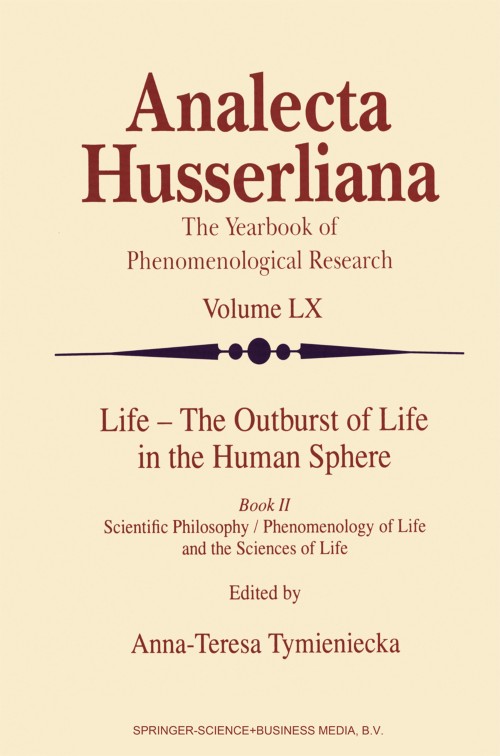
Life - The Outburst of Life in the Human Sphere [electronic resource] : Scientific Philosophy / Phenomenology of Life and the Sciences of Life. Book II / edited by Anna-Teresa Tymieniecka.
Erişim Adresi
ISBN
9789401720830
Dil Kodu
İngilizce
Yer Numarası
DK/13611
Basım Bildirimi
1st ed. 1999.
Yayın Bilgisi
Dordrecht : Springer Netherlands : Imprint: Springer, 1999.
Fiziksel Niteleme
XVI, 514 p. online resource.
Dizi
Analecta Husserliana, The Yearbook of Phenomenological Research, 2542-8330 ; 60
İçindekiler Notu
Inaugural Essay -- The Ontopoietic Self-Individualisation of Being: In Search of the Foothold of Change, Becoming and Transformation -- I Individuality and Complexity — Classic Questions Pertaining to the Ontopoiesis of Life -- Nature and Individuality -- Faktizität und Individualität: Der frühe Heidegger und Aristoteles -- Life and Human Life in Max Scheler: Phenomenological Problems of Identification and Individualization -- The Lifeworld as Hermeneutical Principle for Understanding the Human Condition: Functions and Limits of the “Everyday Life” Concept -- The Phenomenological Conception of Quantum Theory and the Polyphony of Modern Fiction -- Outlines of an Axiology of Human Creations -- II Self-Revelation of Life and Its Human Sphere -- The Ideals of Life in Anna-Teresa Tymieniecka’s Thought -- The Cosmic Tree According to Le Clézio in Le Procès-Verbal, Désert and Le Chercheur d’Or -- Poetic Inspiration and the Renewal of Life: Le Songe de Vaux -- Groundwork for Ontopoetics -- Stefan Zweig and the Secret of Artistic Creation -- Une Approche Phénoménologique de la Musique Byzantine -- Calvinistic Anthropology and French Poetry in the Sixteenth Century: Purity and Guilt in the Baroque Age -- Imagination and Practical Creativity in Paul Ricoeur -- III The Existential Spread -- A Phenomenological Psychology of Emotion: From Sartre’s Esquisse d’une Théorie des Emotions to Ignacio Matte Blanco’s Biological Theory -- Solipsism, Empathy, Otherness: On Husserl’s Overcoming of the “Closure” of the I, to Otherness as a Guarantee of an “Aperture” to the World -- Ontological Insecurity, Existential Self-Analysis and Literature: The Case of Henry James -- The Construction of Reality in the Magic World -- The Phenomenon of Loneliness and the Meta-Theory ofConsciousness -- Economy and Social Planning: Economic Development and the Mobilization of Society’s Basic Resources -- The Embodied Politics of Thomas Hobbes -- Ideology, Utopia and Religion: The Monumental and Absolute Metaphors of Social Imagination -- Friedrich Nietzsche: Bringing Truth to Life -- IV Continuities/Discontinuities of Life’s Expansion -- On a Phenomenological Analysis of the “Erlebnis” of Time -- How to Wake up from Descartes’ Dream or the Impossibility of a Complete Reduction -- Teleological Explanations and Reductionism in Molecular Biology -- Life and Negativity: Towards an Ontology of Human Lack -- Human Creative Activity as Separability of Principles: The Possibility of Good and Evil -- Realism and Faith in Transformation through the Creativeness of a Conscious Life: Simone Weil (1909–1943) -- Index of Names.
Özet, vb.
Science and philosophy have both undergone radical transformations in recent times. Now they are poised for a pivotal alliance. Science has abandoned the mechanistic model of nature. Philosophy has broken through the tight, traditional circle of conceptualisation, intellectualistic preconceptions and cognitive presuppositions. The two now meet to focus on the palpitating, fluctuating stream of nature/life. Their traditional prejudices dispersed under the pressure of new evidence, philosophy/phenomenology of life and the sciences of life meet in the Archimedean point of the human creative condition (proper to the phenomenology of life) and the role of the human subject (central to the scientific view of reality). They necessitate each other: without the sciences of life, philosophy/phenomenology of life cannot penetrate the intricacies of nature/life; without recourse to philosophy to delineate, design, provide clues to the organisation of natural evidence, the sciences of life cannot devise new strategies for inquiry nor survey their field. The present collection throws open the barriers that separate nature and culture, works of physis and those of the spirit. Following the philosophical model of the ontopoieisis of life, focusing on its specifically human sphere - that of the human self-interpretation-in-existence - it encircles the vast, new horizons of the new alliance.
Konu
Phenomenology .
Philosophy of nature.
Biology __ Philosophy.
Philosophy, Modern.
Phenomenology.
Philosophy of Nature.
Philosophy of Biology.
Early Modern Philosophy.
Philosophy of nature.
Biology __ Philosophy.
Philosophy, Modern.
Phenomenology.
Philosophy of Nature.
Philosophy of Biology.
Early Modern Philosophy.
Diğer Yazarlar
Kurum Adı
Eseri Alıntıla
Referansları kullanmadan önce gözden geçirmeniz ve varsa gerekli düzeltmeleri yapmanız önerilir.
Dijital Kaynak
MARC Görünümü
LEADER 06904nam a22006015i 4500
001 812358
003 TR_AnAIT
005 20260130235625
007 cr nn 008mamaa
008 130131s1999 ne | s |||| 0|eng d
020 |a9789401720830|9978-94-017-2083-0
024 7 |a10.1007/978-94-017-2083-0|2doi
041 |aeng
049 |aTürk Tarih Kurumu Kütüphanesi
050 4|aB829.5.A-Z
072 7|aHPCF3|2bicssc
072 7|aPHI018000|2bisacsh
072 7|aQDHR5|2thema
082 04|a142.7|223
090 |aDK/13611
245 10|aLife - The Outburst of Life in the Human Sphere|h[electronic resource] :|bScientific Philosophy / Phenomenology of Life and the Sciences of Life. Book II /|cedited by Anna-Teresa Tymieniecka.
250 |a1st ed. 1999.
264 1|aDordrecht :|bSpringer Netherlands :|bImprint: Springer,|c1999.
300 |aXVI, 514 p.|bonline resource.
336 |atext|btxt|2rdacontent
337 |acomputer|bc|2rdamedia
338 |aonline resource|bcr|2rdacarrier
347 |atext file|bPDF|2rda
490 1 |aAnalecta Husserliana, The Yearbook of Phenomenological Research,|x2542-8330 ;|v60
505 0 |aInaugural Essay -- The Ontopoietic Self-Individualisation of Being: In Search of the Foothold of Change, Becoming and Transformation -- I Individuality and Complexity — Classic Questions Pertaining to the Ontopoiesis of Life -- Nature and Individuality -- Faktizität und Individualität: Der frühe Heidegger und Aristoteles -- Life and Human Life in Max Scheler: Phenomenological Problems of Identification and Individualization -- The Lifeworld as Hermeneutical Principle for Understanding the Human Condition: Functions and Limits of the “Everyday Life” Concept -- The Phenomenological Conception of Quantum Theory and the Polyphony of Modern Fiction -- Outlines of an Axiology of Human Creations -- II Self-Revelation of Life and Its Human Sphere -- The Ideals of Life in Anna-Teresa Tymieniecka’s Thought -- The Cosmic Tree According to Le Clézio in Le Procès-Verbal, Désert and Le Chercheur d’Or -- Poetic Inspiration and the Renewal of Life: Le Songe de Vaux -- Groundwork for Ontopoetics -- Stefan Zweig and the Secret of Artistic Creation -- Une Approche Phénoménologique de la Musique Byzantine -- Calvinistic Anthropology and French Poetry in the Sixteenth Century: Purity and Guilt in the Baroque Age -- Imagination and Practical Creativity in Paul Ricoeur -- III The Existential Spread -- A Phenomenological Psychology of Emotion: From Sartre’s Esquisse d’une Théorie des Emotions to Ignacio Matte Blanco’s Biological Theory -- Solipsism, Empathy, Otherness: On Husserl’s Overcoming of the “Closure” of the I, to Otherness as a Guarantee of an “Aperture” to the World -- Ontological Insecurity, Existential Self-Analysis and Literature: The Case of Henry James -- The Construction of Reality in the Magic World -- The Phenomenon of Loneliness and the Meta-Theory ofConsciousness -- Economy and Social Planning: Economic Development and the Mobilization of Society’s Basic Resources -- The Embodied Politics of Thomas Hobbes -- Ideology, Utopia and Religion: The Monumental and Absolute Metaphors of Social Imagination -- Friedrich Nietzsche: Bringing Truth to Life -- IV Continuities/Discontinuities of Life’s Expansion -- On a Phenomenological Analysis of the “Erlebnis” of Time -- How to Wake up from Descartes’ Dream or the Impossibility of a Complete Reduction -- Teleological Explanations and Reductionism in Molecular Biology -- Life and Negativity: Towards an Ontology of Human Lack -- Human Creative Activity as Separability of Principles: The Possibility of Good and Evil -- Realism and Faith in Transformation through the Creativeness of a Conscious Life: Simone Weil (1909–1943) -- Index of Names.
520 |aScience and philosophy have both undergone radical transformations in recent times. Now they are poised for a pivotal alliance. Science has abandoned the mechanistic model of nature. Philosophy has broken through the tight, traditional circle of conceptualisation, intellectualistic preconceptions and cognitive presuppositions. The two now meet to focus on the palpitating, fluctuating stream of nature/life. Their traditional prejudices dispersed under the pressure of new evidence, philosophy/phenomenology of life and the sciences of life meet in the Archimedean point of the human creative condition (proper to the phenomenology of life) and the role of the human subject (central to the scientific view of reality). They necessitate each other: without the sciences of life, philosophy/phenomenology of life cannot penetrate the intricacies of nature/life; without recourse to philosophy to delineate, design, provide clues to the organisation of natural evidence, the sciences of life cannot devise new strategies for inquiry nor survey their field. The present collection throws open the barriers that separate nature and culture, works of physis and those of the spirit. Following the philosophical model of the ontopoieisis of life, focusing on its specifically human sphere - that of the human self-interpretation-in-existence - it encircles the vast, new horizons of the new alliance.
532 8 |aAccessibility summary: This PDF is not accessible. It is based on scanned pages and does not support features such as screen reader compatibility or described non-text content (images, graphs etc). However, it likely supports searchable and selectable text based on OCR (Optical Character Recognition). Users with accessibility needs may not be able to use this content effectively. Please contact us at accessibilitysupport@springernature.com if you require assistance or an alternative format.
532 8 |aInaccessible, or known limited accessibility
532 8 |aNo reading system accessibility options actively disabled
532 8 |aPublisher contact for further accessibility information: accessibilitysupport@springernature.com
650 0|aPhenomenology .
650 0|aPhilosophy of nature.
650 0|aBiology|xPhilosophy.
650 0|aPhilosophy, Modern.
650 14|aPhenomenology.
650 24|aPhilosophy of Nature.
650 24|aPhilosophy of Biology.
650 24|aEarly Modern Philosophy.
700 1 |aTymieniecka, Anna-Teresa.|eeditor.|4edt|4http://id.loc.gov/vocabulary/relators/edt
710 2 |aSpringerLink (Online service)
773 0 |tSpringer Nature eBook
776 08|iPrinted edition:|z9780792351429
776 08|iPrinted edition:|z9789048150588
776 08|iPrinted edition:|z9789401720847
830 0|aAnalecta Husserliana, The Yearbook of Phenomenological Research,|x2542-8330 ;|v60
856 40|uhttps://doi.org/10.1007/978-94-017-2083-0
912 |aZDB-2-SHU
912 |aZDB-2-SXPR
912 |aZDB-2-BAE
950 |aHumanities, Social Sciences and Law (SpringerNature-11648)
950 |aPhilosophy and Religion (R0) (SpringerNature-43725)
001 812358
003 TR_AnAIT
005 20260130235625
007 cr nn 008mamaa
008 130131s1999 ne | s |||| 0|eng d
020 |a9789401720830|9978-94-017-2083-0
024 7 |a10.1007/978-94-017-2083-0|2doi
041 |aeng
049 |aTürk Tarih Kurumu Kütüphanesi
050 4|aB829.5.A-Z
072 7|aHPCF3|2bicssc
072 7|aPHI018000|2bisacsh
072 7|aQDHR5|2thema
082 04|a142.7|223
090 |aDK/13611
245 10|aLife - The Outburst of Life in the Human Sphere|h[electronic resource] :|bScientific Philosophy / Phenomenology of Life and the Sciences of Life. Book II /|cedited by Anna-Teresa Tymieniecka.
250 |a1st ed. 1999.
264 1|aDordrecht :|bSpringer Netherlands :|bImprint: Springer,|c1999.
300 |aXVI, 514 p.|bonline resource.
336 |atext|btxt|2rdacontent
337 |acomputer|bc|2rdamedia
338 |aonline resource|bcr|2rdacarrier
347 |atext file|bPDF|2rda
490 1 |aAnalecta Husserliana, The Yearbook of Phenomenological Research,|x2542-8330 ;|v60
505 0 |aInaugural Essay -- The Ontopoietic Self-Individualisation of Being: In Search of the Foothold of Change, Becoming and Transformation -- I Individuality and Complexity — Classic Questions Pertaining to the Ontopoiesis of Life -- Nature and Individuality -- Faktizität und Individualität: Der frühe Heidegger und Aristoteles -- Life and Human Life in Max Scheler: Phenomenological Problems of Identification and Individualization -- The Lifeworld as Hermeneutical Principle for Understanding the Human Condition: Functions and Limits of the “Everyday Life” Concept -- The Phenomenological Conception of Quantum Theory and the Polyphony of Modern Fiction -- Outlines of an Axiology of Human Creations -- II Self-Revelation of Life and Its Human Sphere -- The Ideals of Life in Anna-Teresa Tymieniecka’s Thought -- The Cosmic Tree According to Le Clézio in Le Procès-Verbal, Désert and Le Chercheur d’Or -- Poetic Inspiration and the Renewal of Life: Le Songe de Vaux -- Groundwork for Ontopoetics -- Stefan Zweig and the Secret of Artistic Creation -- Une Approche Phénoménologique de la Musique Byzantine -- Calvinistic Anthropology and French Poetry in the Sixteenth Century: Purity and Guilt in the Baroque Age -- Imagination and Practical Creativity in Paul Ricoeur -- III The Existential Spread -- A Phenomenological Psychology of Emotion: From Sartre’s Esquisse d’une Théorie des Emotions to Ignacio Matte Blanco’s Biological Theory -- Solipsism, Empathy, Otherness: On Husserl’s Overcoming of the “Closure” of the I, to Otherness as a Guarantee of an “Aperture” to the World -- Ontological Insecurity, Existential Self-Analysis and Literature: The Case of Henry James -- The Construction of Reality in the Magic World -- The Phenomenon of Loneliness and the Meta-Theory ofConsciousness -- Economy and Social Planning: Economic Development and the Mobilization of Society’s Basic Resources -- The Embodied Politics of Thomas Hobbes -- Ideology, Utopia and Religion: The Monumental and Absolute Metaphors of Social Imagination -- Friedrich Nietzsche: Bringing Truth to Life -- IV Continuities/Discontinuities of Life’s Expansion -- On a Phenomenological Analysis of the “Erlebnis” of Time -- How to Wake up from Descartes’ Dream or the Impossibility of a Complete Reduction -- Teleological Explanations and Reductionism in Molecular Biology -- Life and Negativity: Towards an Ontology of Human Lack -- Human Creative Activity as Separability of Principles: The Possibility of Good and Evil -- Realism and Faith in Transformation through the Creativeness of a Conscious Life: Simone Weil (1909–1943) -- Index of Names.
520 |aScience and philosophy have both undergone radical transformations in recent times. Now they are poised for a pivotal alliance. Science has abandoned the mechanistic model of nature. Philosophy has broken through the tight, traditional circle of conceptualisation, intellectualistic preconceptions and cognitive presuppositions. The two now meet to focus on the palpitating, fluctuating stream of nature/life. Their traditional prejudices dispersed under the pressure of new evidence, philosophy/phenomenology of life and the sciences of life meet in the Archimedean point of the human creative condition (proper to the phenomenology of life) and the role of the human subject (central to the scientific view of reality). They necessitate each other: without the sciences of life, philosophy/phenomenology of life cannot penetrate the intricacies of nature/life; without recourse to philosophy to delineate, design, provide clues to the organisation of natural evidence, the sciences of life cannot devise new strategies for inquiry nor survey their field. The present collection throws open the barriers that separate nature and culture, works of physis and those of the spirit. Following the philosophical model of the ontopoieisis of life, focusing on its specifically human sphere - that of the human self-interpretation-in-existence - it encircles the vast, new horizons of the new alliance.
532 8 |aAccessibility summary: This PDF is not accessible. It is based on scanned pages and does not support features such as screen reader compatibility or described non-text content (images, graphs etc). However, it likely supports searchable and selectable text based on OCR (Optical Character Recognition). Users with accessibility needs may not be able to use this content effectively. Please contact us at accessibilitysupport@springernature.com if you require assistance or an alternative format.
532 8 |aInaccessible, or known limited accessibility
532 8 |aNo reading system accessibility options actively disabled
532 8 |aPublisher contact for further accessibility information: accessibilitysupport@springernature.com
650 0|aPhenomenology .
650 0|aPhilosophy of nature.
650 0|aBiology|xPhilosophy.
650 0|aPhilosophy, Modern.
650 14|aPhenomenology.
650 24|aPhilosophy of Nature.
650 24|aPhilosophy of Biology.
650 24|aEarly Modern Philosophy.
700 1 |aTymieniecka, Anna-Teresa.|eeditor.|4edt|4http://id.loc.gov/vocabulary/relators/edt
710 2 |aSpringerLink (Online service)
773 0 |tSpringer Nature eBook
776 08|iPrinted edition:|z9780792351429
776 08|iPrinted edition:|z9789048150588
776 08|iPrinted edition:|z9789401720847
830 0|aAnalecta Husserliana, The Yearbook of Phenomenological Research,|x2542-8330 ;|v60
856 40|uhttps://doi.org/10.1007/978-94-017-2083-0
912 |aZDB-2-SHU
912 |aZDB-2-SXPR
912 |aZDB-2-BAE
950 |aHumanities, Social Sciences and Law (SpringerNature-11648)
950 |aPhilosophy and Religion (R0) (SpringerNature-43725)
Materyaller
Depodan talep edilen materyal sadece kütüphane içerisinde kullanılmaktadır.
Materyal dışarıya ödünç verilmemektedir.
Materyal dışarıya ödünç verilmemektedir.
