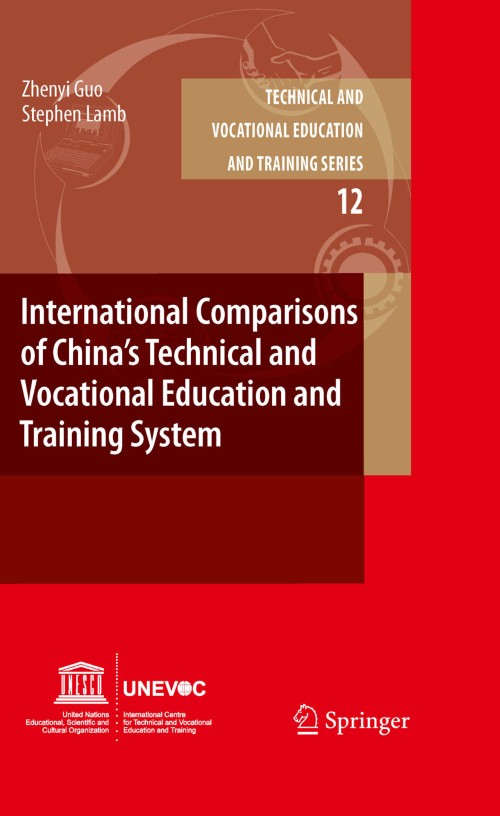
International Comparisons of China’s Technical and Vocational Education and Training System [electronic resource] / by Zhenyi Guo, Stephen Lamb.
Erişim Adresi
ISBN
9789048187430
Dil Kodu
İngilizce
Yer Numarası
DK/13675
Yazar
Basım Bildirimi
1st ed. 2010.
Yayın Bilgisi
Dordrecht : Springer Netherlands : Imprint: Springer, 2010.
Fiziksel Niteleme
X, 198 p. online resource.
Dizi
Technical and Vocational Education and Training: Issues, Concerns and Prospects, 2213-221X ; 12
İçindekiler Notu
Education and Training in China -- International Comparisons of TVET -- A Review of Current Practice in China -- Framework for Comparing China’s TVET System -- Comparisons of Social and Economic Context -- Resources -- Participation and Outcome Indicators -- Work-Based Education and Training -- Conclusion.
Özet, vb.
China is experiencing an unprecedented phenomenon: breakneck industrialization on a scale and at a pace not seen before. It is trying to achieve in just a few decades what Western nations took more than a century to do. The arrival in the country’s cities of tens of millions of rural dwellers, at most semi-skilled, has put huge strain on the country’s system of vocational education, known as TVET. How have the Chinese authorities and their education administrators responded? Is China’s TVET system adapting to the rapidly evolving needs of its industry? Using the province of Yunnan as a subject, this detailed case study is a closely argued and sanguine analysis of the operation of TVET in China. The authors deployed a set of internationally comparable criteria to offer a searching assessment of current performance, at the same time documenting areas of strength and weakness. The question the authors’ methodology answers is how well China’s TVET system is performing compared to technical and vocational education structures in other countries. In fact, they discover that in Yunnan, a province representative of the challenges faced nationwide, much has indeed been done, from a wholesale overhaul of programs to make them relevant to industry requirements, to major investment in infrastructure. Teacher training has been reformed, and take-up of professional master’s and doctoral courses has been encouraged. Joint initiatives with bodies such as UNESCO have improved training and vocational education at high school level. While there is a strong international history of such comparative evaluations, which are essential for policy makers to benchmark their administration, few studies have included China despite the enormous amount of value that can be learned from that country’s experience. This work will provide vital material for researchers, governments and development agencies alike.
Konu
International education .
Comparative education.
Professional education.
Vocational education.
International and Comparative Education.
Professional and Vocational Education.
Comparative education.
Professional education.
Vocational education.
International and Comparative Education.
Professional and Vocational Education.
Diğer Yazarlar
Kurum Adı

Eseri Alıntıla
Referansları kullanmadan önce gözden geçirmeniz ve varsa gerekli düzeltmeleri yapmanız önerilir.
Dijital Kaynak
MARC Görünümü
LEADER 04357nam a22005535i 4500
001 812424
003 TR_AnAIT
005 20260130234908
007 cr nn 008mamaa
008 100702s2010 ne | s |||| 0|eng d
020 |a9789048187430|9978-90-481-8743-0
024 7 |a10.1007/978-90-481-8743-0|2doi
041 |aeng
049 |aTürk Tarih Kurumu Kütüphanesi
050 4|aLB43
050 4|aLC1090
072 7|aJN|2bicssc
072 7|aEDU043000|2bisacsh
072 7|aJND|2thema
082 04|a370.116|223
082 04|a370.9|223
090 |aDK/13675
100 1 |aGuo, Zhenyi.|eauthor.|4aut|4http://id.loc.gov/vocabulary/relators/aut
245 10|aInternational Comparisons of China’s Technical and Vocational Education and Training System|h[electronic resource] /|cby Zhenyi Guo, Stephen Lamb.
250 |a1st ed. 2010.
264 1|aDordrecht :|bSpringer Netherlands :|bImprint: Springer,|c2010.
300 |aX, 198 p.|bonline resource.
336 |atext|btxt|2rdacontent
337 |acomputer|bc|2rdamedia
338 |aonline resource|bcr|2rdacarrier
347 |atext file|bPDF|2rda
490 1 |aTechnical and Vocational Education and Training: Issues, Concerns and Prospects,|x2213-221X ;|v12
505 0 |aEducation and Training in China -- International Comparisons of TVET -- A Review of Current Practice in China -- Framework for Comparing China’s TVET System -- Comparisons of Social and Economic Context -- Resources -- Participation and Outcome Indicators -- Work-Based Education and Training -- Conclusion.
520 |aChina is experiencing an unprecedented phenomenon: breakneck industrialization on a scale and at a pace not seen before. It is trying to achieve in just a few decades what Western nations took more than a century to do. The arrival in the country’s cities of tens of millions of rural dwellers, at most semi-skilled, has put huge strain on the country’s system of vocational education, known as TVET. How have the Chinese authorities and their education administrators responded? Is China’s TVET system adapting to the rapidly evolving needs of its industry? Using the province of Yunnan as a subject, this detailed case study is a closely argued and sanguine analysis of the operation of TVET in China. The authors deployed a set of internationally comparable criteria to offer a searching assessment of current performance, at the same time documenting areas of strength and weakness. The question the authors’ methodology answers is how well China’s TVET system is performing compared to technical and vocational education structures in other countries. In fact, they discover that in Yunnan, a province representative of the challenges faced nationwide, much has indeed been done, from a wholesale overhaul of programs to make them relevant to industry requirements, to major investment in infrastructure. Teacher training has been reformed, and take-up of professional master’s and doctoral courses has been encouraged. Joint initiatives with bodies such as UNESCO have improved training and vocational education at high school level. While there is a strong international history of such comparative evaluations, which are essential for policy makers to benchmark their administration, few studies have included China despite the enormous amount of value that can be learned from that country’s experience. This work will provide vital material for researchers, governments and development agencies alike.
650 0|aInternational education .
650 0|aComparative education.
650 0|aProfessional education.
650 0|aVocational education.
650 14|aInternational and Comparative Education.
650 24|aProfessional and Vocational Education.
700 1 |aLamb, Stephen.|eauthor.|4aut|4http://id.loc.gov/vocabulary/relators/aut
710 2 |aSpringerLink (Online service)
773 0 |tSpringer Nature eBook
776 08|iPrinted edition:|z9789048187423
776 08|iPrinted edition:|z9789048187560
776 08|iPrinted edition:|z9789400732940
830 0|aTechnical and Vocational Education and Training: Issues, Concerns and Prospects,|x2213-221X ;|v12
856 40|uhttps://doi.org/10.1007/978-90-481-8743-0
912 |aZDB-2-SHU
912 |aZDB-2-SXED
950 |aHumanities, Social Sciences and Law (SpringerNature-11648)
950 |aEducation (R0) (SpringerNature-43721)
001 812424
003 TR_AnAIT
005 20260130234908
007 cr nn 008mamaa
008 100702s2010 ne | s |||| 0|eng d
020 |a9789048187430|9978-90-481-8743-0
024 7 |a10.1007/978-90-481-8743-0|2doi
041 |aeng
049 |aTürk Tarih Kurumu Kütüphanesi
050 4|aLB43
050 4|aLC1090
072 7|aJN|2bicssc
072 7|aEDU043000|2bisacsh
072 7|aJND|2thema
082 04|a370.116|223
082 04|a370.9|223
090 |aDK/13675
100 1 |aGuo, Zhenyi.|eauthor.|4aut|4http://id.loc.gov/vocabulary/relators/aut
245 10|aInternational Comparisons of China’s Technical and Vocational Education and Training System|h[electronic resource] /|cby Zhenyi Guo, Stephen Lamb.
250 |a1st ed. 2010.
264 1|aDordrecht :|bSpringer Netherlands :|bImprint: Springer,|c2010.
300 |aX, 198 p.|bonline resource.
336 |atext|btxt|2rdacontent
337 |acomputer|bc|2rdamedia
338 |aonline resource|bcr|2rdacarrier
347 |atext file|bPDF|2rda
490 1 |aTechnical and Vocational Education and Training: Issues, Concerns and Prospects,|x2213-221X ;|v12
505 0 |aEducation and Training in China -- International Comparisons of TVET -- A Review of Current Practice in China -- Framework for Comparing China’s TVET System -- Comparisons of Social and Economic Context -- Resources -- Participation and Outcome Indicators -- Work-Based Education and Training -- Conclusion.
520 |aChina is experiencing an unprecedented phenomenon: breakneck industrialization on a scale and at a pace not seen before. It is trying to achieve in just a few decades what Western nations took more than a century to do. The arrival in the country’s cities of tens of millions of rural dwellers, at most semi-skilled, has put huge strain on the country’s system of vocational education, known as TVET. How have the Chinese authorities and their education administrators responded? Is China’s TVET system adapting to the rapidly evolving needs of its industry? Using the province of Yunnan as a subject, this detailed case study is a closely argued and sanguine analysis of the operation of TVET in China. The authors deployed a set of internationally comparable criteria to offer a searching assessment of current performance, at the same time documenting areas of strength and weakness. The question the authors’ methodology answers is how well China’s TVET system is performing compared to technical and vocational education structures in other countries. In fact, they discover that in Yunnan, a province representative of the challenges faced nationwide, much has indeed been done, from a wholesale overhaul of programs to make them relevant to industry requirements, to major investment in infrastructure. Teacher training has been reformed, and take-up of professional master’s and doctoral courses has been encouraged. Joint initiatives with bodies such as UNESCO have improved training and vocational education at high school level. While there is a strong international history of such comparative evaluations, which are essential for policy makers to benchmark their administration, few studies have included China despite the enormous amount of value that can be learned from that country’s experience. This work will provide vital material for researchers, governments and development agencies alike.
650 0|aInternational education .
650 0|aComparative education.
650 0|aProfessional education.
650 0|aVocational education.
650 14|aInternational and Comparative Education.
650 24|aProfessional and Vocational Education.
700 1 |aLamb, Stephen.|eauthor.|4aut|4http://id.loc.gov/vocabulary/relators/aut
710 2 |aSpringerLink (Online service)
773 0 |tSpringer Nature eBook
776 08|iPrinted edition:|z9789048187423
776 08|iPrinted edition:|z9789048187560
776 08|iPrinted edition:|z9789400732940
830 0|aTechnical and Vocational Education and Training: Issues, Concerns and Prospects,|x2213-221X ;|v12
856 40|uhttps://doi.org/10.1007/978-90-481-8743-0
912 |aZDB-2-SHU
912 |aZDB-2-SXED
950 |aHumanities, Social Sciences and Law (SpringerNature-11648)
950 |aEducation (R0) (SpringerNature-43721)
Materyaller
Depodan talep edilen materyal sadece kütüphane içerisinde kullanılmaktadır.
Materyal dışarıya ödünç verilmemektedir.
