LEADER 03333nam a22005295i 4500
001 812509
003 TR_AnAIT
005 20260130234308
007 cr nn 008mamaa
008 110810s2011 ne | s |||| 0|eng d
020 |a9789048189724|9978-90-481-8972-4
024 7 |a10.1007/978-90-481-8972-4|2doi
041 |aeng
049 |aTürk Tarih Kurumu Kütüphanesi
050 4|aHM716-753.2
072 7|aJHBK|2bicssc
072 7|aSOC026010|2bisacsh
072 7|aJHBK|2thema
082 04|a305.2|223
082 04|a306.87|223
090 |aDK/13759
100 1 |aDavis, Mary Ann.|eauthor.|4aut|4http://id.loc.gov/vocabulary/relators/aut
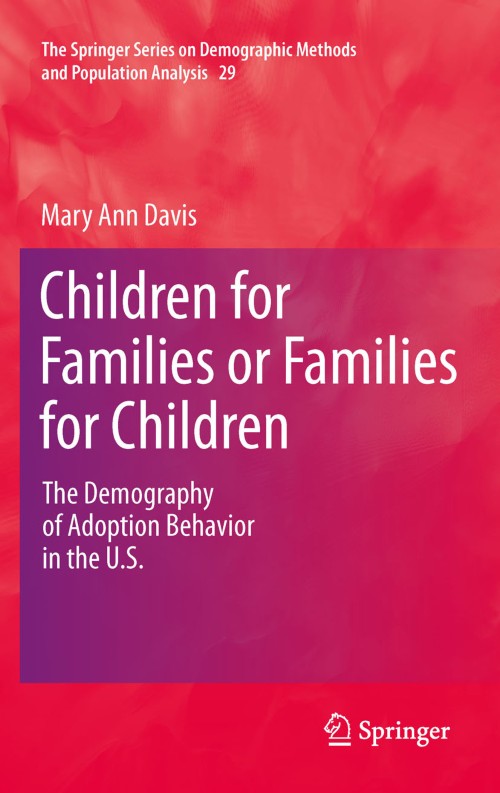
245 10|aChildren for Families or Families for Children|h[electronic resource] :|bThe Demography of Adoption Behavior in the U.S. /|cby Mary Ann Davis.
250 |a1st ed. 2011.
264 1|aDordrecht :|bSpringer Netherlands :|bImprint: Springer,|c2011.
300 |aXVI, 220 p.|bonline resource.
336 |atext|btxt|2rdacontent
337 |acomputer|bc|2rdamedia
338 |aonline resource|bcr|2rdacarrier
347 |atext file|bPDF|2rda
490 1 |aThe Springer Series on Demographic Methods and Population Analysis,|x2215-1990 ;|v29
520 |aDo adoptions provide children for families or families for children? This book analyzes the complex interactions between adopters and adoptees using historical and current data. Who are the preferred parents and children, both domestically and internationally? How do the types of adoptions-domestic adoptions, private and public through the foster care system, and intercountry adoptions-differ? Domestic trends include a shift to open adoptions and a notable increase in "hard to place", foster care adoptions-typically older, siblings, minorities, with physical, educational, or emotional challenges. Adoptive parents are increasingly all ages (including grandparents); all types of marriages (single, married and same-sex couples); all income levels, with subsidized adoptions for children who would otherwise remain in foster or institutional care. Intercountry adoptions have followed waves, pushed by wars and political or economic crises in the sending country, and pulled by the increasing demand from the U. S. Currently there is a decrease in intercountry adoptions from Asia and Eastern Europe with a possible fifth wave from Africa with the greatest number from Ethiopia. This is a resource for family sociologists, demographers, social workers, advocates for children and adoptive parents, as well as those who are interested in the continuing research in adoptions.
650 0|aSociology.
650 0|aSocial groups.
650 0|aDemography.
650 0|aPopulation.
650 14|aSociology of Family, Youth and Aging.
650 24|aPopulation and Demography.
650 24|aSociology.
710 2 |aSpringerLink (Online service)
773 0 |tSpringer Nature eBook
776 08|iPrinted edition:|z9789048189717
776 08|iPrinted edition:|z9789048189731
776 08|iPrinted edition:|z9789400737938
830 0|aThe Springer Series on Demographic Methods and Population Analysis,|x2215-1990 ;|v29
856 40|uhttps://doi.org/10.1007/978-90-481-8972-4
912 |aZDB-2-SHU
912 |aZDB-2-SXS
950 |aHumanities, Social Sciences and Law (SpringerNature-11648)
950 |aSocial Sciences (R0) (SpringerNature-43726)