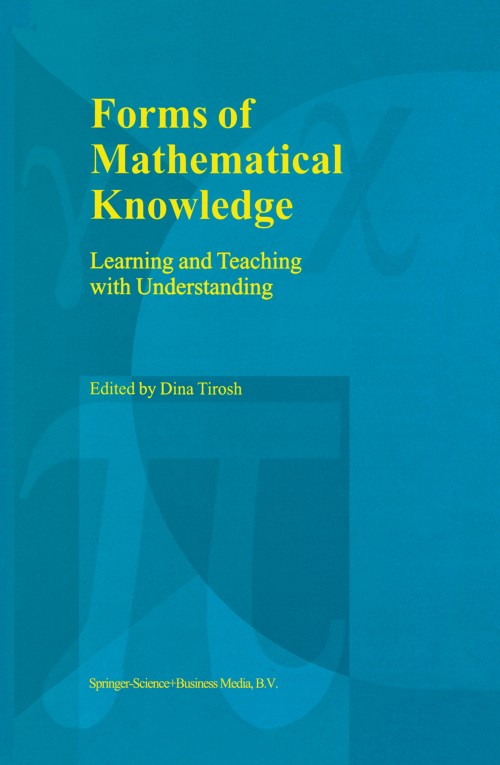
Forms of Mathematical Knowledge [electronic resource] : Learning and Teaching with Understanding / edited by Dina Tirosh.
Erişim Adresi
ISBN
9789401715843
Dil Kodu
İngilizce
Yer Numarası
DK/13784
Basım Bildirimi
1st ed. 1999.
Yayın Bilgisi
Dordrecht : Springer Netherlands : Imprint: Springer, 1999.
Fiziksel Niteleme
IV, 252 p. online resource.
İçindekiler Notu
Intuitions and Schemata in Mathematical Reasoning -- Intuitive Rules: A Way to Explain and Predict Students’ Reasoning -- Forms of Knowledge in Mathematics and Mathematics Education: Philosophical and Rhetorical Perspectives -- Why Johnny Can’t Prove -- Knowledge Construction and Diverging Thinking in Elementary & Advanced Mathematics -- Beyond Mere Knowledge of Mathematics: The Importance of Knowing-To Act in the Moment -- Conceptualizing Teachers’ Ways of Knowing -- Forms of Knowing Mathematics: What Preservice Teachers Should Learn -- The Transition from Comparison of Finite to the Comparison of Infinite Sets: Teaching Prospective Teachers -- Integrating Academic and Practical Knowledge in a Teacher Leaders’ Development Program.
Özet, vb.
What mathematics is entailed in knowing to act in a moment? Is tacit, rhetorical knowledge significant in mathematics education? What is the role of intuitive models in understanding, learning and teaching mathematics? Are there differences between elementary and advanced mathematical thinking? Why can't students prove? What are the characteristics of teachers' ways of knowing? This book focuses on various types of knowledge that are significant for learning and teaching mathematics. The first part defines, discusses and contrasts psychological, philosophical and didactical issues related to various types of knowledge involved in the learning of mathematics. The second part describes ideas about forms of mathematical knowledge that are important for teachers to know and ways of implementing such ideas in preservice and in-service education. The chapters provide a wide overview of current thinking about mathematics learning and teaching which is of interest for researchers in mathematics education and mathematics educators. Topics covered include the role of intuition in mathematics learning and teaching, the growth from elementary to advanced mathematical thinking, the significance of genres and rhetoric for the learning of mathematics and the characterization of teachers' ways of knowing.
Konu
Mathematics __ Study and teaching .
Learning, Psychology of.
Mathematics Education.
Instructional Psychology.
Learning, Psychology of.
Mathematics Education.
Instructional Psychology.
Diğer Yazarlar
Kurum Adı

Eseri Alıntıla
Referansları kullanmadan önce gözden geçirmeniz ve varsa gerekli düzeltmeleri yapmanız önerilir.
Dijital Kaynak
MARC Görünümü
LEADER 04541nam a22005535i 4500
001 812535
003 TR_AnAIT
005 20260130234207
007 cr nn 008mamaa
008 130125s1999 ne | s |||| 0|eng d
020 |a9789401715843|9978-94-017-1584-3
024 7 |a10.1007/978-94-017-1584-3|2doi
041 |aeng
049 |aTürk Tarih Kurumu Kütüphanesi
050 4|aQA10.92-20
072 7|aJNU|2bicssc
072 7|aPB|2bicssc
072 7|aEDU029010|2bisacsh
072 7|aJNU|2thema
072 7|aPB|2thema
082 04|a510.71|223
090 |aDK/13784
245 10|aForms of Mathematical Knowledge|h[electronic resource] :|bLearning and Teaching with Understanding /|cedited by Dina Tirosh.
250 |a1st ed. 1999.
264 1|aDordrecht :|bSpringer Netherlands :|bImprint: Springer,|c1999.
300 |aIV, 252 p.|bonline resource.
336 |atext|btxt|2rdacontent
337 |acomputer|bc|2rdamedia
338 |aonline resource|bcr|2rdacarrier
347 |atext file|bPDF|2rda
505 0 |aIntuitions and Schemata in Mathematical Reasoning -- Intuitive Rules: A Way to Explain and Predict Students’ Reasoning -- Forms of Knowledge in Mathematics and Mathematics Education: Philosophical and Rhetorical Perspectives -- Why Johnny Can’t Prove -- Knowledge Construction and Diverging Thinking in Elementary & Advanced Mathematics -- Beyond Mere Knowledge of Mathematics: The Importance of Knowing-To Act in the Moment -- Conceptualizing Teachers’ Ways of Knowing -- Forms of Knowing Mathematics: What Preservice Teachers Should Learn -- The Transition from Comparison of Finite to the Comparison of Infinite Sets: Teaching Prospective Teachers -- Integrating Academic and Practical Knowledge in a Teacher Leaders’ Development Program.
520 |aWhat mathematics is entailed in knowing to act in a moment? Is tacit, rhetorical knowledge significant in mathematics education? What is the role of intuitive models in understanding, learning and teaching mathematics? Are there differences between elementary and advanced mathematical thinking? Why can't students prove? What are the characteristics of teachers' ways of knowing? This book focuses on various types of knowledge that are significant for learning and teaching mathematics. The first part defines, discusses and contrasts psychological, philosophical and didactical issues related to various types of knowledge involved in the learning of mathematics. The second part describes ideas about forms of mathematical knowledge that are important for teachers to know and ways of implementing such ideas in preservice and in-service education. The chapters provide a wide overview of current thinking about mathematics learning and teaching which is of interest for researchers in mathematics education and mathematics educators. Topics covered include the role of intuition in mathematics learning and teaching, the growth from elementary to advanced mathematical thinking, the significance of genres and rhetoric for the learning of mathematics and the characterization of teachers' ways of knowing.
532 8 |aAccessibility summary: This PDF is not accessible. It is based on scanned pages and does not support features such as screen reader compatibility or described non-text content (images, graphs etc). However, it likely supports searchable and selectable text based on OCR (Optical Character Recognition). Users with accessibility needs may not be able to use this content effectively. Please contact us at accessibilitysupport@springernature.com if you require assistance or an alternative format.
532 8 |aInaccessible, or known limited accessibility
532 8 |aNo reading system accessibility options actively disabled
532 8 |aPublisher contact for further accessibility information: accessibilitysupport@springernature.com
650 0|aMathematics|xStudy and teaching .
650 0|aLearning, Psychology of.
650 14|aMathematics Education.
650 24|aInstructional Psychology.
700 1 |aTirosh, Dina.|eeditor.|4edt|4http://id.loc.gov/vocabulary/relators/edt
710 2 |aSpringerLink (Online service)
773 0 |tSpringer Nature eBook
776 08|iPrinted edition:|z9780792359951
776 08|iPrinted edition:|z9789048153305
776 08|iPrinted edition:|z9789401715850
856 40|uhttps://doi.org/10.1007/978-94-017-1584-3
912 |aZDB-2-SHU
912 |aZDB-2-SXED
912 |aZDB-2-BAE
950 |aHumanities, Social Sciences and Law (SpringerNature-11648)
950 |aEducation (R0) (SpringerNature-43721)
001 812535
003 TR_AnAIT
005 20260130234207
007 cr nn 008mamaa
008 130125s1999 ne | s |||| 0|eng d
020 |a9789401715843|9978-94-017-1584-3
024 7 |a10.1007/978-94-017-1584-3|2doi
041 |aeng
049 |aTürk Tarih Kurumu Kütüphanesi
050 4|aQA10.92-20
072 7|aJNU|2bicssc
072 7|aPB|2bicssc
072 7|aEDU029010|2bisacsh
072 7|aJNU|2thema
072 7|aPB|2thema
082 04|a510.71|223
090 |aDK/13784
245 10|aForms of Mathematical Knowledge|h[electronic resource] :|bLearning and Teaching with Understanding /|cedited by Dina Tirosh.
250 |a1st ed. 1999.
264 1|aDordrecht :|bSpringer Netherlands :|bImprint: Springer,|c1999.
300 |aIV, 252 p.|bonline resource.
336 |atext|btxt|2rdacontent
337 |acomputer|bc|2rdamedia
338 |aonline resource|bcr|2rdacarrier
347 |atext file|bPDF|2rda
505 0 |aIntuitions and Schemata in Mathematical Reasoning -- Intuitive Rules: A Way to Explain and Predict Students’ Reasoning -- Forms of Knowledge in Mathematics and Mathematics Education: Philosophical and Rhetorical Perspectives -- Why Johnny Can’t Prove -- Knowledge Construction and Diverging Thinking in Elementary & Advanced Mathematics -- Beyond Mere Knowledge of Mathematics: The Importance of Knowing-To Act in the Moment -- Conceptualizing Teachers’ Ways of Knowing -- Forms of Knowing Mathematics: What Preservice Teachers Should Learn -- The Transition from Comparison of Finite to the Comparison of Infinite Sets: Teaching Prospective Teachers -- Integrating Academic and Practical Knowledge in a Teacher Leaders’ Development Program.
520 |aWhat mathematics is entailed in knowing to act in a moment? Is tacit, rhetorical knowledge significant in mathematics education? What is the role of intuitive models in understanding, learning and teaching mathematics? Are there differences between elementary and advanced mathematical thinking? Why can't students prove? What are the characteristics of teachers' ways of knowing? This book focuses on various types of knowledge that are significant for learning and teaching mathematics. The first part defines, discusses and contrasts psychological, philosophical and didactical issues related to various types of knowledge involved in the learning of mathematics. The second part describes ideas about forms of mathematical knowledge that are important for teachers to know and ways of implementing such ideas in preservice and in-service education. The chapters provide a wide overview of current thinking about mathematics learning and teaching which is of interest for researchers in mathematics education and mathematics educators. Topics covered include the role of intuition in mathematics learning and teaching, the growth from elementary to advanced mathematical thinking, the significance of genres and rhetoric for the learning of mathematics and the characterization of teachers' ways of knowing.
532 8 |aAccessibility summary: This PDF is not accessible. It is based on scanned pages and does not support features such as screen reader compatibility or described non-text content (images, graphs etc). However, it likely supports searchable and selectable text based on OCR (Optical Character Recognition). Users with accessibility needs may not be able to use this content effectively. Please contact us at accessibilitysupport@springernature.com if you require assistance or an alternative format.
532 8 |aInaccessible, or known limited accessibility
532 8 |aNo reading system accessibility options actively disabled
532 8 |aPublisher contact for further accessibility information: accessibilitysupport@springernature.com
650 0|aMathematics|xStudy and teaching .
650 0|aLearning, Psychology of.
650 14|aMathematics Education.
650 24|aInstructional Psychology.
700 1 |aTirosh, Dina.|eeditor.|4edt|4http://id.loc.gov/vocabulary/relators/edt
710 2 |aSpringerLink (Online service)
773 0 |tSpringer Nature eBook
776 08|iPrinted edition:|z9780792359951
776 08|iPrinted edition:|z9789048153305
776 08|iPrinted edition:|z9789401715850
856 40|uhttps://doi.org/10.1007/978-94-017-1584-3
912 |aZDB-2-SHU
912 |aZDB-2-SXED
912 |aZDB-2-BAE
950 |aHumanities, Social Sciences and Law (SpringerNature-11648)
950 |aEducation (R0) (SpringerNature-43721)
Materyaller
Depodan talep edilen materyal sadece kütüphane içerisinde kullanılmaktadır.
Materyal dışarıya ödünç verilmemektedir.
