

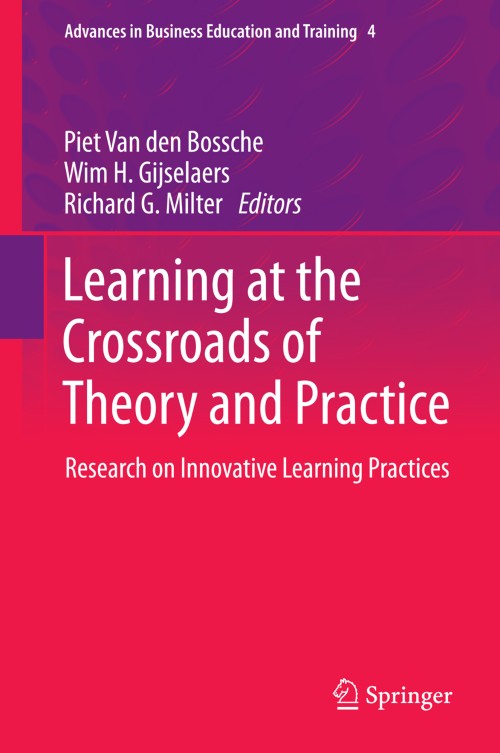
Learning at the Crossroads of Theory and Practice [electronic resource] : Research on Innovative Learning Practices / edited by Piet Van den Bossche, Wim H. Gijselaers, Richard G. Milter.
Erişim Adresi
ISBN
9789400728462
Dil Kodu
İngilizce
Yer Numarası
DK/13786
Basım Bildirimi
1st ed. 2012.
Yayın Bilgisi
Dordrecht : Springer Netherlands : Imprint: Springer, 2012.
Fiziksel Niteleme
VIII, 252 p. online resource.
Dizi
Advances in Business Education and Training, 2543-0645 ; 4
İçindekiler Notu
Preface -- Learning at the crossroads of theory and practice: an overview -- Part I: Integrating theory and practice in business education -- Enhancing the academic internship learning experience for business education - a critical review and future directions; Maike Gerken et al -- Combining formal and non-formal learning for undergraduate management students based in London; Martin Rich and Ann Brown -- Work-based learning versus work-related learning - an exploration of the possibilities of work-related learning through a review of the Venture Matrix at Sheffield Hallam University, UK; David Laughton -- Part 2: Workplace learning -- What keeps low and high-qualified workers competitive: Exploring the Influence of Job Characteristics and Self-Directed Learning Orientation on Work-Related Learning; David Gijbels et al -- The Use of Personal Development Plans (PDPs) in organizations and the role of its perceived purpose; Nina Ketels et al -- Determinants, benefits and barriers of informal learning in the Netherlands; Marjolein Caniëls and Paul Kirschner -- Improving the Involvement of Higher Education Institutions in learning and innovation in a regional framework -- Herman van den Bosch and Marjolein Caniëls -- Part 3: Classroom enrichment -- On the Effectiveness of Economic Experiments as a Method of Teaching Undergraduates; Ilona Ebbers et al -- Integrating ICT in business education: using TPACK to reflect on two course redesigns; Bart Rienties and Danielle Townsend -- A longitudinal analysis of knowledge spillovers in the classroom; Nuria Hernandez Nanclares et al -- Part 4: Bridging the gap -- Opportunities for Technology Enhanced Remedial Maths; Venkat V.S.S. Sastry and Piers MacLean -- Effectiveness of a voluntary postsecondary remediation program in mathematics; Dirk Tempelaar et al -- Learning to Learn;Bernadette Pol -- EDiNEB news: Past, present and future of EDiNEB from the perspectives of participants and Management Team; Bart Rienties et al -- Index.
Özet, vb.
Core concepts in education are changing. For example, professional performance or expertise is not uniquely the fruit of specialist knowledge acquired at professional schools, but the sum of influences exerted by a complex web of continuous learning opportunities for which an individual is well (or ill) prepared by their schools and their workplace. The key contributory factors to professional expertise are how professional schools connect to professional practice, how schools prepare graduates for continuous learning, and how the workplace endorses continuous development. Thus, the question this volume addresses—how to design learning and working environments that facilitate the integration of these three elements—is at the heart of contemporary pedagogical theory. The authors also ask a second vital question: how do we educate learners that go on to maximize their life’s learning opportunities by regulating their own ongoing learning? Learning at the Crossroads of Theory and Practice argues that with the theory of learning at a crossroads, this is an unprecedented opportunity for learning about learning. The book sheds light on different elements of this challenge: integrating theory and practice in business education, generating and fully exploiting workplace learning opportunities, and enriching our classrooms by coupling theoretical knowledge with the richness of real-life experience.
Konu
Professional education.
Vocational education.
Education, Higher.
Learning, Psychology of.
Educational technology.
Education __ Curricula.
Professional and Vocational Education.
Higher Education.
Instructional Psychology.
Digital Education and Educational Technology.
Curriculum Studies.
Vocational education.
Education, Higher.
Learning, Psychology of.
Educational technology.
Education __ Curricula.
Professional and Vocational Education.
Higher Education.
Instructional Psychology.
Digital Education and Educational Technology.
Curriculum Studies.
Diğer Yazarlar
Kurum Adı
Eseri Alıntıla
Referansları kullanmadan önce gözden geçirmeniz ve varsa gerekli düzeltmeleri yapmanız önerilir.
Dijital Kaynak
MARC Görünümü
LEADER 05795nam a22006135i 4500
001 812537
003 TR_AnAIT
005 20260130234159
007 cr nn 008mamaa
008 130228s2012 ne | s |||| 0|eng d
020 |a9789400728462|9978-94-007-2846-2
024 7 |a10.1007/978-94-007-2846-2|2doi
041 |aeng
049 |aTürk Tarih Kurumu Kütüphanesi
050 4|aLC1051-1072
050 4|aLC1041-1048
072 7|aJNRV|2bicssc
072 7|aEDU046000|2bisacsh
072 7|aJNRV|2thema
082 04|a370.113|223
090 |aDK/13786
245 10|aLearning at the Crossroads of Theory and Practice|h[electronic resource] :|bResearch on Innovative Learning Practices /|cedited by Piet Van den Bossche, Wim H. Gijselaers, Richard G. Milter.
250 |a1st ed. 2012.
264 1|aDordrecht :|bSpringer Netherlands :|bImprint: Springer,|c2012.
300 |aVIII, 252 p.|bonline resource.
336 |atext|btxt|2rdacontent
337 |acomputer|bc|2rdamedia
338 |aonline resource|bcr|2rdacarrier
347 |atext file|bPDF|2rda
490 1 |aAdvances in Business Education and Training,|x2543-0645 ;|v4
505 0 |aPreface -- Learning at the crossroads of theory and practice: an overview -- Part I: Integrating theory and practice in business education -- Enhancing the academic internship learning experience for business education - a critical review and future directions; Maike Gerken et al -- Combining formal and non-formal learning for undergraduate management students based in London; Martin Rich and Ann Brown -- Work-based learning versus work-related learning - an exploration of the possibilities of work-related learning through a review of the Venture Matrix at Sheffield Hallam University, UK; David Laughton -- Part 2: Workplace learning -- What keeps low and high-qualified workers competitive: Exploring the Influence of Job Characteristics and Self-Directed Learning Orientation on Work-Related Learning; David Gijbels et al -- The Use of Personal Development Plans (PDPs) in organizations and the role of its perceived purpose; Nina Ketels et al -- Determinants, benefits and barriers of informal learning in the Netherlands; Marjolein Caniëls and Paul Kirschner -- Improving the Involvement of Higher Education Institutions in learning and innovation in a regional framework -- Herman van den Bosch and Marjolein Caniëls -- Part 3: Classroom enrichment -- On the Effectiveness of Economic Experiments as a Method of Teaching Undergraduates; Ilona Ebbers et al -- Integrating ICT in business education: using TPACK to reflect on two course redesigns; Bart Rienties and Danielle Townsend -- A longitudinal analysis of knowledge spillovers in the classroom; Nuria Hernandez Nanclares et al -- Part 4: Bridging the gap -- Opportunities for Technology Enhanced Remedial Maths; Venkat V.S.S. Sastry and Piers MacLean -- Effectiveness of a voluntary postsecondary remediation program in mathematics; Dirk Tempelaar et al -- Learning to Learn;Bernadette Pol -- EDiNEB news: Past, present and future of EDiNEB from the perspectives of participants and Management Team; Bart Rienties et al -- Index.
520 |aCore concepts in education are changing. For example, professional performance or expertise is not uniquely the fruit of specialist knowledge acquired at professional schools, but the sum of influences exerted by a complex web of continuous learning opportunities for which an individual is well (or ill) prepared by their schools and their workplace. The key contributory factors to professional expertise are how professional schools connect to professional practice, how schools prepare graduates for continuous learning, and how the workplace endorses continuous development. Thus, the question this volume addresses—how to design learning and working environments that facilitate the integration of these three elements—is at the heart of contemporary pedagogical theory. The authors also ask a second vital question: how do we educate learners that go on to maximize their life’s learning opportunities by regulating their own ongoing learning? Learning at the Crossroads of Theory and Practice argues that with the theory of learning at a crossroads, this is an unprecedented opportunity for learning about learning. The book sheds light on different elements of this challenge: integrating theory and practice in business education, generating and fully exploiting workplace learning opportunities, and enriching our classrooms by coupling theoretical knowledge with the richness of real-life experience.
650 0|aProfessional education.
650 0|aVocational education.
650 0|aEducation, Higher.
650 0|aLearning, Psychology of.
650 0|aEducational technology.
650 0|aEducation|xCurricula.
650 14|aProfessional and Vocational Education.
650 24|aHigher Education.
650 24|aInstructional Psychology.
650 24|aDigital Education and Educational Technology.
650 24|aCurriculum Studies.
700 1 |aVan den Bossche, Piet.|eeditor.|4edt|4http://id.loc.gov/vocabulary/relators/edt
700 1 |aGijselaers, Wim H.|eeditor.|4edt|4http://id.loc.gov/vocabulary/relators/edt
700 1 |aMilter, Richard G.|eeditor.|4edt|4http://id.loc.gov/vocabulary/relators/edt
710 2 |aSpringerLink (Online service)
773 0 |tSpringer Nature eBook
776 08|iPrinted edition:|z9789400728455
776 08|iPrinted edition:|z9789400728479
776 08|iPrinted edition:|z9789401784764
830 0|aAdvances in Business Education and Training,|x2543-0645 ;|v4
856 40|uhttps://doi.org/10.1007/978-94-007-2846-2
912 |aZDB-2-SHU
912 |aZDB-2-SXED
950 |aHumanities, Social Sciences and Law (SpringerNature-11648)
950 |aEducation (R0) (SpringerNature-43721)
001 812537
003 TR_AnAIT
005 20260130234159
007 cr nn 008mamaa
008 130228s2012 ne | s |||| 0|eng d
020 |a9789400728462|9978-94-007-2846-2
024 7 |a10.1007/978-94-007-2846-2|2doi
041 |aeng
049 |aTürk Tarih Kurumu Kütüphanesi
050 4|aLC1051-1072
050 4|aLC1041-1048
072 7|aJNRV|2bicssc
072 7|aEDU046000|2bisacsh
072 7|aJNRV|2thema
082 04|a370.113|223
090 |aDK/13786
245 10|aLearning at the Crossroads of Theory and Practice|h[electronic resource] :|bResearch on Innovative Learning Practices /|cedited by Piet Van den Bossche, Wim H. Gijselaers, Richard G. Milter.
250 |a1st ed. 2012.
264 1|aDordrecht :|bSpringer Netherlands :|bImprint: Springer,|c2012.
300 |aVIII, 252 p.|bonline resource.
336 |atext|btxt|2rdacontent
337 |acomputer|bc|2rdamedia
338 |aonline resource|bcr|2rdacarrier
347 |atext file|bPDF|2rda
490 1 |aAdvances in Business Education and Training,|x2543-0645 ;|v4
505 0 |aPreface -- Learning at the crossroads of theory and practice: an overview -- Part I: Integrating theory and practice in business education -- Enhancing the academic internship learning experience for business education - a critical review and future directions; Maike Gerken et al -- Combining formal and non-formal learning for undergraduate management students based in London; Martin Rich and Ann Brown -- Work-based learning versus work-related learning - an exploration of the possibilities of work-related learning through a review of the Venture Matrix at Sheffield Hallam University, UK; David Laughton -- Part 2: Workplace learning -- What keeps low and high-qualified workers competitive: Exploring the Influence of Job Characteristics and Self-Directed Learning Orientation on Work-Related Learning; David Gijbels et al -- The Use of Personal Development Plans (PDPs) in organizations and the role of its perceived purpose; Nina Ketels et al -- Determinants, benefits and barriers of informal learning in the Netherlands; Marjolein Caniëls and Paul Kirschner -- Improving the Involvement of Higher Education Institutions in learning and innovation in a regional framework -- Herman van den Bosch and Marjolein Caniëls -- Part 3: Classroom enrichment -- On the Effectiveness of Economic Experiments as a Method of Teaching Undergraduates; Ilona Ebbers et al -- Integrating ICT in business education: using TPACK to reflect on two course redesigns; Bart Rienties and Danielle Townsend -- A longitudinal analysis of knowledge spillovers in the classroom; Nuria Hernandez Nanclares et al -- Part 4: Bridging the gap -- Opportunities for Technology Enhanced Remedial Maths; Venkat V.S.S. Sastry and Piers MacLean -- Effectiveness of a voluntary postsecondary remediation program in mathematics; Dirk Tempelaar et al -- Learning to Learn;Bernadette Pol -- EDiNEB news: Past, present and future of EDiNEB from the perspectives of participants and Management Team; Bart Rienties et al -- Index.
520 |aCore concepts in education are changing. For example, professional performance or expertise is not uniquely the fruit of specialist knowledge acquired at professional schools, but the sum of influences exerted by a complex web of continuous learning opportunities for which an individual is well (or ill) prepared by their schools and their workplace. The key contributory factors to professional expertise are how professional schools connect to professional practice, how schools prepare graduates for continuous learning, and how the workplace endorses continuous development. Thus, the question this volume addresses—how to design learning and working environments that facilitate the integration of these three elements—is at the heart of contemporary pedagogical theory. The authors also ask a second vital question: how do we educate learners that go on to maximize their life’s learning opportunities by regulating their own ongoing learning? Learning at the Crossroads of Theory and Practice argues that with the theory of learning at a crossroads, this is an unprecedented opportunity for learning about learning. The book sheds light on different elements of this challenge: integrating theory and practice in business education, generating and fully exploiting workplace learning opportunities, and enriching our classrooms by coupling theoretical knowledge with the richness of real-life experience.
650 0|aProfessional education.
650 0|aVocational education.
650 0|aEducation, Higher.
650 0|aLearning, Psychology of.
650 0|aEducational technology.
650 0|aEducation|xCurricula.
650 14|aProfessional and Vocational Education.
650 24|aHigher Education.
650 24|aInstructional Psychology.
650 24|aDigital Education and Educational Technology.
650 24|aCurriculum Studies.
700 1 |aVan den Bossche, Piet.|eeditor.|4edt|4http://id.loc.gov/vocabulary/relators/edt
700 1 |aGijselaers, Wim H.|eeditor.|4edt|4http://id.loc.gov/vocabulary/relators/edt
700 1 |aMilter, Richard G.|eeditor.|4edt|4http://id.loc.gov/vocabulary/relators/edt
710 2 |aSpringerLink (Online service)
773 0 |tSpringer Nature eBook
776 08|iPrinted edition:|z9789400728455
776 08|iPrinted edition:|z9789400728479
776 08|iPrinted edition:|z9789401784764
830 0|aAdvances in Business Education and Training,|x2543-0645 ;|v4
856 40|uhttps://doi.org/10.1007/978-94-007-2846-2
912 |aZDB-2-SHU
912 |aZDB-2-SXED
950 |aHumanities, Social Sciences and Law (SpringerNature-11648)
950 |aEducation (R0) (SpringerNature-43721)
Materyaller
Depodan talep edilen materyal sadece kütüphane içerisinde kullanılmaktadır.
Materyal dışarıya ödünç verilmemektedir.
Materyal dışarıya ödünç verilmemektedir.
